


Last updated: 21 October 2026
Is your hair naturally straight, and do you see a curl disappear again within an hour? That's not because you're clumsy with the flat iron. Straight hair simply holds a curl differently from hair with more natural wave, and there's a clear reason for that. In this article you'll first read why that happens, and then what you can achieve with the right preparation and technique.
In this article
- Why does straight hair let go of a curl so quickly?
- The honest ceiling for straight hair: what technique does and doesn't fix
- Preparation: where it usually goes wrong with straight hair
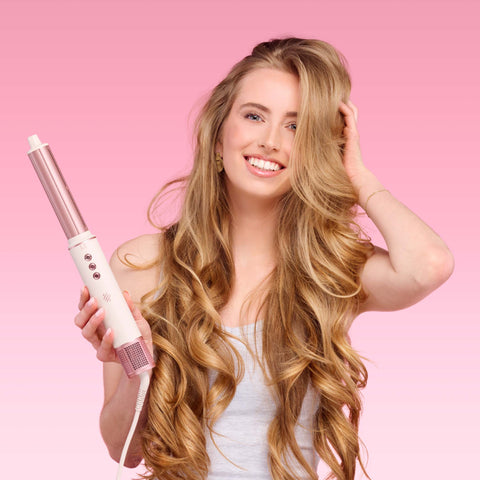
- Step by step: curling straight hair with an airstyler
- Heatless curls: why it's a different story for straight hair
- Humidity, weather and the rest of the day with straight hair
- Frequently asked questions
Why does straight hair let go of a curl so quickly?
Straight hair is naturally smooth. The outer layer of each hair, the cuticle, lies flat and tight, so it gives the curved shape of a curl little to hold on to. A curl is a temporary shape that your hair keeps as long as it stays dry. As soon as moisture gets in, from the air or from your own scalp, the hair goes back to its original, smooth shape. With straight hair that happens faster than with hair that has more natural wave, because the cuticle gives less grip and a thicker section pulls down harder.
Two things play a role here. First, the weight of the section you curl: the thicker and heavier the section, the faster that weight pulls the curl straight again. Also read our guide on how much hair to take at a time. Second, the smoothness of the cuticle itself. NEMO Kennislink explains why hair frizzes in humid weather: moisture in the air creates new, temporary bonds in the hair that make it change shape. That same effect, moisture setting the hair in motion, also pushes a freshly made curl in straight hair back towards its smooth shape. A closed, smooth cuticle, typical of healthy straight hair, gives less hold than a rougher or more porous structure. De Haarstichting explains that open cuticles let moisture through where closed cuticles keep it out. It's the same principle that makes a smooth cuticle give a curl little grip. Want to read more broadly about how hair gets its shape? Then also take a look at why hair curls.
The honest ceiling for straight hair: what technique does and doesn't fix
Hair structure sets the ceiling of what's possible. Technique decides how close you get to it. Naturally straight hair needs more preparation than hair with more natural wave. With the right preparation and technique, a curl stays beautifully in place in straight hair too.
Have you seen a curl drop within a few hours before? Then there's almost always something to gain in the steps that follow.
Preparation: where it usually goes wrong with straight hair
Hair that's too clean, too smooth or not fully dry takes a curl less well. A smooth section gives little hold, and moisture in the hair pushes the shape straight back. So blow-dry your hair fully before you start styling. With straight hair, styling on the first or second day after washing usually gives more grip than styling on wash day itself, because the hair then feels a little less smooth.
Have you just washed your hair, or does your hair quickly feel flat and smooth? A texture spray or a little dry shampoo on the lengths gives extra hold before you start. It's not a required step, but it is a missed opportunity if you skip it with hair that normally turns smooth quickly.
Step by step: curling straight hair with an airstyler
With your preparation sorted, here are the steps to create the curl as well as possible. You'll need an airstyler or flat iron, a heat protectant, and if you like, a light hairspray to finish.
1
Protect your hair before you start
Apply a heat protectant to fully dry hair, spread over the whole length. This protects the hair fibre from the heat of styling and also helps the curl hold a little better. Read more about the right way to use it in our guide on heat protection when styling.
2
Choose the right heat setting for your hair
Straight, thick hair often needs a higher heat setting than fine hair for the curl to form properly. Go too low and the curl drops straight away. Go too high and you put unnecessary strain on your hair. Our guide on which setting suits which hair type helps you pick the right one.
3
Divide your hair into smaller sections
Thinner sections take a curl better than wide chunks, especially with straight hair, where each section already has less hold. So divide your hair into sections no thicker than a few centimetres. Want to know exactly how thick a section can be? You can read that in how thick a section of hair can be.
4
Work evenly from root to tip
Move slowly and evenly from root to tip, so every section gets the same amount of heat. A ceramic attachment, like the one on the Airstyler Pro Ceramiq, spreads the heat more evenly over the section than an unevenly heated element. With straight hair in particular, that even spread helps the curl form better.
5
Let the curl cool before you release it
This is the step people skip most often, and with straight hair it makes the biggest difference. Let each section cool for a moment, still wound around your finger or the styler, before you let it go. A curl that's released while warm falls back to its smooth shape faster. Read more about how long to let a curl cool.
6
Set the curl with a light spray
Finish with a light hairspray, spread over the whole length. Choose a light formula that sets the curl without making your hair hard or stiff. With straight hair, that's the difference between a natural result and hair that feels sticky.
Heatless curls: why it's a different story for straight hair
Heatless curling works differently from creating a curl with a tool. Instead of setting a new shape in your hair, you wake up your own curl pattern, which is often still invisible. You can do that with rag curls, braids or a scrunchie curl method. With truly straight hair, there's often no wave to wake up, and then this route works poorly or not at all. That's not a question of technique, but of hair structure.
This principle is part of the broader Curly Girl Method, an approach focused on showing your own, natural hair pattern rather than creating an artificial curl. Want to try one of the heatless techniques yourself, for example if your hair does have some natural wave? Our guide on curls without a curling iron shows seven ways and what you can realistically expect from them.
Humidity, weather and the rest of the day with straight hair
Humid weather and sweating do the same to straight hair as moisture from outside: the hair goes back to its smooth, original shape. The more humid the day, the faster that happens, and with straight hair it shows sooner than with hair that has more natural wave. Our guide on keeping curls in humid weather goes deeper into what you can do about it.
Does your curl look good right after styling, and only drop gradually later in the day? Then that's a different issue from the one this article is about. In that case, read on in why curls drop quickly and what to do about it.
Frequently asked questions
Can straight hair be curled?
Yes. With heat, that works for almost every hair type, including hair that's completely straight by nature. Without heat, the result depends on how much natural wave your hair already has: the straighter your hair is by nature, the less a heatless method will give you.
Why won't my straight hair stay curled?
Usually it's the combination of a smooth cuticle and moisture pulling the hair back to its original shape, as we explain above in "Why does straight hair let go of a curl so quickly?". For most straight hair types, preparation, technique and a light setting spray can make the difference between a curl that's gone after an hour and a curl that stays.
How do you get curls if you have straight hair?
Follow the step-by-step plan above, from protection to setting. With straight hair, the order of the steps matters just as much as the steps themselves.
Can you also curl straight hair with an airstyler?
Yes, the principle is the same as with a flat iron: wind the hair, heat it and let it cool before you release it. The difference lies in the heat setting and the thickness of the section you take, and with straight hair that matters a little more than with hair that already has some natural wave.
Written by Anne Leensen, Ace & Taylor
Sources: NEMO Kennislink, "Waarom pluist haar als het vochtig is en helpen haarproducten het voorkomen?" (in Dutch). De Haarstichting, "Droog haar" (in Dutch).


