


Curling your hair without a curling iron can be done in several ways: with a braid, a sock, a headband, or simply by sleeping smart. This approach is also often called "heatless curls," the term you'll see on TikTok and Instagram. Below you'll find which method suits your hair, how to do it, and what each method delivers in terms of time and hair condition.
Table of contents
- What does 'curling without a curling iron' actually mean?
- Which method suits you?
- 7 ways to curl without a curling iron
- Need a faster result? The airstyler as a low-heat middle ground
- Comparison: time, hair condition, and how long it lasts
- How to make your curls last longer
- Want to work with heat after all?
- Frequently asked questions
What does 'curling without a curling iron' actually mean?
Curling without a curling iron means shaping your hair without using a heated styling device. Instead, your hair is wrapped or braided around something, and the shape sets while it dries or while you sleep. In English this is called "heatless curls," a term that became popular mainly through social media and that you'll increasingly see in Dutch search queries too.
The main difference from curling with a tool is the time it takes: you trade speed for a method that adds no heat to your hair. Further down in this article you'll see what that means in practice for your morning routine and for your hair condition.
Which method suits you?
Before choosing a method, it helps to be clear on three things: how much time you have beforehand (an evening or just a couple of hours), how long your hair is, and how much structure you want in the end result. For loose, fine waves, work with larger sections of hair. For tighter, smaller curls, divide your hair into thinner strands. Short hair (chin-length) works best with the headband or sock method, since you need less length to wrap something around. Long hair benefits more from braiding or a bathrobe belt, since you'll have enough material for a secure braid or wrap.
7 ways to curl without a curling iron
Every method below works on damp to slightly damp hair, and every method works better the longer your hair gets to dry into shape.
1. Braiding
Braid your hair into one or more braids while it's still slightly damp. The thinner the braid, the finer the resulting wave. Leave the braid in for at least a couple of hours, or better yet, overnight, and only undo it once your hair is fully dry. For beginners this is often the easiest method, since you don't need any extra tools.
2. A sock (hair donut)
Fold an old sock into a ring or donut shape. Roll your ponytail around this donut, starting at the ends of your hair and rolling up toward your scalp. Secure with a bobby pin if it starts to come loose. This method gives an even, round curl along the full length of your hair.
3. A headband or scarf
Place a wide, soft headband on top of your head, like a crown. Take a small section of hair at a time and wrap it around the band, working away from your face, until all your hair is wrapped. Leave the band in for at least a couple of hours, preferably overnight. This is the method you'll see most often on TikTok under the name "heatless curls."
4. A bathrobe belt or tights
Works the same way as the headband method, but with a long, soft belt or an old pair of tights tied around your head. Handy if you don't have a suitable headband, and the extra length makes it easier to wrap multiple layers for a fuller result.
5. Foam rollers (papillottes) or homemade rollers
Foam rollers (papillottes) are soft, bendable rods you twist a section of hair around and secure at the ends by folding them over. If you don't have any at home, an improvised version with strips of toilet paper or straws also works, though the result is a bit less even. Ideal if you want to control curl thickness section by section.
6. Buns
Divide your hair into several small sections and twist each one into a bun, secured with a bobby pin. More buns give a finer, more natural wave; fewer buns give larger, loose waves. This method takes a bit more time to set up but needs no extra tools at all.
7. Leaving it in overnight
This isn't so much a separate method as the common success factor behind all the methods above: the longer your hair gets to dry into the desired shape, the better and longer the curl holds. A method you undo after just a few hours in the morning usually gives a softer curl that drops out faster than if you leave it in all night.
Need a faster result? The airstyler as a low-heat middle ground
None of the methods above cost you money on a device, but they do cost time: you have to plan ahead, and the result isn't there within ten minutes. If you don't have that time, an airstyler is a middle-ground option that's gentler than a curling iron but works faster than a night's sleep with a braid in your hair.
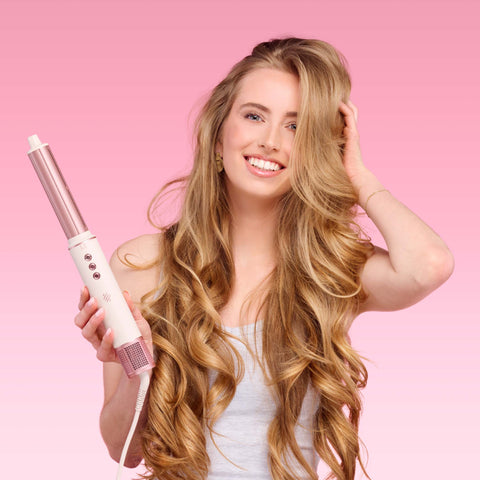
For heat styling, 180 degrees is often treated as the upper limit, and from around 200 degrees the outer layer of the hair shaft starts to open up, which can lead to tangling and breakage over the long term. The airstyler from Ace & Taylor works with settings of 35, 70, and 110 degrees, well below both thresholds, and has a ceramic barrel to distribute heat evenly. For anyone who wants to switch regularly between straight and curled styles without using a high-temperature tool every time, this is one of the few options that accounts for both time and hair condition. The airstyler is recommended by Dutch hairdressers, among others.
Comparison: time, hair condition, and how long it lasts
| Method | Time needed | Effect on hair condition | How long it lasts |
|---|---|---|---|
| Braiding | A couple of hours to overnight | No heat, minimal stress | Medium to long |
| Sock (hair donut) | A couple of hours to overnight | No heat, minimal stress | Medium to long |
| Headband or scarf | A couple of hours to overnight | No heat, minimal stress | Medium to long |
| Bathrobe belt or tights | A couple of hours to overnight | No heat, minimal stress | Medium |
| Foam rollers | A couple of hours to overnight | No heat, minimal stress | Medium |
| Buns | A couple of hours to overnight | No heat, minimal stress | Short to medium |
| Airstyler (low heat) | A few minutes | Low temperature (up to 110 degrees), even heat distribution | Short to medium, repeatable daily |
The tool-free methods win on hair condition and on not needing to spend money on a device. The airstyler wins on time and on predictability, since you're not dependent on how your hair happens to dry while you sleep.
How to make your curls last longer
Three things largely determine how long your result lasts, whichever method you choose. Start with hair that's completely dry before you undo or comb it out; damp hair drops back into its original shape faster. Use a light texturising spray or hairspray before you set the curl, which gives the hair structure something to hold onto. And after undoing the curl, don't comb it all the way out with a brush; instead, separate it with your fingers, so the individual waves stay visible instead of flattening into one big wave. Want to know what you should avoid doing after curling? Read our blog on mistakes that make your curls drop out faster.
Want to work with heat after all?
Some hair types, such as thick or coarse hair, hold a curl more easily with a bit of heat. If you'd rather work with a tool, our step-by-step guides explain how to curl your hair with a straightener or how to curl your hair with a hairdryer. Both articles walk you through the steps, including the right temperature to use.
Frequently asked questions
What's the easiest way to curl hair without a curling iron?
For most people, braiding is the most accessible method, since you don't need any extra tools and the technique takes little practice. Want a more even, rounder curl along the full length of your hair? The sock method usually gives a more consistent result.
Does curling without a curling iron also work with short hair?
Yes, although not every method works equally well with short hair. For hair up to chin-length, the headband or sock method usually gives the best result, since it needs less length than braiding or the bathrobe-belt method.
How long should I leave a heatless method in?
Plan on at least a couple of hours for a visible result, and overnight for the most defined and longest-lasting curl. The longer your hair gets to dry into the desired shape, the better the curl holds once you take it out.
What can I use if I don't have a curling iron?
You can fall back on a braid, a sock, a headband, a bathrobe belt, or foam rollers, each described under "7 ways to curl without a curling iron" above. If you'd prefer a faster result than any of these methods offer, an airstyler on a low heat setting is a middle-ground option.
Do heatless curls last as long as curls from a curling iron?
This varies by hair type and method, but in most cases a curl made without heat lasts a bit less long than one made with a curling iron, especially with fine or straight hair. A light texturising spray and separating the curl with your fingers instead of a brush help narrow that gap.


