


Last updated: August 10, 2026 · 5 min read
Yes, a heat protectant (spray or serum) is still worth using, even if you already style on a low temperature. An airstyler that works with airflow at, say, 35, 70, or 110°C sits well below the temperature where a straightener causes cuticle damage (roughly 150°C and up). So the risk is already much smaller, but a heat protectant adds an extra layer of protection, helps hold onto moisture, and is still worthwhile for colored or already damaged hair.
Quick summary
- An airstyler works with airflow at relatively low temperatures, often between 35°C and 110°C.
- Cuticle damage from a straightener typically starts around 150°C, so the risk at low temperatures is already smaller.
- A heat protectant isn't a hard necessity at these low settings, but it's a useful extra layer of protection.
- For colored, bleached, or already damaged hair, a heat protectant is still recommended.
- If you also use a straightener or curling iron at a higher temperature, a heat protectant really is important there.
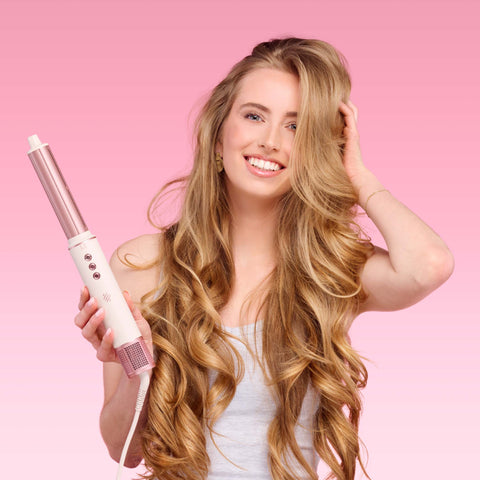
Further down you'll find exactly what a heat protectant does, and which temperature setting on the Airstyler Pro Ceramiq suits your hair.
What does a heat protectant actually do?
A heat protectant lays a thin protective layer over your hair shaft, usually with silicones or polymers. That layer slows how quickly heat penetrates the hair and helps it hold onto moisture, so it dries out less during styling.
It doesn't make your hair heatproof, no product can do that. It does reduce direct exposure and often gives you a smoother, less frizzy finish, on top of the heat protection itself.
Is a heat protectant still needed at a low temperature, like with an airstyler?
Less critically needed than with a hot straightener, but not pointless either. Hair is largely made up of the protein keratin, held together by hydrogen bonds that temporarily loosen with heat and moisture. With dry hair and direct contact, like a straightener at 150 to 230°C, cuticle damage already starts around 150°C, and around 230°C the protein structure suffers irreversible damage.
An airstyler works differently: with moving air instead of a hot plate, at say 35°C, 70°C, or 110°C. That's well below the damage threshold of direct-contact tools, and heat carried by airflow (convection) also spreads less concentrated than heat from a hot plate (conduction). Still, any form of heat puts some stress on your hair, so a heat protectant is a simple, cheap way to lower that small remaining risk even further.
Who does a heat protectant matter most for?
Especially hair that's already more vulnerable: colored, bleached, permed, or chemically treated hair. That hair shaft often already has a damaged outer layer, so any extra heat source has a faster effect.
If you also use a straightener or curling iron at a higher temperature alongside your airstyler, for example on the ends or for a tighter curl, a heat protectant is genuinely worth it there. At those temperatures the risk of cuticle damage is considerably higher than with an airstyler.
How do you use a heat protectant when airstyling?
- Wash your hair and towel-dry it, not soaking wet and not fully dry.
- Spread a heat protectant spray evenly through your lengths and ends, paying the most attention to the tips.
- Comb the product through properly, so it doesn't clump in one spot.
- Don't leave the product too wet, oversaturating it actually leads to slower drying and a less sleek end result.
- Style as you normally would, using the temperature setting that suits your hair type.
A serum works a bit differently from a spray: it's usually more concentrated, and you apply it mainly to the dry ends after styling, for extra shine and protection against breakage, less as a base before styling.
| Tool | Temperature range | Heat protectant needed? |
|---|---|---|
| Airstyler (airflow) | 35°C to 110°C | Not strictly necessary, but recommended as an extra layer |
| Straightener / curling iron (direct plate) | 150°C to 230°C | Yes, strongly recommended |
Frequently asked questions
Can I use an airstyler without heat protectant?
Yes, that's fine, especially on the lower settings of an airstyler. The risk of heat damage is already small there. For extra protection and a smoother finish, a heat protectant is still a nice addition.
Does a heat protectant also work against frizz?
Many heat protectants contain ingredients that smooth the hair shaft and hold in moisture, which can reduce frizz. That effect comes on top of the heat protection itself, not instead of it.
Spray or serum, which is better with an airstyler?
A spray is usually applied before styling on damp hair, spread over the whole length. A serum is more concentrated and is often applied after styling to the dry ends, for shine and extra protection against breakage.
Does it matter which brand of heat protectant I use with my Ace & Taylor airstyler?
No, a heat protectant works independently of the styling tool brand. Mainly choose a product that fits your hair type, for example a light spray for fine hair or a richer formula for thick or dry hair.
A low temperature already makes a difference, a good heat protectant completes the picture.
The Airstyler Pro Ceramiq styles with airflow at 35, 70, or 110°C, with a fully ceramic-coated barrel for even heat, suitable for all hair types from 1A to 4C.
2 year warranty
30 day home trial
Works on all hair types
Trustpilot 4.7/5
Shop the Airstyler Pro Ceramiq
AL
Written by Lena A. for Ace & Taylor, based on questions we regularly get from customers about heat and hair protection.


