


Last updated: 2 September 2026
Let a curl cool for at least 30 to 60 seconds before you touch it. With thick or long sections, pin the curl up and wait 5 to 10 minutes. A curl is only properly set once it's back at room temperature and feels dry. Warm hair is still mouldable and loses its shape at the first movement.
TL;DR
- Rule of thumb: 30 to 60 seconds per thin section cooling in your hand, 5 to 10 minutes if you pin the curl up with a clip.
- Two things have to be true before you touch: the section is back at room temperature and it's dry. Leftover moisture keeps the curl mouldable.
- The shape isn't set by the heat, but by the cooling. As the hair cools, the hydrogen bonds in the keratin re-form in their new, curled position.
- Bone-dry hair only becomes truly mouldable at around 144 °C, but the more water there is in your hair, the lower that threshold drops. That's why styling on damp hair works at much lower temperatures.
- Cold air genuinely helps, but not because it "seals the cuticle". It simply speeds up the cooling.
Further down you'll read how your tool's temperature setting changes the cooling time, and what to look out for when choosing a new airstyler or curling iron.
Why does a curl need to cool first?
Because your hair only locks in its new shape while it cools, not while it heats up. The heat makes your hair soft and pliable, the cooling makes the shape stick.
Your hair contains millions of tiny connections between the keratin proteins. Some of them are hydrogen bonds: weak bonds that break open with water and heat, and re-form as your hair cools and dries. Wrap a warm, damp section around a curling barrel and those bonds re-form in the bend you've created. That's the whole trick behind a heat-styled curl. It's also why a curl disappears the moment your hair gets properly wet: water breaks exactly those bonds open again.
Think of it like a plastic straw. Warm, it's floppy and bends without effort. Cold, it holds the bend. For hair this is called the glass transition. Research using DSC (Wortmann et al., Biopolymers, 2006) found a glass transition of around 144 °C for dry human hair, and showed that water acts as a plasticiser: the more moisture in the fibre, the lower that temperature goes. With properly damp hair it drops towards room temperature.
This isn't fringe theory. Styling tool patents use exactly this threshold as the "styling temperature", for example around 120 °C at roughly 30% moisture in the hair. Some tools even have a separate cooling zone or a final setting that only kicks in once the hair's temperature has dropped below a threshold, so the shape clicks into place. In other words, manufacturers literally build in a cooling step. You can do that at home with your hands and a few clips.
How long does cooling actually take?
A thin section feels cool within roughly 30 to 60 seconds. A thick section, or a full set of curls in long hair, needs 5 to 15 minutes before you can safely comb through.
These are guidelines, not laws of nature. The real cooling time depends on how thick your section is, how much moisture is still in it and how warm and humid your bathroom or bedroom is. Always check by feel.
How do you know a curl has really cooled down?
Feeling is more reliable than watching the clock. These three checks tell you in five seconds.
- Hold the curl against the inside of your forearm. That skin is more sensitive than your fingertips. Still feel warmth? Wait.
- Gently squeeze the curl. Does it feel cool but still a bit clammy? Then it isn't ready. Moisture keeps hair mouldable, even once the heat is gone.
- Stretch the curl out a centimetre and let go. If it springs back into its spiral, it's set. If it stays drooping, give it another minute.
How to cool curls with clips: step by step
Pinning up is the most reliable method, because the curl keeps its shape throughout the entire cooling process. Here's how.
- Work in sections of 2 to 3 cm and start at the bottom of your head. Thin sections cool faster and curl more evenly.
- Let the section slide off your curling barrel as a little coil, so don't pull it straight down and stretch it out.
- Roll that coil up towards your scalp and secure it with a flat clip or a hairpin. Don't use a clip with sharp teeth on a warm section: it presses a kink into the soft hair.
- Work your way around your whole head. Time is your friend now: do your make-up or tidy up your things in the meantime.
- If you like, give the pinned-up set 20 to 30 seconds of cold air. Keep the tool at a distance and move calmly, otherwise you'll blow the shape loose.
- Take the clips out one by one and let each curl drop into your hand. Feel: cool and dry? Then you're good to go.
- Only now comb or finger through the curls, and then spray hairspray if you want. On a warm curl you're more likely to flatten the shape than fix it.
Does the cool shot really work, or is it marketing?
The cool setting genuinely works, but not for the reason you usually read. It pulls heat and moisture out of your hair faster, so the shape sets sooner. The claim that it makes your hair shinier because "the cuticle closes" isn't supported by evidence.
That cuticle myth comes from the world of cold rinses in the shower. The British Institute of Trichologists is clear about it: cold water doesn't seal the cuticle and doesn't make your hair smoother or shinier. That effect comes from conditioner, not from temperature. Shine measurements after a cold rinse found no difference either.
What cold air does do is exactly what you need: it gets your hair below the glass transition faster. Think of it as the brake that clicks your shape into place. It doesn't need to do more than that to be useful.
Watch out: cold air is no substitute for drying. If you blow a curl cool while there's still moisture in it, it feels cold but will still drop later. Cool and dry, that's the double check.
What goes wrong if you touch or comb through too soon?
You pull the curl straight out in one movement, and your hair gets frizzy faster. Warm hair is softer and stretches more easily, so you deform it without noticing.
In practice you see three things happen:
- The curl drops within an hour. The hydrogen bonds haven't re-formed in the new shape yet, so the hair falls back into its old position.
- Your hair gets frizzy. Any friction on still-soft, warm hair creates flyaways and a rough surface.
- You start styling all over again. That's the real damage. Not that one round of heat, but the second and third round because the result didn't hold.
Small habits count too. Tucking your hair behind your ear, heading outside in a beanie or holding a phone against your temple while your hair is still warm: that sets a shape just as effectively, only not the shape you wanted.
Does cooling time depend on your tool and temperature setting?
Yes. The hotter you style, the more heat sits in the section and the longer it takes to get back to room temperature. A curling iron at 180 to 200 °C leaves behind a far hotter section than an airstyler working with air at a lower temperature.
With an airstyler the airflow does double duty: it forms the curl and carries moisture away at the same time. That means you can often get away with a lower temperature, and the section is cool sooner. It's also why the glass transition in damp hair matters so much: with water in your hair you simply need fewer degrees to shape it.
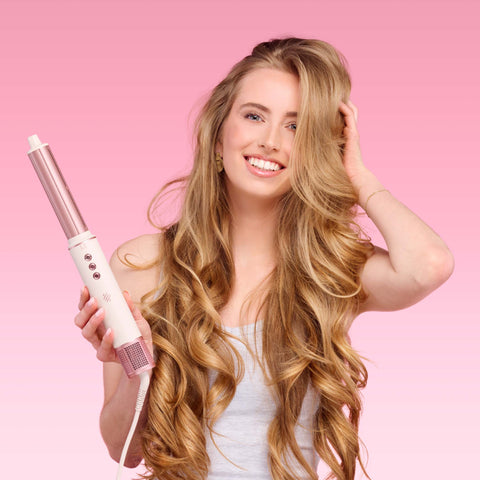
With the Airstyler Pro Ceramiq™ from Ace & Taylor you see that reflected in the settings: 35 °C, 70 °C and 110 °C, plus a cool shot function for that final cold pass. Even the highest setting stays well below the temperature of a classic curling iron, so your curl is back at room temperature sooner and you have to wait less time before you can comb. The curling attachments are fully ceramic coated (not a thin layer of spray on plastic), so the heat is spread more evenly across the section instead of concentrating in hot spots.
The rule stays the same for every tool, from 35 to 200 °C: cool and dry before you touch.
Curls that get the time to cool down hold for longer. With the Airstyler Pro Ceramiq™ you style at 35, 70 or 110 °C and click the shape into place with the cool shot, instead of blasting it with 200 °C.
- ✓ Fully ceramic coated curling attachments, no thin spray layer
- ✓ 30-day money-back guarantee: try it at home
- ✓ 2-year warranty, designed in the Netherlands
- ✓ Trustpilot 4.7/5 ("Excellent") from 400+ reviews
In our own customer survey (214 users, 30 days of use), 96% reported curls that held for at least 24 hours. This is research by Ace & Taylor among its own customers, not independent research.
View the Airstyler Pro Ceramiq™Frequently asked questions
Do you also need to let hair cool after using a straightener?
Yes, exactly the same principle applies. Let the section hang straight down until it's cool and dry, and don't tuck it behind your ear or under a headband. Otherwise you'll set a kink right where you bent it.
Is cooling in your hand as good as pinning up?
For loose waves your hand is often enough: hold the curl loosely in your palm for 30 to 60 seconds. For curls that need to last all day, pinning up is better, because the shape is held in place while the hair sets.
Can you let curls cool in the bathroom after a hot shower?
Better not. Your hair absorbs moisture from the air, and the higher the humidity, the more water soaks in. So in warm, steamy air the curl dries less well and stays soft. Move to a cooler, drier room.
When do you spray hairspray: before or after cooling?
After cooling. On a warm curl you have to touch and move the section to spray it while the hair is still mouldable, and that's exactly when you lose shape. Let it cool, take the clip out and then spray lightly from a distance.
Why does my curl feel cool but still drop?
Then there was still moisture in the hair, or your curls cooled in a humid room. Water breaks open the hydrogen bonds that hold your curl together. Cool isn't enough: the section has to be properly dry too.
Written by Anne Leensen, Ace & Taylor. Last updated: 2 September 2026.


