



Last updated: 12 October 2026
Hairdressers most often work with hair dryers from Parlux, GHD, BaByliss Pro or Dyson. They do not choose by brand name but by features: a strong motor, a focused airflow, a comfortable weight in the hand and reliable heat control. Exactly those features are now available outside the salon too, often in a more compact form.
TL;DR
- Hairdressers pick a hair dryer for its motor, airflow, weight and heat control, not for the logo.
- Brands you often see in salons are Parlux, GHD, BaByliss Pro and Dyson.
- A professional hair dryer has to handle full working days; at home you only dry one head of hair a day.
- Research shows that blow-drying at a distance of about 15 centimeters, with the dryer kept moving, is gentler on your hair than air drying.
- For home use, those same features matter more than whether a hairdresser uses the same model.
What do hairdressers look for in a hair dryer?
Hairdressers judge a hair dryer on four points: motor power, airflow, weight and heat control. A salon dryer often runs six to eight hours a day, so the motor has to keep up that pace for years. Airflow counts too: the stronger and more focused the air, the faster hair dries and the more precisely you can style. Weight is just as important, because you feel a heavy dryer in your wrist by the end of the day. And with good heat control, the hairdresser can match the temperature to fine, thick or damaged hair. How much power fits that job is covered in our article on the right wattage for your hair dryer.
Which brands do you see most often in the salon?
In Dutch salons you mostly come across Parlux, GHD, BaByliss Pro and Dyson. Parlux is loved for its light weight and durable motors. GHD is known for consistent performance, day in, day out. BaByliss Pro has a wide range for different styling needs. And the Dyson Supersonic stands out with its compact digital motor, which spins at up to 110,000 revolutions per minute, and heat control that continuously measures and adjusts the temperature of the air. So each brand has its own strength; there is no single model that all hairdressers use.
What makes a professional hair dryer different from a regular one?
The biggest difference is in the motor and the heat control, not in the looks. Here is how the two compare:
Do you need a salon hair dryer at home?
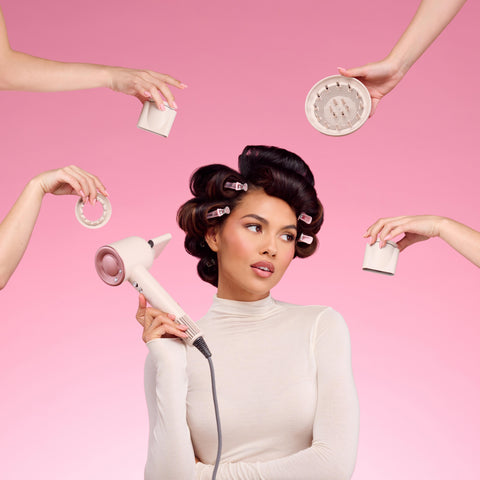
No. At home you dry one head of hair a day, not ten, so you do not need a dryer built for a salon. It is smart to look for the same features, though. The Ace & Taylor PrecisionAir hair dryer, for example, has a brushless motor that spins at 110,000 revolutions per minute, an airflow of up to 22 meters per second, ionic technology against frizz and magnetic attachments, including a diffuser. That gives you the technology hairdressers look for, in a size that fits in your bathroom cabinet.
How do you blow-dry at home like a hairdresser?
These five steps get you close to that salon result:
- Towel-dry your hair first, so the dryer has less work to do.
- Apply a heat protectant before you start.
- Hold the dryer about 15 centimeters away and keep it moving. Research shows your hair handles that better than air drying.
- Work in sections, from the bottom layer upwards, and pick the right attachment for each step. Which nozzle or diffuser works when is covered in this guide to hair dryer attachments.
- Finish each section with the cool setting. That sets the style and adds shine.
Frequently asked questions
Which hair dryer do most hairdressers use?
There is no single model. Parlux, GHD, BaByliss Pro and Dyson are the ones you see most often, because those brands combine strong motors with low weight and good heat control.
Is an expensive hair dryer automatically better for your hair?
No. How you blow-dry counts at least as much: keeping enough distance and staying in motion protects your hair more than any price tag.
How many revolutions does a professional hair dryer motor make?
Modern digital and brushless motors in the top segment reach well over 100,000 revolutions per minute. The Dyson Supersonic spins at up to 110,000 revolutions, just like the Ace & Taylor PrecisionAir.
Is blow-drying worse for your hair than air drying?
Not by definition. A study in Annals of Dermatology found that blow-drying at a distance of 15 centimeters, with the dryer constantly moving, caused less damage than natural drying, because hair that stays wet for a long time can get damaged from the inside.
Sources
- Lee, Y. et al. (2011), Hair Shaft Damage from Heat and Drying Time of Hair Dryer, Annals of Dermatology: pmc.ncbi.nlm.nih.gov
- Tech Advisor, review of the Dyson Supersonic (motor speed and heat control): techadvisor.com
Anne Leensen
Want to blow-dry at home with the features hairdressers look for? Take a look at the PrecisionAir hair dryer, also available in pink. You try it at home for 30 days and get a 2 year warranty.


