


Last updated: 10 October 2026
There is no fixed safe number. What counts is your total heat load: temperature, how long the heat stays on your hair, how many times you pass over the same section and how wet your hair is while you do it. As a practical guideline, healthy hair usually handles 2 to 3 hot styling sessions a week, and fine or bleached hair 1 to 2.
TL;DR
- No study has ever established a "safe" number of styling sessions per week. What counts is the heat dose: temperature x time x number of passes over the same section x how much moisture is in your hair.
- The hair shaft is made of dead, keratinised cells. It cannot repair itself, so heat damage builds up and only grows out.
- Hair grows roughly 1 cm a month on average (about 0.35 mm a day). With shoulder-length hair, your ends are easily 2 to 3 years old and have been through every single styling session.
- Keratin in wet hair changes structure at around 120 to 150 degrees; dry hair only at around 230 to 240 degrees. That is why heat on damp hair is harder on your hair than heat on dry hair.
- Practical guideline: thick healthy hair 3 to 4 times a week, normal hair 2 to 3 times, fine or bleached hair 1 to 2 times, and coily hair preferably tied to your wash day.
Further down you will read why the type of tool you use matters more for your weekly frequency than the number of sessions itself.
Why can nobody give you a fixed number of times per week?
Because "one styling session" is not a fixed amount of heat. A quick blow-dry on setting 1 and half an hour with a straightener at 220 degrees both count as "once", while they put completely different strain on your hair.
The "1 or 2 times a week max" number you read everywhere online does not come from research. It is a rule of thumb that brands and blogs copy from each other. There is no study that has pinpointed at which weekly number of styling sessions hair does or does not get damaged, simply because every head of hair is different: thickness, porosity, colour history, how you brush, how you sleep.
What lab research does confirm: heat changes the protein structure of hair, and hair that has been repeatedly treated with a hot straightener clearly breaks more often afterwards during combing. So the damage is not only in how your hair looks right after styling, but in how fragile it is for everything you do with it afterwards.
So what does count? The four dials of your heat dose
Do not think in "times per week", think in dose. Four things together determine how heavy a styling session is, and you can turn all four.
- Temperature. This is the biggest dial. The difference between 160 and 200 degrees matters far more to your hair than the difference between two and three sessions a week.
- Contact time. How long does the heat stay on the same spot? Hot plates sitting still on a section are harder on hair than warm air moving along it.
- Number of passes. Three passes over the same section is three times the dose. Sections that are too thick are the main culprit here, because you automatically end up going over them more often.
- Moisture level. Keratin in wet hair already changes structure at around 120 to 150 degrees, while dry hair only becomes sensitive to that at around 230 to 240 degrees. A hot straightener on damp hair is therefore the harshest combination there is.
This also explains why two women who both "style three times a week" end up with completely different hair. One blow-dries on a medium setting and curls with warm air. The other goes over damp sections four times at 210 degrees. Same frequency, many times the dose.
How hard does each tool hit your hair?
Not every tool weighs the same in your weekly budget. Direct metal contact at high temperature is the heaviest, moving warm air the lightest.
The "counts as" column is a practical weighting rule to help you plan your week, not a measured lab value. The logic behind it does hold up: the higher the temperature and the more direct and prolonged the contact, the bigger the dose.
How often can you style, by hair type?
Below is a realistic guideline. It is based on how vulnerable each hair type is to heat, not on a study that measured a maximum per hair type. See it as a starting point that you adjust based on what your hair tells you.
Does your hair recover between two styling sessions?
No. The hair sticking out of your scalp consists of dead, keratinised cells with no blood supply. There is no biological mechanism at all that repairs a damaged hair shaft. So a day of rest between two styling sessions is not a recovery period, just a pause.
What masks, conditioners and bond builders do is make the outside feel smoother and stronger and hold the hair fibre together temporarily. That is genuinely valuable, because smooth hair breaks less easily when you brush it. But it does not reverse the damage.
The only real recovery is growth. Hair grows roughly 0.35 mm a day, so around 1 cm a month or about 15 cm a year. With hair down to your shoulders (roughly 30 cm), your ends are already 2 to 3 years old. Those ends have been through every styling session of the past few years, all added up. That is why they are always the first to go dry, frizzy and split, and that is why it is smart to skip your ends as a rule or go over them with less heat.
Does blow-drying count as heat styling too?
Yes, but more lightly. The air from a hairdryer is usually around 100 degrees and cools down further on its way to your hair, while the plates of a straightener get to 180 to 230 degrees and sit right against your hair.
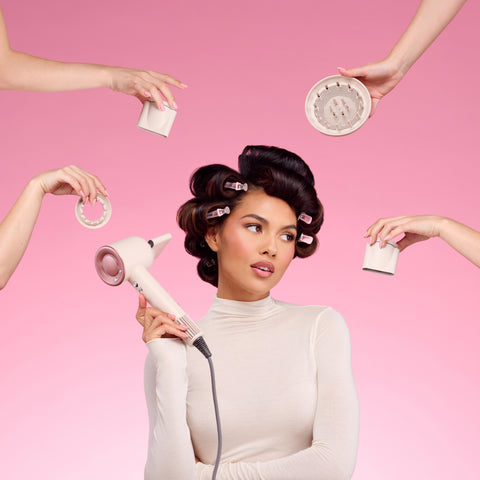
There is a catch, though. While you blow-dry, your hair is still wet, and keratin is more sensitive in that wet state: the protein structure already changes at around 120 to 150 degrees, compared to around 230 to 240 degrees when dry. So blow-dry with movement, on a medium setting, and keep the dryer at a distance instead of holding it still on one spot.
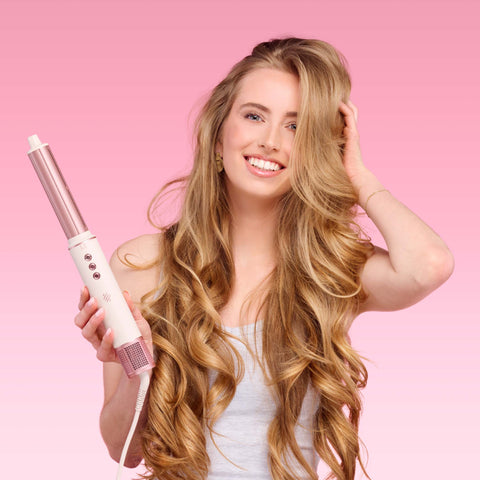
This is also exactly why an airstyler counts differently in your weekly planning than a curling iron. With the Airstyler Pro Ceramiq, airflow does most of the work and your hair wraps itself around the curling attachment, instead of you clamping it against a hot surface for seconds. The attachments are also fully ceramic coated, not a thin layer of spray on plastic, so the heat is spread more evenly across the surface and you are less likely to get a hot spot in one part of your section. In practice that means: for many women three times a week fits here, where the same hairstyle done with a curling iron at 200 degrees would really weigh heavier.
How do you style more often without your hair noticing?
By lowering the dose per session instead of counting sessions. These seven steps lower your total heat dose the most, in order of impact.
- Drop 20 degrees. Start low and only go up if the result really does not hold. Plenty of women style 30 degrees hotter than necessary for years.
- Style on dry hair, unless you are using a tool explicitly made for damp hair. Damp hair plus high heat is the harshest combination.
- Work with thinner sections. A section that you can do in one go saves you two extra passes. Working thinner is faster and gentler on your hair.
- Always use heat protectant and let it dry before you apply heat.
- Skip your ends or go over them with less heat and fewer passes. Your ends are your oldest hair.
- Let your curl cool down before you touch it. A curl only sets while it cools. Get that right and you will not have to restyle the next day, which immediately saves you a whole session that week.
- Stretch your style. A silky pillowcase, a loose braid or bun in bed, dry shampoo at the roots: anything that saves day 2 and 3 takes heat out of your week.
Which signs mean: style less often, starting now?
Your hair lets you know before things really go wrong. If you spot two or more of these signs, ease down to one hot session a week for a few weeks.
- Your hair feels rough or straw-like, even right after washing.
- You see white dots or lots of split ends along the lengths, not just at the very bottom.
- Short broken hairs that stand up like a frizzy layer on top of your head.
- Your curls or waves drop much faster than they used to, or the pattern has disappeared in places.
- Wet hair feels spongy and stretches a long way before it springs back or snaps.
Easing down works better than stopping completely and then going straight back to your old routine. It is about the total over months, not about one perfect week.
Frequently asked questions
Can you blow-dry every day?
You can, as long as you use a medium setting, keep the dryer moving and stay about 15 to 20 cm away. Air of around 100 degrees that keeps moving is a completely different story from 200-degree plates sitting still. Do towel-dry and air-dry your hair to about 70 percent first, that way your blow-drying time is shorter.
Is styling three times a week at 150 degrees better than once at 220 degrees?
Usually yes, because temperature is the heaviest factor in your heat dose. Above roughly 200 degrees the structure of dry keratin clearly deteriorates, while lower temperatures are much gentler. But it still adds up: three sessions at 150 degrees with four passes per section can still be harsher than one tidy session.
Should I take a week off if my hair feels damaged?
A break prevents new damage, but it does not repair existing damage, because the hair shaft is dead tissue. Use that period mainly to adjust your routine: lower temperature, thinner sections, heat protectant, a trim on the ends. That pays off far more in the long run than a few styling-free days.
Does an airstyler count as heavily as a curling iron?
No. With an airstyler, airflow does the work and your hair sits against a warm surface for a shorter time and more loosely, while with a curling iron you clamp it against metal or ceramic at 150 to 210 degrees. In a weekly plan you can therefore count an airstyler session as roughly half a session, although the same rules apply: low setting, thin sections, heat protectant.
How often can you style bleached hair?
Stick to a maximum of 1 to 2 hot sessions a week and stay below 160 degrees. Bleaching breaks down sulphur bonds in the hair fibre, which makes the hair more porous so heat penetrates faster. Never style bleached hair while it is still damp.
Does heat damage really grow out?
Yes, that is the only way it disappears. At around 1 cm of growth a month, it takes years with shoulder-length hair before all the damaged length is gone. Regular trims speed that up visibly, because otherwise split ends keep travelling further up.
Want to style more often without cranking up your heat dose? The Airstyler Pro Ceramiq™ works with airflow and fully ceramic-coated curling attachments instead of hot plates clamping your hair, with three temperature settings so you can start low.
- 2-year warranty and 30-day money-back guarantee, so you can simply try it at home
- Trustpilot 4.8/5 ("Excellent") and 10,000+ customers
- Works on all hair types, from 1A to 4C, and designed in the Netherlands
- Free shipping in NL, BE and DE: order before 23:59 and it arrives tomorrow
From our own customer survey among 214 users (30 days of use, so not independent research): 87% experienced less hair damage right away and 96% experienced curls that held for at least 24 hours. Curls that last a day longer literally save you one styling session a week.
Written by Anne Leensen, Ace & Taylor


