


Last updated: 2 October 2026
No, that's not something you can count on. The protective layer stays on your hair until your next wash, but it thins out from brushing, friction against your pillowcase and sebum from your scalp. So apply a fresh thin layer before every heat session, including a quick touch-up on dry hair on day 2 or 3.
In short
- Heat protectant works through a thin film of polymers and silicones on your hair. That layer spreads the heat and prevents extremely hot spots.
- The layer only really washes away when you shampoo, but it wears down along the way: brushing, sleeping, running your hands through your hair and sebum all take a little off.
- There's no research measuring how much protection is left on day 2. That's why reapplying is the safe choice, not a sales trick.
- On dry hair you use less: a light mist over the lengths and ends you're actually going to heat, then let it dry for about half a minute.
- Wet or damp hair is the most vulnerable to heat. Keratin in wet hair starts to change at around 120 to 150 degrees, in dry hair only at around 230 to 240 degrees.
Further down you'll also read how much heat protection you still need if your tool works with airflow and a lower temperature instead of hot plates.
What does heat protectant actually do to your hair?
Heat protectant lays a thin, invisible film around your hair. That layer doesn't block the heat, it slows it down and spreads it out, so your hair doesn't take a peak of heat in one single spot.
In a study in the Journal of Cosmetic Science (Zhou and colleagues, 2011), researchers looked at hair treated with a straightener at very high temperatures. They built up a polymer layer on the hair to reduce overheated spots and hold on to water vapour better. Hair that had been pre-treated with certain film-forming polymers broke noticeably less after that heat treatment and the combing that followed.
That second part matters more than it sounds. Your hair always holds some water. If that water gets too hot too fast, it can start to boil inside the hair shaft and create tiny bubbles in the fibre, also known as bubble hair. A fibre like that is permanently weakened. A film layer helps flatten out that peak.
So heat protectant isn't a shield. It's more of a buffer. And a buffer that's no longer there doesn't buffer anything.
Does heat protectant stay in your hair until you wash it?
Partly yes, partly no. The film formers and silicones cling to the outside of your hair and only really come off with shampoo, but the amount still sitting there decreases a little every hour.
How fast that happens depends on the formula. Water-friendly silicones and light polymers rinse out easily, heavier types like dimethicone really need a cleanser. But rinsing isn't the only way the layer disappears. These take a little off too:
- Brushing and combing. Every stroke scrapes along the outer layer and carries some residue off into your brush.
- Sleeping. A night of turning on a cotton pillowcase means hours of friction and transfer.
- Sebum. Oil from your scalp travels down to the lengths as you brush and mixes with whatever is still there.
- Hands, scarves, coats, a ponytail or bun. All little bits of friction that add up.
To be fair: there's no published research that neatly measures how much thermal protection is left after 24 hours of wear. You'll see numbers floating around online ("works for four hours") that aren't based on anything. What we do know is how such a layer works and what eats away at it. Based on that mechanism, the logical conclusion is: don't assume you still have full protection on day 2.
Why should you reapply on day 2, even if your hair still feels soft?
Because feeling soft isn't the same as being protected. That softness often comes from sebum and leftover conditioning ingredients, and those don't do the same job as a film-forming heat protectant.
- The layer has become uneven. What's left isn't neatly spread out anymore. The ends, which are the thinnest and the oldest, lose it fastest.
- On day 2 you often heat different sections. With a touch-up you grab exactly the strands that have dropped. Whether those got properly covered by the spray on day 1 is anyone's guess.
- Heat damage adds up. Your hair doesn't recover between two styling sessions. Every session without protection is an extra one, not a fresh start.
- Spraying costs you nothing. Two seconds and a few drops of product, versus fibre damage you can only grow out. That trade-off isn't a tough call.
Is styling on day 2 actually less risky than on day 1?
In one respect, yes: dry hair handles heat better than wet hair. But that advantage only applies if your hair is truly dry, and it doesn't outweigh the damage you build up with repeated sessions.
The reason is water. Water acts as a plasticiser in the hair fibre. Measurements using DSC (a method that measures at which temperature a material changes) show that the alpha-keratin in wet hair already denatures at around 120 to 150 degrees, while in dry hair that only happens at around 230 to 240 degrees. So wet or damp hair under a hot plate is a completely different story from dry hair.
On the other hand, on day 2 you're usually redoing the same sections, often the lengths and the ends. Those are the parts that have been through the most. So: a slightly better starting point, but no free pass.
When should you reapply heat protectant, and when not?
Short rule: every time heat touches your hair, there should be protection on it. Below you'll find what that means per situation.
How do you reapply heat protectant on dry hair without it getting sticky?
The trick is less product, from further away, and only on the parts that get heat. On day 2 you need about half of what you'd use on wet hair.
- Brush out tangles first. Spraying onto a knot creates a sticky spot where the product just sits.
- Split your hair into two or three sections. That way you can target the mid-lengths and ends instead of soaking everything from above.
- Hold the bottle 20 to 30 centimetres from your hair. Any closer and you get wet patches, any further and most of it misses your hair.
- Spray once or twice per section. Your hair can feel very slightly cool, not damp and definitely not wet.
- Distribute with your fingers or a comb. An uneven layer protects unevenly.
- Wait about 30 seconds. Let the solvent evaporate before you add heat, otherwise you're heating up the moisture you just sprayed on.
- Skip your scalp. You don't need protection there and it makes your roots greasy and flat faster.
Careful with creams and oils: a leave-in cream or hair oil isn't automatically a heat protectant. Only if the label states that the product protects against heat (often with a temperature, like up to 200 or 230 degrees) has it been tested and formulated for that job.
Do you get build-up if you spray again every day?
You can, but only if you use too much and wait too long to wash. A light mist per styling session is rarely the problem, a generous layer on top of three days of dry shampoo is.
If you recognise this, there's probably too much residue on your hair:
- Your hair feels rough or a bit stiff instead of smooth.
- It looks dull and the shine is gone, even right after styling.
- Your curls drop faster because your hair has become heavier.
- Your brush quickly fills up with a greyish film.
The fix is simple and you don't have to stop protecting your hair: use a deeper-cleansing shampoo every one to two weeks, and from now on apply your spray to the lengths instead of all over your head.
Do you still need heat protection with an airstyler on a low setting?
Yes, but less. A tool that works with warm airflow instead of hot plates clamping your hair puts a far lower peak load on your fibres. Still, warm air is heat too, and with a touch-up you're often working on the ends that have been through the most.
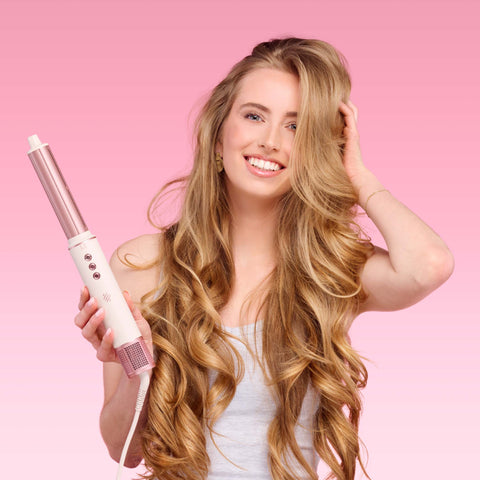
The difference is mostly about contact. With a straightener, the hot surface presses directly against your hair, creating local peaks. With an airstyler, your hair wraps around a curling barrel while the air flows around it, so the warmth spreads more evenly. That's why the Airstyler Pro Ceramiq has a fully ceramic-coated barrel (not a thin sprayed-on layer) and several temperature settings, so for a touch-up on dry hair you can choose the lowest setting and still get your curl back.
In practice: on day 2 with an airstyler on the lowest setting, one light mist over the lengths is enough. You don't have to redo your whole routine.
Less heat needed for the same result
Because the Airstyler Pro Ceramiq works with airflow and a ceramic-coated barrel instead of hot clamping plates, you can do day 2 touch-ups on the lowest setting. In our own customer survey (214 users, 30 days of use), 87% said they noticed less hair damage straight away. That's our own customer poll, not independent research.
- 2-year warranty
- 30-day money-back guarantee, just try it at home
- Free shipping in NL, BE and DE, order before 23:59 and it arrives tomorrow
- Trustpilot 4.8/5 based on 632 reviews
Frequently asked questions
Can you use heat protectant on dry hair, or does my hair need to be damp?
Dry hair is perfectly fine, and for a touch-up that's exactly the point. Do check the label though: some formulas are made for towel-dried hair and feel heavier on dry hair. In that case use less product and work it through properly with your fingers.
How much heat protectant do I need for shoulder-length hair?
On wet hair, a few sprays per section is usually enough to lightly cover all the lengths without making your hair wetter. On day 2 you need about half that. Too much product doesn't protect better, it just makes your hair heavier and flatter.
Does dry shampoo protect my hair from heat?
No. Dry shampoo absorbs oil and adds grip, but it doesn't form a protective film against heat. Brush the powder out as thoroughly as you can first, then apply a proper heat protectant to the lengths.
Does my leave-in conditioner work as a heat protectant too?
Sometimes, but only if the manufacturer explicitly says so. Plenty of leave-ins condition and detangle without ever being tested for thermal protection. If there's no heat claim or temperature on the packaging, don't assume it does that job.
Do I need heat protectant if I only blow-dry and don't straighten or curl?
Yes. Blow-drying is exactly when your hair is wet, and wet hair handles heat worse than dry hair. Spray on towel-dried hair and keep the dryer at a distance and moving.
Is it a big deal if I forget to spray once?
Forgetting once on a low setting isn't a disaster, because heat damage builds up over many sessions. Just don't make a habit of it, and deliberately drop your tool a setting lower that time.
Written by Anne Leensen, Ace & Taylor


