


Last updated: 8 October 2026
No, pure hair oil is not a proper heat protectant. A layer of coconut or argan oil lubricates your hair and adds shine, but it doesn't form the heat-slowing film that a real heat protectant does. At 180 to 200 degrees, oil can even go past its smoke point. So use oil before you wash, or after you style, not as a replacement.
In short
- The "high smoke point = good heat protection" argument doesn't hold up. A smoke point only tells you when the oil itself starts to break down, not whether it holds back heat.
- Unrefined coconut oil already smokes at around 177 \u00b0C. Plenty of straighteners and curling irons run hotter than that by default.
- Real heat protectants work with film-forming polymers and silicones. Those conduct heat slowly and spread it more evenly across the hair fibre.
- Coconut oil does have proven value: as a pre-wash treatment it reduces protein loss from the hair. That's a different thing from a heat shield.
- Oil plus wet hair plus a hot tool is the worst possible combination. Water inside the hair shaft evaporates and leaves cavities behind (bubble hair).
Further down you'll also read why the temperature and heat distribution of your styling tool ultimately make more difference than the bottle you use beforehand.
Why doesn't the smoke point argument hold up?
Because a smoke point tells you something about the oil, not about your hair. It's the temperature at which the oil itself starts to break down and smoke. Whether that oil also blocks the heat of a hot plate is a completely different question.
That distinction gets muddled in just about every blog about "natural heat protection". The reasoning goes: argan oil doesn't smoke until around 215 degrees, so you can safely style up to 215 degrees. That's like saying a pan doesn't get hot as long as the oil in it isn't smoking.
There's another problem: the smoke point figures doing the rounds in hair blogs are often lifted from the cooking world and then rounded up. For cosmetic argan oil, numbers around 215 \u00b0C circulate, but those mostly come from brand copy, not independent measurements. For cold-pressed cooking oils the figures are well documented, and they come out lower than you'd think.
So what does a real heat protectant do?
A heat protectant lays a thin, clinging layer around the hair fibre that passes heat on slowly and spreads it more evenly. That way your hair doesn't hit a peak temperature all at once, but warms up more gradually.
The building blocks that do this are film-forming polymers and silicones. In a study published in 2011 in the Journal of Cosmetic Science (Zhou and colleagues), hair was treated with various cosmetic pre-treatments and then styled with a straightener at well over 200 degrees. Polymers such as polyquaternium-55 and a VP/acrylate copolymer cut hair breakage during combing afterwards by roughly half. That's no small difference.
Silicones like dimethicone are poor conductors of heat by nature. That's exactly the property that makes them useful: they slow down heat transfer into the hair shaft. Funny detail: a lot of products sold as "hair oil for heat" are, going by the ingredient list, mainly silicone serums with a bit of plant oil mixed in. So what you're really buying is the silicones, not the oil.
Important nuance: even a good heat protectant doesn't bring the damage down to zero. It reduces it. It's a buffer, not a shield.
Can oil actually damage your hair if you style with it?
Yes, it can. Not because oil turns toxic, but for two very down-to-earth reasons from physics: oil heats up faster than water, and oil traps moisture in places you don't want it during styling.
1. Oil heats up faster. Water has a high specific heat capacity (about 4.2 joules per gram per degree). Plant oil sits around 1.5 to 2. In plain language: you need less than half the energy to get oil as hot as water. So a thick layer of oil on your hair doesn't cool anything, it just gets hot right along with it.
2. Moisture in the hair shaft turns into steam. Keratin, the protein your hair is made of, can take far more when it's dry. In lab measurements, the denaturation point of dry hair keratin sits around 230 to 240 \u00b0C, but for wet keratin it falls somewhere between 120 and 155 \u00b0C. Working on wet hair with a hot tool also causes the phenomenon known as "bubble hair": the water in the hair shaft evaporates, expands and leaves cavities behind. That hair becomes brittle and snaps off. It's been documented in medical case reports involving hair treated wet with a hairdryer or straightener.
Pile oil onto damp hair and then run 200 degrees over it: you're combining exactly the two things you want to avoid.
So which oil actually does what?
Short answer: coconut oil has the best evidence behind it, but as a pre-wash treatment. The rest mainly do something for shine and softness. Below you'll see what's genuinely known about each oil.
Smoke points are indications from the food world and vary per batch, pressing method and refining.
So when should you use oil?
At two moments: well before washing, and in a very small amount after styling. That way you get the benefits of oil without taking it into a hot iron with you.
The best-known evidence comes from research by Rele and Mohile, published in the Journal of Cosmetic Science. They compared coconut oil with mineral oil and sunflower oil and found that coconut oil clearly reduced protein loss from the hair, in undamaged, bleached and heat-damaged hair alike. That effect is attributed to lauric acid: a small, straight fatty acid chain that can genuinely be drawn into the hair shaft. The best result came from using it before washing.
Here's how to build it up:
- The night before or 30 minutes before washing: massage some coconut oil through the lengths and ends. Skip the scalp if your hair gets greasy quickly.
- Wash it out. One round of shampoo is usually enough, two if you used a lot. Plenty stays behind in the hair.
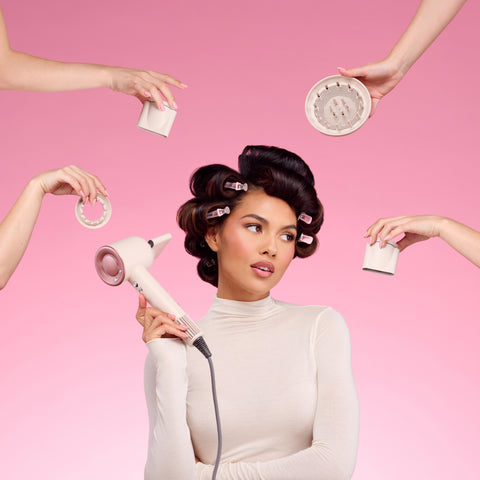
- Towel dry, then heat protectant. Spread it evenly, section by section. A spot you miss is a spot without protection.
- Let it dry down a bit. Don't spray and then go straight over soaking wet hair with a hot iron.
- Style on the lowest setting that gives you the result you want. Start low and only go up if it really won't cooperate.
- After styling: rub one or two drops of oil between your hands and run it through the ends only. That's your shine, without any heat involved.
What makes more difference: your product or your tool?
Your tool. A heat protectant can roughly halve the damage, but the temperature you work at determines the total amount of heat your hair gets. Styling 30 degrees lower makes more difference than any bottle ever will.
That's also where the difference lies between a glowing plate and styling with air. With a straightener or curling iron, hot metal or ceramic touches your hair directly, often at 180 to 230 degrees. With an airstyler, warm air shapes the curl: the temperature is lower and the heat doesn't come from one hot contact point, but from the airflow.
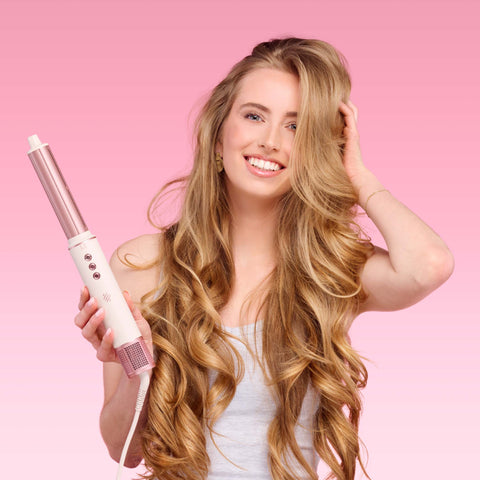
On the Airstyler Pro Ceramiq\u2122 from Ace & Taylor, the curling attachments are fully ceramic coated, not just sprayed on the outside. Ceramic releases heat more evenly, which means fewer hotspots: those small, far too hot patches where damage usually starts. That's exactly the same principle a heat protectant is trying to achieve, only coming from the tool itself.
And no, that doesn't mean you can skip heat protectant. A lower temperature and a protective layer do different things. Together they work best.
The summary in one sentence
Oil nourishes and adds shine, a heat protectant slows heat down, and your temperature setting determines how much heat there is in the first place. Those three don't replace each other.
Frequently asked questions
Can I use argan oil as a heat protectant if I straighten at 150 degrees?
On a low setting the risk is smaller, but you still don't have a heat-slowing film. Argan oil mainly gives shine and softness. Use a real heat protectant before styling and save the argan oil for your ends afterwards.
Why does my hair smell burnt when I use oil before styling?
Then you're probably above the smoke point of that oil. Unrefined coconut oil already smokes at around 177 degrees and plenty of irons run hotter. That smell is a clear signal: turn the temperature down and take the oil out of your prep routine.
Is leaving coconut oil in my hair and then blow-drying the same as deep-frying?
Not quite, because a hairdryer blows air and doesn't touch your hair with a hot plate. It's still unwise though: the oil heats up faster than water and can start smoking on a hot setting. Rinse coconut oil out before you dry.
Does a leave-in conditioner work as heat protection too?
Often partly, yes, if it contains film-forming polymers or silicones. Check the ingredient list for names ending in "-cone" or starting with "polyquaternium". If all it contains is water, plant extract and oil, don't count on heat protection.
How much heat protectant do I need for mid-length hair?
Count on roughly six to eight spritzes, spread over four or five sections, from about 20 centimetres away. More important than the amount is the distribution: comb the product through so every section is covered.
Does a hair mask from the night before protect my hair against heat?
No, not directly. A mask improves the condition and moisture level of your hair, which means it copes a bit better with styling. What it doesn't give you is a protective layer on the outside at the moment you style.
Want to rely less on whatever you put in your hair? Then the temperature of your tool is the place to start: the Airstyler Pro Ceramiq\u2122 styles with airflow and fully ceramic-coated curling attachments, so the heat is spread more evenly instead of sitting on one hot contact point.
- 2-year warranty
- 30-day money-back guarantee: try it out at home, no rush
- Free shipping to NL, BE and DE, order before 23:59 and it arrives tomorrow
- Trustpilot 4.8/5 ("Excellent") and 10,000+ customers
Written by Anne Leensen, Ace & Taylor
Sources include: Rele & Mohile, Journal of Cosmetic Science (effect of coconut, mineral and sunflower oil on hair damage); Zhou et al., Journal of Cosmetic Science 2011 (cosmetic pre-treatments and thermal damage from flat irons); published case reports on bubble hair after heat on wet hair.


