




Last updated: 6 October 2026
A silk or satin pillowcase reduces the friction between your hair and your pillow. Friction and rubbing are a well-known cause of damage to the outer layer of your hair. But independent clinical research showing that such a pillowcase actually reduces hair breakage simply doesn't exist. So count on fewer tangles and less frizz, not on repair.
In short
- Friction and rubbing damage the hair cuticle and cost your hair protein. That's stated in a review article on hair cosmetics in the International Journal of Trichology (Dias, 2015).
- Silk and satin have a smoother surface than cotton. Your hair glides over it more easily and is less likely to snag.
- There is no independent, peer-reviewed research proving that a silk pillowcase measurably reduces hair breakage. The percentages you see online almost always come from tests that sellers commissioned themselves.
- "Silk draws less moisture from your hair" doesn't hold up on the fibre side. Silk absorbs roughly 11% of its weight in moisture, cotton 7 to 11%. Polyester satin barely anything (0.4 to 0.8%).
- Going to bed with wet or damp hair does more harm than your pillowcase can undo. Wet hair swells by about 10% in thickness and the cuticle scales lift slightly.
Further down you'll read which evening routine makes more difference than the fabric of your pillowcase, and how to make airstyler curls last a second day.
What does a silk pillowcase actually do for your hair?
It lowers the friction between your hair and the fabric. That means your hair rubs against the pillow less during the night, which saves you tangles, frizz and broken hairs at the surface.
Your hair has an outer layer of scales that overlap like roof tiles. That layer protects the core. Every time your hair rubs against something (a brush, a hair tie, a sweater, your pillow) a tiny bit of that layer wears away. The review article Hair Cosmetics: An Overview (International Journal of Trichology, 2015) puts it simply: abrasion and friction are major causes of hair damage, because your hair loses protein in the process.
Cotton consists of short fibres with fuzzy ends. That feels soft against your skin, but the surface is microscopically rough. Silk consists of long, smooth filaments. Your hair glides over a surface like that more easily. That's physics, not marketing.
What it does not do: repair your hair, make it grow faster, or reverse heat damage. A pillowcase can only prevent new damage, not fix old damage.
Is there scientific proof that it works?
Not directly. There is no independent, peer-reviewed clinical study in which women slept on silk for months and ended up with measurably less hair breakage. What does exist: evidence for the underlying mechanism (friction damages hair) plus lab tests paid for by pillowcase brands themselves.
That distinction matters. If you google it, you'll find figures like "34% less friction" or "51% more damage from cotton". Trace it back to the source and it always turns out to be a test commissioned by the company selling the pillowcases. Such a test may well have been done properly, but it's still a party with a stake in the outcome. So treat those numbers as an indication, not as fact.
How to read a claim like that: does it fail to mention who funded the research, how many hairs were tested, and whether it was done on real people or on loose strands? Then you know enough. "Independent lab" only means the lab is independent, not the client.
The honest conclusion: a smooth pillowcase is plausibly useful and can't do any harm. Just don't expect a miracle cure, and don't spend your money on the priciest version because a percentage convinced you.
Silk, satin or cotton: what's the difference?
Silk is a fibre, satin is a weave. So satin can be made of silk, but it's usually polyester. Both feel smooth, but they behave differently when it comes to moisture and warmth.
Moisture absorption is the standard textile value (moisture regain): how much moisture a fibre takes up under normal conditions relative to its dry weight.
Does cotton really draw moisture out of your hair?
Not as clear-cut as brands make it sound. Looking purely at the fibres, silk actually absorbs as much moisture as cotton or slightly more: around 11% versus 7 to 11%. The fibre that absorbs almost nothing is polyester satin.
Where cotton does lose a point: a cotton pillowcase also soaks up your leave-in, cream and hair oil. Apply something to your lengths in the evening and part of it ends up in your pillowcase instead of in your hair. You'll notice that most with curly and dry hair.
In short: choose a smooth pillowcase because of the friction, not because silk "keeps your hair hydrated". That last claim isn't supported by the fibre data.
What helps more at night than your pillowcase?
How your hair goes to bed counts for more than what it lies on. Wet hair swells by about 10% in thickness and the cuticle scales lift slightly, which makes rubbing hit harder. Dry, cooled hair copes far better with a night of movement.
- Don't go to sleep with damp hair. If your hair still feels cool and moist at the roots or in the inner layer, it's still wet. Blow-dry that last 10% on a low setting.
- Let styled hair cool down completely first. A curl or a smooth section only sets once the hair has cooled. Lie down straight away and you'll flatten the shape while it's still movable.
- Brush or comb your hair out before bed. Small bit of effort, big difference: a tangle that's already there in the evening takes more force to pull loose in the morning.
- Gather your hair loosely on top of your head. The "pineapple": a loose bundle at your crown with a soft scrunchie. That way your lengths aren't trapped under your head.
- Use a scrunchie or spiral hair tie, not a tight elastic with a metal clamp. That's exactly the spot where hair snaps.
- Got long or curly hair? Braid it loosely. One loose braid or two braids keep the lengths together and stop hairs rubbing against each other all night.
- Limit the heat you style with. The less your hair has to endure during the day, the less vulnerable it is at night. Lower temperature, fewer passes over the same section.
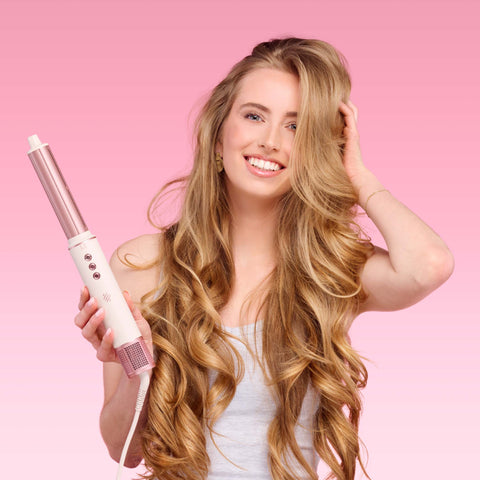
That last point is where your tool comes in. With the Airstyler Pro Ceramiq, warm air wraps your hair around a fully ceramic-coated curling barrel (not a thin layer of sprayed-on coating), instead of you clamping a section between hot plates and pulling it through. That means you work with lower temperatures and less mechanical pulling, and that's exactly the same kind of damage a smooth pillowcase tries to do something about at night.
How do you keep airstyler curls in shape overnight?
By storing your curls high and loose and not combing them out again. Curls lose their shape from being flattened and brushed out, not so much from the night itself.
- Let every curl cool down completely before you touch it. Warm hair that you pin up loses its shape.
- Gather your hair loosely at your crown with a soft scrunchie, or coil each curl up and secure it with a clip (the classic pin curl).
- Sleep on silk, satin or in a bonnet, so your curls don't rub open into frizz.
- In the morning: don't brush. Shake your hair loose with your fingers and refresh the limp bits with one short pass of your curling barrel.
- Go easy on the oil before bed. Too much product weighs the curl down and pulls it out.
In our own customer survey (214 users, 30 days of use), 96% reported curls that held for at least 24 hours. That's research among our own customers, not independent research, so read it as experience rather than a laboratory result.
Does a silk pillowcase help with hair loss or thinning hair?
No. At most, a pillowcase can limit breakage along the lengths. It does nothing for the hair follicle, for hormones, or for hereditary hair loss.
The difference: with breakage, a hair snaps somewhere along its length and you find short pieces of hair. With hair loss, the whole hair is released and you see a small white bulb at the end (the root). If you're mainly seeing the latter, and a lot is falling out for days on end, a pillowcase isn't the answer. Go and see your GP or a dermatologist.
What you can expect when you switch: fewer tangles in the morning, less bed hair and less of that wispy frizz around your face. That's real, but it's cosmetic.
What should you look for when buying one?
Smoothness, washability and price, in that order. A cheap satin pillowcase that you wash every week does more for your hair than an expensive silk one you're too scared to put in the machine.
- Momme (mm) for silk: this is a measure of the weight and density of the fabric, usually 19 to 25. Higher means sturdier and more durable in use, not automatically better for your hair.
- Closure: an envelope closure or zip keeps the pillowcase in place better than an open side.
- Washing instructions: silk wants cold, short cycles with a mild detergent, preferably in a laundry bag, then dried out of direct sunlight. If that's not something you'll keep up, go for polyester satin.
- A certification like OEKO-TEX says something about harmful substances in the textile, not about what the fabric does for your hair.
Change your pillowcase as often as the rest of your bedding, or more often if you put products in your hair in the evening or have an oily scalp. A pillowcase full of sebum and product is no upgrade for your scalp, however smooth it is.
A smooth pillowcase limits the damage of one night. The biggest gain is during the day: styling with warm air and a fully ceramic-coated curling barrel instead of hot plates and pulling.
2-year warranty • 30-day money-back guarantee • Free shipping in NL, BE and DE • Trustpilot 4.8/5 from 632 reviews
View the Airstyler Pro CeramiqWritten by Anne Leensen, Ace & Taylor
Frequently asked questions
How often should you wash a silk pillowcase?
Just as often as your regular bedding, so roughly every one to two weeks. Do it more often if you use oil or leave-in in the evening or have an oily scalp. Wash silk cold and short with a mild detergent, ideally in a laundry bag, and let it dry out of direct sunlight.
Is a satin pillowcase just as good as silk?
In terms of friction, polyester satin comes close, and it's considerably cheaper and easier to wash. The difference is comfort: polyester doesn't breathe well, so you lie warmer, and it can build up static in dry air. If you sleep hot or struggle with frizz from static hair, silk is nicer.
Does a silk pillowcase help with split ends?
It can help prevent new ones, because less rubbing means less wear on your hair cuticle. Ends that have already split won't grow back together. You cut those off, no matter how you sleep.
Can I sleep on a silk pillowcase with wet hair?
Better not. Wet hair swells by about 10% in thickness and the cuticle scales lift slightly, which makes it more prone to rubbing and kinking. A smooth pillowcase doesn't take that downside away. Let your hair dry first or blow-dry the last bit on a low setting.
Does a bonnet work better than a silk pillowcase?
For curly and coily hair, often yes, because your hair is then completely away from the pillow, even if you toss and turn a lot at night. A pillowcase only protects the part that's lying on the pillow. The downside of a bonnet: it has to stay on all night, otherwise it's no use to you.


