


Last updated: 8 September 2026
No, the glass of water test does not measure your hair porosity. Whether a strand floats or sinks mostly comes down to the surface tension of water and to whatever is sitting on your hair (conditioner, oil, sebum, styling product). Not to holes in your hair. Porosity is a real thing, but you measure it in a lab, not in a glass.
TL;DR
- A hair has a density of roughly 1.3 g/cm³, so it is heavier than water. Purely by physics, every strand should sink. The fact that it stays on top is down to surface tension.
- Healthy hair has a lipid layer on the outside (including 18-MEA) that repels water. According to the scientific literature, bleaching strips more than 80% of it in a single treatment. That turns the surface water-loving.
- So the glass of water test and the droplet test mainly measure how water behaves on the surface, plus product residue. Not how porous your hair is on the inside.
- The drying time test ("dry within 1 hour = high porosity") is skewed by how much hair you have, how thick your strands are and your curl pattern.
- What does predict how your hair reacts to heat: your chemical history (bleaching, colouring, perming) and how your hair feels and stretches when wet.
And that last point is exactly what you need in order to pick the right temperature and the right tool. Further down you will read which setting suits which kind of hair damage.
What is hair porosity, really?
Porosity is how easily water and other substances move in and out of your hair fibre. It is a genuine, measurable property, but in science it is measured with equipment such as gas sorption, thermoporometry (DSC) or dye uptake under a microscope.
Your hair is not one solid thread. The outside consists of overlapping, roof-tile-like scales (the cuticle). On top of that sits a thin lipid layer, of which 18-methyleicosanoic acid (18-MEA) is the best known component. That layer makes healthy hair water-repellent and smooth.
As soon as that layer gets damaged, your hair starts behaving differently. A review in Dermatology Research and Practice (2025) states that bleaching removes the outer 18-MEA layer, which makes the hair surface water-loving and increases friction. More than 80% of the 18-MEA disappears with just one bleaching treatment. That is why bleached hair feels rough and "thirsty" and tangles more quickly.
Important: porosity is therefore not a fixed hair type you are born with, the way your curl pattern is. It is mostly a consequence of what has happened to your hair. And it varies across your own head: your ends are years older than the hair at your roots.
Why doesn't the glass of water test work?
Because you are not measuring whether the hair absorbs water, but whether the water is allowed to "grab" the hair. That is a surface story, not a porosity story.
Three reasons why your result tells you very little:
- Surface tension is strong. Water has a kind of invisible skin on its surface. It holds up all sorts of things that are heavier than water. At around 1.3 g/cm³, a hair is heavier than water, so it does not really "float": it rests on the tension. Add a single drop of washing-up liquid to the glass and that same strand often sinks straight away.
- Residue decides the outcome. Conditioner, hair oil, silicones, dry shampoo and your own sebum all make the surface water-repellent. So a damaged strand with a bit of conditioner on it will simply stay afloat. And hair you have just washed with a strong shampoo gets wet faster.
- One hair is not a sample. Your hair is not the same everywhere. If you fish one strand out of your comb, you have no idea whether it came from the fragile ends or from fresh new growth.
Chemist Michelle Wong of Lab Muffin Beauty Science explains the same thing: these tests say something about how water interacts with the hair surface, not about whether the water is drawn inside.
There is another reason to be careful with the "sponge" story. In research on water absorption in hair (Barba et al., Thermochimica Acta, 2010), bleached hair actually took up less moisture in total than untreated hair, even though the fibre did become more permeable. So damaged hair lets water through faster, but "porous = soaks up more water" is putting it too simply.
So what about the droplet test and the drying time test?
Those are slightly more informative, but still not a measurement. The droplet test looks at the same lipid layer as the sink test, and the drying time test is mostly determined by how much hair you have.
So how do you know if your hair is porous?
By looking at what has been done to your hair and how it behaves, especially when it is wet. That is not a measurement, but it is a solid estimate. And for your styling routine, a solid estimate is plenty.
- Go through your history. Have you bleached, highlighted, permed or relaxed your hair? Then it is high porosity. Full stop. You don't need a glass of water for that.
- Feel the difference between root and end. Take a section and let it slide between your fingers, from top to bottom. Do the bottom 10 centimetres feel rougher, drier or thinner? That is where your damage sits.
- Do the stretch test on wet hair. Take one wet strand, gently stretch it a little and let go. Healthy hair springs back. Hair that snaps immediately, or that stretches out and stays limp (that "elastic band" feeling), has damage in its core. This tells you more than all the water clues put together.
- Watch how your hair gets wet under the tap. Does one part of your hair feel soaked instantly while another part still repels water at first? Then your porosity is unevenly distributed, which is completely normal with regrowth plus coloured ends.
- Pay attention to styling behaviour. Does your hair take up colour and products very quickly, but does your curl also drop fast and your shine disappear? Then it is behaving like damaged, porous hair.
What does porosity mean for heat styling?
Less than you think. The biggest risk factor with heat is not your porosity label, but how much water is still in your hair at that moment.
That is well documented. Thermal analyses show that keratin fibres in water already lose their ordered structure at around 140 to 150 °C, whereas dry hair only shows a clear denaturation peak at around 230 °C. So wet hair is considerably more vulnerable at the same temperature than dry hair.
On top of that there is "bubble hair": a well-known hair defect where water inside the hair shaft evaporates and bubbles form within the fibre. According to the literature (Detwiler et al. 1994, Gummer 1994) this can already occur with hairdryers operating at around 175 °C, and even with a curling iron at 125 °C left on damp hair for a minute. The hairs then snap off easily at that spot.
In practice that means three things: don't use hot plates or a hot iron on damp hair, never let a tool sit still in one place, and choose moving warm air over a short burst of high heat.
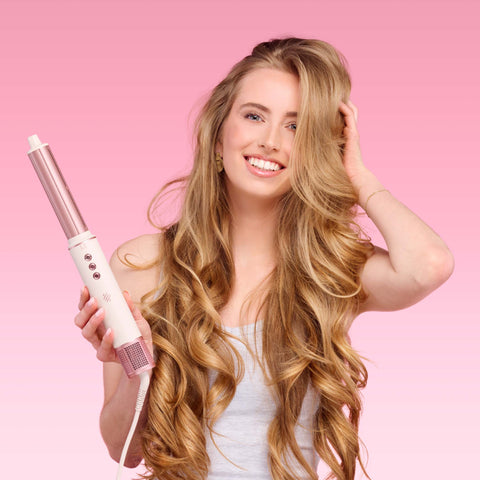
This is also why the material of your tool matters. With a curling barrel that is fully ceramic coated, like the one on the Airstyler Pro Ceramiq™, the heat spreads more evenly across the surface than with thinly sprayed coatings on plastic. Your hair then takes its shape from the airflow and the cooling down, not from a localised hot spot. Exactly what you want if your ends are already porous.
Can you lower porosity again?
You can't really reverse it, but you can mask it day to day. Damaged cuticle scales don't grow back together and the lost lipid layer doesn't spontaneously return on hair you already have.
What does help: conditioners and leave-ins with caring ingredients lay a film over the surface, which makes your hair feel smoother, tangle less and break less easily when combing. That effect is real, but temporary: it washes out. Structural damage is only solved by adding less damage and by having your ends trimmed regularly.
So: don't use the tests to slap on a label, use your own eyes and hands to see where your hair is most fragile. And adjust your temperature accordingly.
Porous ends but curls that still hold? With the Airstyler Pro Ceramiq™ you shape your hair with airflow and a fully ceramic-coated curling barrel, so you can work on a lower setting than with a classic curling iron.
- 2-year warranty and 30-day money-back guarantee: try it out at home, no rush
- Trustpilot 4.7/5 ("Excellent") and 10,000+ customers
- Suitable for all hair types, 1A to 4C
- Free shipping in NL, BE and DE. Order before 23:59 and it arrives tomorrow
Discover the Airstyler Pro Ceramiq™
From our own customer survey (214 users, 30 days of use, Ace & Taylor): 87% immediately experienced less hair damage and 96% experienced curls that held for at least 24 hours. This is our own customer survey, not independent research.
Frequently asked questions
Does damaged hair always sink in a glass of water?
No. Whether a hair sinks depends mostly on the surface tension of the water and on whatever is sitting on that strand. A damaged strand with a little conditioner or sebum on it will float just fine, and a healthy strand can sink if you break the tension with a drop of washing-up liquid.
Does fast-drying hair mean my hair is high porosity?
Not necessarily. Drying time is mainly determined by how much hair you have, how thick your strands are and your curl pattern. Fine, thin hair dries quickly without being damaged, and thick hair can take hours while the ends are seriously porous.
So which test is reliable?
No home test truly measures porosity. What you can do: go through your chemical history, run your fingers along the hair shaft to feel whether it is rough, and do the stretch test on wet hair. If a strand stretches out and stays limp, there is damage in the core.
Should I choose a lower temperature if my hair is porous?
Yes, that is a safe choice. Porous hair is usually also weaker hair, so start on the lowest setting that still works. Even more important: only style when your hair is (almost) dry, because in damp hair the same temperature causes more damage.
Can I "seal" my porosity with a mask?
You can make the surface temporarily smoother, but you don't actually close the cuticle scales again. Conditioners and leave-ins lay down a film that reduces friction and breakage. It washes out, so you repeat it with every wash.
Is porosity the same as hair type?
No. Your curl pattern (1A to 4C) and the thickness of your strands are largely inherited. Porosity is mainly the result of what has happened to your hair, such as bleaching, colouring or years of heat. That is also why it differs from one section of your hair to another.
Written by Anne Leensen, Ace & Taylor
Sources used in this article: Lai et al., Dermatology Research and Practice (2025) on 18-MEA and bleaching; Barba et al., Thermochimica Acta (2010) on water absorption in treated hair; thermal analyses of keratin (including Popescu, International Journal of Cosmetic Science, 2016); Detwiler et al. (1994) and Gummer (1994) on bubble hair; Lab Muffin Beauty Science on porosity tests.


