



Last updated: 5 October 2026
The cool shot blows air at roughly room temperature. It does not close your hair cuticles. What it does do: cool your hair down quickly so the shape you just created sets. Hair is mouldable when it is warm and damp, and only fixes once it is cold and dry. So use it as the final step on every section.
In short
- Cool air does not "close" your cuticles. Cuticles are not little doors with muscles, they can only lift up or lie flat.
- Heat plus water makes hair temporarily mouldable. As the hair cools and dries, the hydrogen and salt bonds reform in the new shape. That is the whole trick behind blow-drying and curling.
- Bone-dry hair only becomes genuinely reshapeable at around 144 degrees (measured with DSC, Wortmann et al., Biopolymers 2006). Water lowers that threshold considerably, which is why styling at hairdryer temperatures only works while your hair is still slightly damp.
- Cool air does dry, but much more slowly. Saturated air at 20 degrees holds about 17 grams of water per cubic metre, at 60 degrees that is around 130 grams.
- In practice: 20 to 40 seconds of cool air per section, only once that section is almost dry, and no touching until it feels cold.
Whether you really need that cool shot also depends on how hot your tool gets. Further down you will read what that means for a tool that maxes out at 110 degrees, compared to a straightener running at 200 degrees.
What exactly does cool air do to your hair?
Cool air cools your hair down, and that sets the shape you created with heat and tension. So it is not a treatment, it is a fixing step.
Your hair contains different types of bonds between the keratin chains. The weak bonds (hydrogen and salt bonds) let go as soon as water and heat come into play, and reform as your hair dries and cools. If your hair is wrapped around a round brush or sitting in a curl at that moment, those bonds reform in that new position. That is exactly why a blowout lasts a few days, and exactly why it disappears after washing or on a very humid day: water resets those bonds.
The strong bonds (disulphide bonds) are not affected here. Those only change permanently with chemistry, like a perm or a relaxer. Everything you do with a hairdryer, airstyler or straightener is temporary work on the weak bonds.
How easily hair becomes reshapeable depends heavily on how much water is in it. Researchers found a glass transition for dry human hair at around 144 degrees: the temperature above which the keratin structure becomes genuinely soft and mouldable (Wortmann et al., Biopolymers 2006). Water acts as a plasticiser and lowers that threshold. That is why you can shape a slightly damp section beautifully at 70 or 110 degrees, while the same section bone-dry gives way far less.
The cool shot fits neatly into that. As long as your section is warm and damp, it can still change shape, for example dropping under its own weight. Cool it down first while it is still in shape, and it is set before gravity does its thing.
Does the cool shot close your cuticles?
No. That is the most copy-pasted story about the cool shot, and it is not true. Cuticles are dead, keratinised scales that overlap like roof tiles. They have no muscles and no hinges, so they do not "open" from heat and do not "close" from cold.
What does happen: when your hair gets wet, it swells and the edges of those scales can lift slightly. If the hair is damaged, those edges are already permanently raised or partly gone. That feels rough and looks dull. Drying and cooling lets the hair shrink back to its normal shape, and a smooth, flat outer layer reflects light better. That is what you see as shine. So it is not a door closing, it is a surface lying flat.
The difference is not just theory. If you think cold closes cuticles, you use the cool shot as a repair: a quick blast of cold after blow-drying on the highest setting. If you know it is about fixing, you use it at the right moment: while the section is still in shape.
Does the cool shot help against frizz?
Indirectly yes, but not in the way it is usually promised. Cool air does not remove frizz that is already there. It mainly helps because it sets your hairs in the direction you have just given them, so fewer hairs spring up out of the section.
Frizz usually has three causes: moisture from the air that makes your hair swell, a damaged outer layer so hairs no longer lie smoothly alongside each other, and static charge. That last one will not go away with cold. Static builds up through friction in dry air, for example between hair and a brush in winter. Moisturising products and ionic technology help with that, not the temperature of the air.
One practical point though: every extra round of hot blow-drying because your style "is not sitting right yet" is extra heat. By cooling each section properly, you often need to correct less. Less correcting means less heat, and that is the biggest win for your hair.
When do you use which setting?
In short: heat to evaporate water and create shape, cold to lock that shape in. Below you will find what to do at each stage and why.
Can you dry your hair completely with cool air?
You can, but it takes far longer. Cool air evaporates water too, it just absorbs much less water vapour than warm air does.
That is simple physics. Saturated air at 20 degrees holds about 17 grams of water per cubic metre. At 40 degrees that is around 51 grams, and at 60 degrees around 130 grams. Heat room air of 20 degrees with 50 percent humidity up to 80 degrees and the relative humidity drops to roughly 2 percent. That air is starving, so it picks up the water from your hair very quickly. Cool air mainly depends on lots of airflow and lots of time.
So drying with cold air only is not free protection. Your hair stays wet longer and therefore stays swollen and vulnerable longer, and you spend far more time drying. In a widely cited Korean lab study using hair tresses, blow-drying from 15 cm away with continuous movement caused less surface damage than simply letting the hair air-dry (Lee et al., Annals of Dermatology, 2011). That does not mean heat is harmless, but it does mean "as little heat as possible" is not automatically the best choice. Smart distribution works better: warm while your hair is still wet, lower once it is damp, cold to fix.
Does the cool shot reduce heat damage?
A little, but mainly because it means you need less heat. There is no independent research specifically measuring the cool air button, so be sceptical if a brand promises otherwise.
What you can reasonably argue:
- You stop the heat sooner. As soon as the shape is there, you switch to cold instead of carrying on with warm air.
- You need to correct less. A section that has been set cold drops less quickly, so you go back in with the tool less often.
- You do not comb through warm hair. Warm, damp hair is softer and stretches more easily. A section that is already cold and dry copes better with a brush.
- Your style lasts longer, so you style less often per week. Cumulatively that is the biggest difference, because heat damage adds up and does not grow out.
Does this also work with an airstyler, curling iron or straightener?
With an airstyler yes, because it blows air and usually has a cool setting. With a curling iron or straightener there is no airflow, so there you fix the shape by simply letting the section go cold before you touch it.
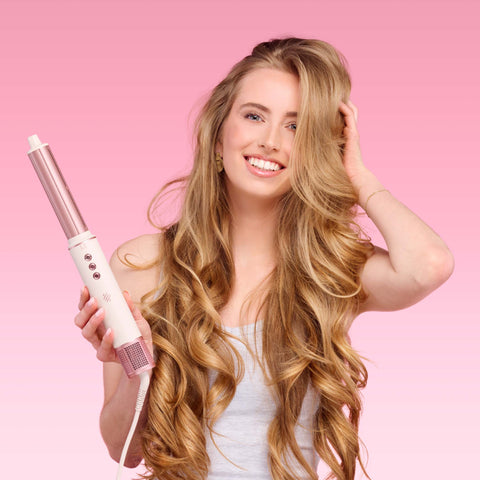
With an airstyler that is extra practical, because you can leave the section wrapped around the curling attachment while it cools. On the Ace & Taylor Airstyler Pro Ceramiq™ the cool setting sits at around 28 degrees, alongside heat settings of 35, 70 and 110 degrees. That top point of 110 degrees is immediately the big difference compared to a straightener that can reach 180 to 230 degrees: you work with air and time instead of one hot plate on your hair. Our own styling tip is simple and fits the physics above perfectly: heat the section properly for 30 to 40 seconds, then cool it for 30 to 40 seconds on the cool setting before you release it.
If you work with a curling iron or straightener, the same principle applies without a button. Wind up the curl and pin it with a clip, or let it sit coiled in your hand until it reaches room temperature. Only then comb it out or break it up with your fingers. Anyone who runs their hands through their hair right after curling pulls the shape out at the exact moment it has not set yet.
How to use the cool shot, step by step
- Apply heat protection to towel-dried hair and let it absorb briefly.
- Rough-dry your hair first on a warm setting with plenty of airflow, about 15 cm away and keeping the dryer moving, until it is slightly damp.
- Divide your hair into sections and clip them up. Work with sections no thicker than the width of your brush or curling attachment.
- Shape the section on a warm setting. Count on 30 to 40 seconds per section, until it feels dry.
- Keep the section in shape and switch to the cool setting. Keep holding the section or the brush, so do not let go.
- Blow cold for 20 to 40 seconds, until the section feels cold in your hand. Feeling it matters more than watching the clock.
- Release the section and leave it alone. No combing, no twisting, no tugging at your curl.
- Finish with 10 to 20 seconds of cool air over your whole head on a low speed, and only then apply hairspray or a few drops of oil.
Good to know: on many hairdryers the cool shot is a button you have to hold down, often marked with a blue or snowflake symbol. Let go and the heat comes back on. On airstylers it is usually a fixed setting you can leave switched on.
Frequently asked questions
Is cool air better for your hair than warm air?
Cool air delivers no heat, so in that sense it is safer. But drying with cold air only takes much longer and keeps your hair wet and swollen for longer. The best combination is warm while your hair is still wet, and cold to lock the shape in.
How do I know whether my hairdryer really blows cool air?
Hold the airflow against the inside of your forearm. You will immediately feel whether it is cooler than room temperature or more on the lukewarm side. Lukewarm air is normal, because the motor and housing give off some heat themselves.
Does the cool shot help against static hair?
Barely. Static charge builds up through friction in dry air, not from heat. A leave-in or a light oil, gentler brushing and ionic technology work better for that.
Should I use the cool shot on every section or only at the end?
Per section works better. You fix the shape at the moment it is still movable. Cool air over your whole head at the end is a nice extra, but it cannot bring back a section that has already dropped.
Why does my curl drop even though I do use the cool shot afterwards?
Usually because the section was not completely dry, or because it was still warm when you let go. Moisture and residual heat keep the hair mouldable. Take thinner sections and check with your fingers whether the section is genuinely cold.
Does the cool shot work on curly or coily hair too?
Yes, and often even more noticeably. Curly and coily hair changes shape dramatically with moisture, so letting it cool completely before you touch it makes a big difference to how long the definition holds. Touch the curl as little as possible while it cools.
Set your style without cooking your hair
If you want to build up with heat and fix with cold on every section without ever going above 110 degrees, the Airstyler Pro Ceramiq™ is made for exactly that: three heat settings (35, 70 and 110 degrees), a cool setting of around 28 degrees and fully ceramic-coated curling attachments, so the heat is distributed evenly instead of in hot spots.
- 2-year warranty and 30-day money-back guarantee, so you can try it out at home
- Free shipping in NL, BE and DE: order before 23:59 and it arrives tomorrow
- Trustpilot 4.8/5 ("Excellent") and more than 10,000 customers
- From our own customer survey (214 users, 30 days of use, so not independent research): 96% experienced curls that held for at least 24 hours
Written by Anne Leensen, Ace & Taylor


