




Last updated: 15 August 2026
That sizzling sound is water in your hair evaporating in a split second. Water boils at 100 degrees, while a straightener or curling iron gets to 170 or even 230 degrees. If you hear sizzling, your hair is too wet for the heat you're using. And that's not harmless: the steam can cause bubbles and breakage from the inside out.
IN SHORT
- Sizzling = water boiling inside your hair. Your hair always holds some moisture, and a lot more right after washing.
- The steam can't escape fast enough and forms bubbles inside the hair shaft. Dermatologists call this bubble hair.
- In research (Detwiler et al., Journal of the American Academy of Dermatology, 1994) those bubbles appeared with an iron at just 125 degrees on damp hair, after one minute.
- Wet hair is more vulnerable to heat than dry hair: the keratin structure of dry hair only changes at around 230 degrees, while in damp hair that already happens around 150 degrees.
- This damage doesn't repair itself. Your follicles stay healthy though, so new hair grows in normally.
Below you'll read exactly what happens in that one second, how to hear the difference between "normal" and "something's wrong", and why a tool that works with warm air handles this differently than two hot plates.
What exactly is that sizzling sound?
It's the sound of liquid water exploding into steam. Exactly the same sound as a drop of water in a hot frying pan, only this time it's happening between your strands.
Your hair is like a sponge: it absorbs water and holds onto it, deep into the core (the cortex) as well. Towel-dried hair might feel "almost dry", but it's still full of moisture on the inside. The moment you press a surface of 180 or 200 degrees onto that, the water doesn't evaporate calmly. It shoots past boiling point all at once.
Steam needs roughly 1,600 times more space than the same bit of water. That expansion has to go somewhere. With a hairdryer, the steam can drift away through the hair's surface. Between two clamped plates it can't, so the pressure forces its way out straight through your hair.
Is sizzling really harmful, or is it not that bad?
It is that bad. The sizzle is the moment permanent damage can form inside your hair, and it happens faster than most people think.
The condition is called bubble hair: small, vapour-filled cavities inside the hair shaft, visible under a microscope. The hair becomes thin, rough and brittle there, and snaps off. Dermatologist Susan Detwiler and colleagues described a case in the Journal of the American Academy of Dermatology in 1994 caused by an overheated hairdryer, and they were able to recreate the effect in the lab on ordinary hair. An iron at 125 degrees, one minute on damp hair, was already enough. A hairdryer at 175 degrees produced the same picture. That same year, Christopher Gummer described in the British Journal of Dermatology how brief, localised heating of damp hair fibres produces those same bubbles.
It has been seen in practice since then too. The International Journal of Trichology published a case of a 22-year-old woman whose hair became dry and brittle within two weeks after she used a straightener on wet hair. So not years of daily styling, just a few rushed mornings.
There's something else at play as well. Moisture lowers the temperature at which hair's protein structure gives way. Measurements on keratin show that dry hair only undergoes its characteristic change at around 230 degrees, while in wet hair that already happens around 150 degrees. So wet hair literally tolerates less heat than dry hair, while on wet hair you're actually inclined to work longer and harder.
Put simply: sizzling isn't a sign that it's working. It's a warning that you've skipped a step.
Which sounds are harmless and which aren't?
Not every sound while styling means damage. A soft rush of airflow is normal, a sharp sizzle on contact with a hot surface isn't. This table helps you hear the difference.
How do you know if it has already caused damage?
You won't see bubble hair as individual bubbles with the naked eye, but you will feel and see the consequences. Usually within a few days to two weeks.
- A section of hair that feels rough and straw-like while the rest feels normal.
- Short, snapped-off hairs exactly where you always start with the iron.
- Ends that look white or split in several directions.
- Curls or waves that no longer bounce back in that section after washing.
- Hair that no longer seems to hold product in that spot.
Important to know: this damage inside the hair shaft doesn't repair itself. No mask, no bonding treatment and no oil will make a cavity in the hair shaft whole again. What does help is cutting off the damaged pieces and growing on from there. The follicle in your scalp isn't harmed by this, so the new hair growing in is perfectly healthy.
Does this mean you should never style wet hair?
No. The problem isn't moisture and heat together, the problem is moisture plus a hot surface clamping down on your hair. Blow-drying wet hair is completely normal and sensible.
A hairdryer works with moving air. The heat spreads across the whole section, the water evaporates gradually at the outside and the steam can simply escape. In a study in Annals of Dermatology (2011), researchers compared different drying methods. Blow-drying from about 15 centimetres away with continuous movement caused less damage than letting hair air-dry. So staying wet for hours isn't free either.
The difference is in how the heat reaches your hair: airflow that carries moisture away, or a hot contact surface that traps it.
How do you go safely from shower to styling?
In five steps, and the first two matter most.
- Squeeze, don't rub. Press the water out of your hair with a towel or an old T-shirt. Rubbing lifts the cuticles and causes frizz, before any heat even comes into play.
- Dry to about 80 percent. Blow-dry first on a low to medium setting, keeping it moving and about a hand's width away. Your hair can feel cool and soft, but no longer cold and heavy with moisture.
- Apply heat protection to damp hair and let it soak in for a moment. If you put the iron straight onto a wet layer of spray, you'll hear that sizzle anyway.
- Test one section. Does it sizzle? Stop and blow-dry a bit longer. If it stays quiet, you're good to go.
- Work in thin sections and keep moving. One calm, continuous pass is better than going over the same spot three times with a tool that stands still.
Why doesn't an airstyler sizzle?
Because an airstyler doesn't clamp your hair between two hot plates, it shapes it around a barrel with a warm airflow. The moisture still in your hair is carried away by the air instead of being locked in.
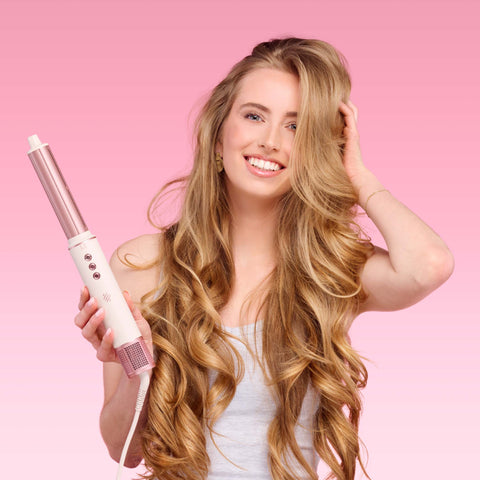
That's exactly the idea behind the Airstyler Pro Ceramiq: you dry and shape in the same motion on towel-dried hair, without the peak temperatures of a classic curling iron. The barrels are fully ceramic coated, not just a thin sprayed-on layer, and ceramic distributes heat more evenly than bare metal or plastic. Fewer hot spots mean less chance of that one moment where the moisture in your hair wants out too fast.
One honest caveat: even with an airstyler you don't want to start on soaking wet hair. Not because of bubbles, but because you'll be drying forever and your curl won't hold. Towel-dried to about 80 percent dry is the sweet spot.
Your hair sizzles even though it's dry: now what?
Then it's often not moisture in your hair, but your product or your tool. Two things to check.
1. Your styling product. Many leave-ins, sprays and mousses are largely water or alcohol. Apply one and go straight over it with heat, and that layer evaporates with a sizzle. Let it sit for a minute or two before you start.
2. Build-up on your tool. Residue from hairspray, oil and salt accumulates and burns again with every use. You'll recognise it by a burnt smell, a sticky surface and hair that keeps snagging. Wipe your plates or barrels down when they're cold, with a slightly damp cloth and a little alcohol on a cotton pad if needed. Never scrub and never submerge.
From sizzling to silent styling
Want to be done with that sizzling moment without giving up your curls? With the Airstyler Pro Ceramiq you dry and style in one motion using warm air, so moisture goes out with the airflow instead of getting trapped between hot plates.
- Fully ceramic-coated barrels, not a thin sprayed-on layer
- Suitable for all hair types, 1A through 4C
- 30-day money-back guarantee, just try it at home
- 2-year warranty and free shipping in NL, BE and DE
- Trustpilot 4.7/5 based on 632 reviews
In our own customer survey among 214 users (30 days of use), 87% reported noticing less hair damage right away. This is research by Ace & Taylor among its own customers, not independent research.
View the Airstyler Pro CeramiqFrequently asked questions
Does sizzling once mean instant permanent damage?
Not necessarily, but the risk is real. In the lab, bubbles formed after just one minute at 125 degrees on damp hair. One quick sizzle is less serious than pressing down for several seconds, but it's always a sign to stop and keep drying.
How long should I wait after washing before I can style?
Don't watch the clock, go by feel. Your hair should feel cool without being clammy or heavy, and a section shouldn't stick to your fingers anymore. With a hairdryer you're usually there within 10 to 15 minutes. Air-drying can take hours.
So are wet-to-dry straighteners safe then?
Tools that work with airflow instead of clamped hot plates let moisture escape, which makes them a different story than a regular straightener. Even so, the same rule applies: the less water left in your hair, the less heat and the fewer passes you need.
Can I see bubble hair myself?
The bubbles themselves are only visible under a microscope. What you will notice at home is a rough, straw-like section of hair that breaks off at one level, often exactly where you always start with the iron. A hairdresser or dermatologist can confirm it.
Will my hair grow back normally after this damage?
Yes. The damage is in the hair shaft, not in the follicle in your scalp. The damaged section won't recover and is best cut off, but new hair grows in perfectly healthy.
Does heat protection help against sizzling?
Heat protection reduces heat damage on dry hair, but it doesn't remove water from your hair. On hair that's too wet, it will still sizzle. Think of it as an extra layer, not a replacement for drying properly.
Written by Lena A., Ace & Taylor


