


Last updated: 30 September 2026
The top layer of your hair didn't grow differently from the rest. It has simply been through a lot more. That layer catches the sun, the wind, the friction of your comb and your beanie, and it almost always takes the most heat when you style. The hairs underneath sit sheltered, which keeps them smooth and supple for much longer.
In short
- The difference isn't down to your hair type, it's down to exposure. The top layer is your most "weathered" hair.
- UVB radiation penetrates roughly 5 micrometres into the hair fibre. The cuticle is 6 to 10 layers thick, each one 0.3 to 0.5 micrometres, so the sun mainly hits that outer shell.
- Damp hair is more vulnerable to heat than dry hair: wet keratin already changes structure around 140 to 155 degrees, dry keratin only above 200 degrees.
- When styling, the top layer usually gets the most passes, because it's the layer you can see and therefore keep touching up.
- Damaged cuticle scales don't grow back. You can smooth them temporarily, limit further damage and grow the rest out.
Further down you'll read which order to style your hair in, which temperature suits that fragile top layer, and why the type of tool matters more than the number of settings on the display.
Why is the top layer the driest and frizziest?
Because that layer takes everything first. Sun, wind, rain, your comb, your beanie, your hair tie and your styling tool all reach the outermost hairs before anything else. The hairs underneath are literally in the shade and are protected by the layer above them.
Your hair is dead material. It can't repair itself. So everything that happens to it over months and years stays in there. Hairdressers call this weathering. The longer a hair has been out of your scalp and the more it has been through, the rougher the cuticle becomes. Rough cuticles give less shine, catch light differently and let moisture escape faster. That feels dry and looks frizzy.
In the top layer, five things come together:
- Sun. The top of your head is closest to the sky. Your parting gets an extra dose on top of that.
- Friction. You brush the top layer most often and for the longest. Beanies, scarves, glasses and hair ties also rub mostly there.
- Heat. This is the layer you see in the mirror, so this is the layer you touch up when something doesn't fall right.
- Products. Dry shampoo, hairspray and texture spray almost always land on the outside.
- Visibility. Damage in the top layer is simply far more noticeable than the same damage lower down.
So it's not a mystery, and it's not a sign that something is wrong with your hair or your scalp. It's the sum total of exposure.
How much damage really comes from the sun?
More than most people think, and mostly on the outside of the hair fibre. Sunlight slowly breaks down the proteins and lipids in the cuticle, and that's exactly the layer that keeps your hair smooth and shiny.
Research into sunlight and hair shows that UVB radiation can penetrate about 5 micrometres into the hair fibre, after which the intensity drops off sharply. An intact cuticle consists of 6 to 10 layers of 0.3 to 0.5 micrometres each, so UVB doesn't structurally reach the core, but it does change the cuticle scales themselves. UVA penetrates deeper, all the way into the cortex.
What that does in practice: after exposure to sunlight, hairs lose measurably more protein, and that applies to every hair type and hair colour. In sun-damaged hair, the amino acids in the cuticle are usually more affected than those in the cortex, simply because the outermost layers absorb the most radiation. In short: UVB is mainly about protein loss and a rougher outer shell, UVA is mainly about colour change.
That's also why the top layer is lighter in colour than the rest for a lot of women. That's not an old set of highlights growing out, that's the sun breaking down your pigment. And hair without an intact cuticle and with less pigment feels drier and takes heat differently.
Quick check: lift the top layer of your hair and compare a section from the top with a section from the nape, at the same length. Does the nape section feel clearly smoother and stronger? Then you don't have a problem with your hair quality in general, but with the exposure of your outer layer.
Why does my top layer get more heat than the rest of my hair?
Because you style what you see. You do the bottom layers once and then you're done, because they're invisible. You do the top layer once, look at it, and then redo that one little bit at your parting. And again the next day.
The number of passes matters more than you'd think. Heat damage is cumulative: every time you heat a section, moisture evaporates, the cuticle scales lift a little more and the fibre becomes slightly more brittle. Two extra passes over the same little section aren't half a pass, they're two full ones.
And there's a second factor: moisture. In keratin research, the temperature at which the structure of wet keratin changes sits around 140 to 155 degrees, while dry keratin only shifts at around 205 to 240 degrees. Put differently: the same section tolerates far less heat while it's still damp. And the top layer is often exactly the layer you start pulling at and styling early in the drying process, because you want to see how it falls.
Practical conclusion: the top layer doesn't need more degrees, it needs fewer passes and less moisture in the hair at the moment the heat hits it.
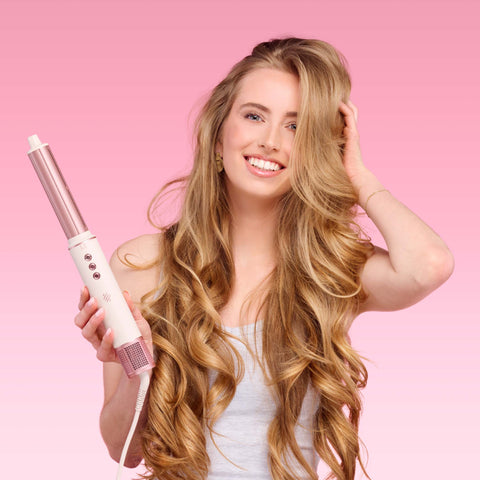
This is also exactly where the difference between types of tools lies. With a straightener or curling iron, you press a hot surface directly against the fibre, and you often have to correct because you don't get the shape in one go. With an airstyler, the airflow does the shaping work and you don't have to clamp the section at all. On the Airstyler Pro Ceramiq, the curling attachment is fully ceramic coated, not just a thin layer of spray over plastic. Ceramic distributes heat more evenly, so you get fewer hot spots on exactly that fragile outer layer. And because you work with multiple settings, you can deliberately set the top layer lower than the rest.
Top layer versus bottom layer: what takes which hit?
This overview shows why two hairs of the same age, from the same scalp, can feel so different.
Is it really damage, or is something else going on?
Not every frizzy top layer is damaged hair. Three other explanations are common, and they each call for a different approach.
- New baby hairs. Every day hairs fall out and new ones grow in. Those short, young hairs poke through your top layer and look like frizz, but they're actually healthy. How to spot them: they're short, they stand upright and they have an intact, tapered tip instead of a frayed end.
- Different hair thickness on your crown. Hair thickness isn't the same everywhere on your head. In a study of Ghanaian women comparing hairs from five areas of the scalp, the hairs from the crown had a significantly larger diameter than those from the other areas. Thicker hair is stiffer and follows your curl or your blowout less easily. That can feel "unmanageable" without any damage being involved.
- Grey hair. For many women, grey hair starts at the parting and the crown. Hair without pigment has a different structure and often feels coarser and drier, even if it has never seen heat.
You recognise genuine heat and weathering damage by something else: the section still feels rough after washing, it stretches while you comb it out and doesn't spring back, and you find white dots or splits along the length. If you mainly see that in your top layer and not at your nape, you have your answer.
How do I style my top layer with as little damage as possible?
Treat your top layer as your most fragile hair, not as your most visible hair. That means: lower temperature, fewer passes and last in line. Here's how, step by step.
- Split into four: two bottom sections, two top sections. Clip the upper half out of the way. This is the most important step, because without sectioning you automatically style that fragile layer along with the rest.
- Apply heat protection to damp hair and let it dry off. Spray the top layer separately, with the hair lifted up, so the product actually reaches the outermost hairs and not just the layer underneath.
- Blow-dry until your hair is almost dry. No heat styling on damp hair. Damp hair tolerates noticeably less temperature than dry hair.
- Style the bottom sections first on your normal setting. That way you build shape and bounce into the hair that can handle it.
- Drop one setting for the top layer. Work with thinner sections. Thinner means the heat travels through the section more evenly, so you don't have to go over it twice.
- One pass, then hands off. Let the section cool completely before you judge whether it sits right. Warm hair is still malleable and always looks limper than the end result.
- Do touch-ups with your fingers, not with heat. A little cream or a light spray on your hands, then through the top layer: nine times out of ten that fixes what you were about to fix with an extra pass.
- Move your parting every few weeks. Then the same strip of hair isn't always in full sun and under tension in the same spot.
One extra tip if you often wear a ponytail or a bun: change the height. The hairs running over the curve of your hair tie are under the most tension, and those are always the hairs from your top layer.
Can I still repair that top layer?
Not truly repair, but you can clearly improve it. Cuticle scales that have worn away or broken off don't come back, because hair has no living cells that can repair anything. What does work is temporarily filling and smoothing that rough outer shell while you stop doing whatever caused the damage.
Specifically, this helps:
- Leave-in or oil on the top layer and the lengths only. Not on your scalp, but on the layer that needs it most.
- A weekly mask that you leave in for at least five to ten minutes. A quick massage and rinse does too little.
- Protection in summer: a hat, or a leave-in with a UV filter on the top layer and your parting for a day outside.
- Gentler brushing. Start at the ends and work upwards. And don't run the brush over your top layer ten times out of habit.
- Cutting off the worst centimetres. With hair that's genuinely frayed, a trim is faster than any treatment.
Count on months, not weeks. Hair grows about a centimetre a month on average, so a top layer weathered by years of sun and heat isn't replaced in a single season.
Fewer passes over your most fragile layer
Because the airflow of the Airstyler Pro Ceramiq does the shaping work and the curling attachment is fully ceramic coated, you usually don't need to touch up that visible top layer to make it fall beautifully.
From our own customer research among 214 users after 30 days of use: 87% experienced noticeably less hair damage straight away. That's research by Ace & Taylor among its own customers, not independent research.
- 2-year warranty
- 30-day money-back guarantee, so you can try it out at home
- Free shipping in NL, BE and DE, order before 23:59 and it arrives tomorrow
- Trustpilot 4.7/5 ("Excellent"), 400+ reviews in total
Frequently asked questions
Does the top layer of my hair grow differently from the bottom layer?
No, it grows the same way from the same kind of follicles. Thickness can vary a little between areas of your scalp, with crown hair often being the thickest. The difference in how your hair feels comes first and foremost from exposure, not from growth.
Should I style my top layer at a lower temperature than the rest?
Yes, that's usually a smart idea. That layer is already the most weathered and it also gets the most passes, so one setting lower plus thinner sections often gives a smoother result than more heat. Always let the section cool completely before you decide whether it sits right.
Why is my top layer lighter in colour than the rest of my hair?
That's often down to the sun. UVA radiation breaks down the pigment in your hair, which gradually lightens the outer layer. With coloured hair it happens even faster, because artificial dyes also fade from light and heat.
Is frizz in my top layer always heat damage?
No. A large part of what looks like frizz is new hairs that are still short and standing upright. Those have an intact, tapered tip. With real damage you see frayed or split ends, and the hair still feels rough after washing.
Does a hair mask help with a dry top layer?
It helps with how your hair feels and looks, but it doesn't rebuild the damaged cuticle. Leave a mask on for at least five to ten minutes and apply it specifically to the top layer and the lengths. Combine it with less heat and less friction, otherwise you're working against yourself.
How long does it take for a weathered top layer to grow out?
Hair grows about a centimetre a month on average. With shoulder-length hair, you're looking at well over a year before most of the damaged hair is gone. Regularly trimming off the worst centimetres speeds up the sense of improvement enormously.
Written by Anne Leensen for Ace & Taylor.


