


Last updated: 22 September 2026
Yes, with a straightener or curling iron you let your heat protectant dry first. If there's still water in your hair when those hot plates close, that water evaporates explosively and weakens your hair from the inside out. With a blow dryer or hot air it isn't necessary: those tools are designed to evaporate water gently, and at a far lower temperature.
In short
- Water in your hair lowers the temperature at which keratin breaks down. Wet hair loses its ordered structure at around 140 to 150 °C, while dry hair holds on until roughly 215 to 230 °C.
- A straightener is often set to 180 to 230 °C. Water in your hair then boils inside the hair fibre and leaves cavities behind. This is called bubble hair, first described in 1994 by researcher C.L. Gummer.
- In a study in the Journal of Cosmetic Science (Christian et al., 2011), a water-based spray and an alcohol-based spray protected the hair equally well chemically, but the water version caused more structural damage and a greater loss of strength.
- Rule of thumb: hot plate = dry first. Hot air = towel-dry or slightly damp is fine.
- Dried heat protectant still works. The protective film stays on your hair, only the water or alcohol evaporates.
That difference between hot plates and hot air is exactly why some tools can be used on damp hair and others can't. Further down you'll read how to handle it per tool.
Why is water in your hair such a problem with heat?
Because water makes your hair softer and more vulnerable to heat. Damp keratin gives way at a far lower temperature than dry keratin, and the water itself can start boiling inside the hair fibre.
Your hair is built from keratin: long, neatly coiled protein chains. As long as your hair is dry, those chains keep their shape up to fairly high temperatures. Research into keratin fibres shows that the ordered sections are lost in water at around 140 to 150 °C, while dry fibres hold their structure up to roughly 215 to 230 °C. So water acts like a plasticiser: it makes the proteins more mobile, and therefore more sensitive.
On top of that there's a second, much blunter problem. Water boils at around 100 °C. A straightener or curling iron gets far hotter than that. Close a tool like that around a section that still holds moisture and the water evaporates faster than it can escape. It forces its way out through the hair fibre and leaves air bubbles and cavities behind. In dermatological literature this phenomenon is known as bubble hair. In 1994, Gummer described in the British Journal of Dermatology that brief, localised heating of damp hair is already enough to create those bubbles, resulting in dry, weak hair that breaks easily. Later case reports link it directly to straighteners used on wet hair.
That crackling or hissing sound you hear when you run the iron over a damp section? That isn't "steam escaping", that's the sound of this process.
What does research say about water-based versus alcohol-based heat protectant?
That the water in the spray itself plays a role. A water-based spray protected hair just as well chemically as an alcohol-based spray, but left more visible and measurable structural damage behind.
In the study by Christian, Winsey, Whatmough and Cornwell (Journal of Cosmetic Science, 2011), hair sections were treated with a straightener after being sprayed with either a water-based heat protectant ("wet") or an ethanol-based one ("dry"). The researchers looked at the breakdown of the amino acid tryptophan using fluorescence spectroscopy, at the structure under a light microscope, and at the strength of individual hairs using tensile tests.
The outcome in three points:
- Both sprays reduced chemical damage to tryptophan. There was no difference between the water and alcohol bases here.
- Under the microscope, structural damage was actually greater in hair treated with water or with the water-containing spray.
- The tensile tests confirmed it: hair treated with the water spray lost more strength (a sharper drop in Young's modulus).
The authors write that the rapid evaporation of water is the most likely cause, and conclude that heat protectants would be improved by leaving the water out and working with volatile solvents such as ethanol.
An important nuance: this is one study, with hair swatches in a lab and a straightener. It doesn't prove that your spray is "bad". What it does show nicely: the water in the product isn't neutral, and it's sensible to let it evaporate before a hot plate closes around it. That costs you a few seconds and it's free.
How do you know your heat protectant is really dry?
Check with your fingers and your lips. Damp hair feels cool because evaporating water draws heat away. If the section feels cool or clammy, it isn't ready yet.
- Spray from a distance. Hold the spray about 20 to 25 cm from your hair and keep moving. That gives you a thin, even layer instead of wet patches.
- Comb it through. A wide-tooth comb or your fingers spreads the product and increases the surface area. It dries faster that way.
- Wait while you work. Spray the whole section you're about to style, not strand by strand. While you finish the first strand, the rest is already drying.
- Do the cheek test. Hold the section against your cheek or the back of your hand. Cool and clammy means: keep waiting. Room temperature and smooth means: ready.
- In a hurry? Blow it dry. A few seconds of cool or lukewarm air from your dryer lets the water evaporate without stressing your hair. This is the fastest safe route.
Note the difference between "wet" and "dried product". Your hair doesn't have to be bone dry and crunchy. What matters is that there's no free water left in or on your hair the moment something hot closes around it.
Does this apply to a blow dryer or airstyler too?
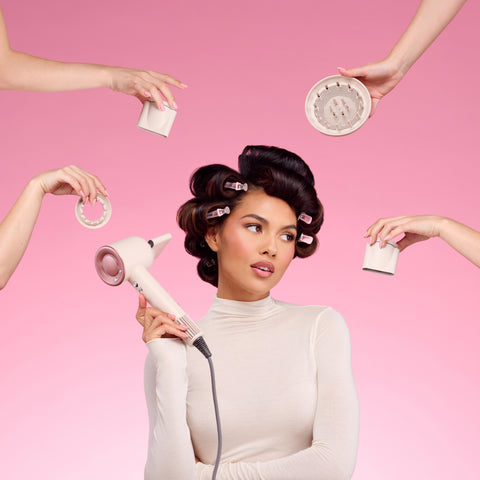
No, not in the same way. A blow dryer and an airstyler are made precisely to evaporate water from your hair, gradually and with air instead of direct contact.
The difference lies in how heat transfers. A hot plate passes its heat straight to everything it touches, in a fraction of a second, at 180 °C or more. Air transfers far less heat per second and also cools down on its way to your hair. As a result the water evaporates calmly at the surface instead of explosively inside the fibre. That's why using heat protectant on towel-dry hair before blow drying is perfectly normal, and even smart.
That hot air can be gentle also shows up in research in Annals of Dermatology (Lee et al., 2011). Hair sections dried for 60 seconds with a dryer held 15 cm away (where the air was about 47 °C) and with a moving hand showed less damage to the cell membrane complex than sections left to air dry. So keeping your distance and keeping moving does more than you'd think.
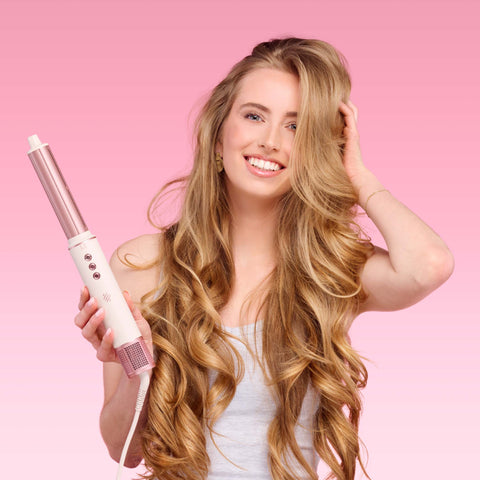
This is also why a hot-air tool is more practical for many women. With the Airstyler Pro Ceramiq™ from Ace & Taylor you dry and style in the same movement, without a hot plate clamping around a damp section. The curling attachment is fully ceramic coated, not a thin layer of spray, so the heat is spread evenly across the surface instead of concentrating in hot spots. In our own customer research (214 users, 30 days of use), 87% said they experienced less hair damage straight away. That's our own survey, not independent research, but it lines up with what the physics above predicts.
Spray, cream or oil: which dries fastest?
Alcohol-based sprays and dry sprays evaporate fastest, water-heavy sprays the slowest. Creams and oils contain little or no free water, but do need to go on in a thin layer.
The drying times above are guidelines, not measured values. How long it actually takes depends on how much product you use, how thick your hair is, and how warm and dry the air in your bathroom is.
What if you don't have time to wait?
Then pick a different route than "I'll just quickly grab the straightener anyway". There are three solutions that are all faster than repairing damage.
- Blow the spray dry. Cool or lukewarm setting, keep moving, a few seconds per section. Done.
- Work in section order. Spray the bottom section, style the previous one. That way you're never standing still.
- Style with air instead of plates. An airstyler or blow-dry brush can go on towel-dry hair, so you skip the waiting time entirely.
What you'd better not do: press a wet section between hot plates "just this once" because it's only one time. With damp hair the threshold for real, lasting damage is a lot lower than with dry hair.
Frequently asked questions
How long should heat protectant dry before I use my straightener?
Until the section no longer feels cool or clammy. With a thin layer of alcohol-based spray that's often a few seconds, with a water-heavy spray it can take a minute or longer. A few seconds of cool air from your dryer always gets you there faster.
Can I spray heat protectant on wet hair before I blow dry?
Yes, that's exactly the right moment. A blow dryer evaporates the water gradually and at much lower temperatures at your hair than a straightener. The problem only arises when there's still moisture in your hair as hot plates close.
Is alcohol-based heat protectant worse for my hair?
Not necessarily for the hair fibre. In the study by Christian et al. (2011) the alcohol version protected just as well chemically and caused less structural damage than the water version. If you have a sensitive or dry scalp, alcohol can feel unpleasant. In that case go for a water base and let it dry properly.
Does heat protectant still work once it has dried?
Yes. The active ingredients form a thin film on your hair that spreads the heat and passes it on more slowly. Only the carrier (water or alcohol) evaporates. What protects stays put.
Can I tell if I have bubble hair?
Not with the naked eye. The air cavities sit inside the hair fibre and become visible under a microscope or with trichoscopy. What you will notice: breakage in specific spots, a dry, rough texture and hairs snapping off at the same height. Those pieces can't be repaired, only cut off.
Does turning my straightener down help if my hair is still damp?
A little, but it doesn't solve it. As soon as the plates go above 100 °C, the water in your hair can still boil. And because damp keratin already loses its structure at around 140 to 150 °C, "low" is still relatively high for wet hair. Drying first is more effective than a lower setting.
Rather not stand around waiting for your spray to dry every time?
With the Airstyler Pro Ceramiq™ you style towel-dry hair using hot air and a fully ceramic-coated curling attachment, so no hot plate around a damp section.
- 2-year warranty
- 30-day money-back guarantee, so you can try it out at home
- Free shipping in NL, BE and DE. Order before 23:59 and it arrives tomorrow
- Trustpilot 4.7/5 ("Excellent") and more than 10,000 customers
Written by Anne Leensen, Ace & Taylor
Sources: Gummer CL, "Bubble hair: a cosmetic abnormality caused by brief, focal heating of damp hair fibres", British Journal of Dermatology, 1994. Christian P, Winsey N, Whatmough M, Cornwell PA, "The effects of water on heat-styling damage", Journal of Cosmetic Science, 2011. Lee Y et al., "Hair Shaft Damage from Heat and Drying Time of Hair Dryer", Annals of Dermatology, 2011. Popescu C et al., on thermal denaturation of keratin in wet and dry states.


