




Last updated: 4 October 2026
Heat styling almost never causes real hair loss, but it definitely causes breakage. Hair loss starts at the root, and your roots sit safely beneath your skin. Heat only touches the hair above your scalp, and that part is dead material. That is why hair snaps along its length. It feels like you have less hair, but your roots are simply doing their job.
In short
- A shed hair has a small white or pale bulb at the end (what is known as a club hair). A broken hair does not have that and is often shorter than the rest.
- The American Academy of Dermatology calls losing 50 to 100 hairs a day normal. That is just your hair growth cycle at work.
- The hair root sits inside your skin, and in fully grown hair it reaches down into the fat layer beneath. A straightener or blow dryer does not get anywhere near it, unless you burn your scalp.
- Styling can cause hair loss indirectly: through pulling (traction alopecia) or through a burn on your scalp, not through heat on your lengths.
- Heat on wet hair is the riskiest of all: the water inside the hair shaft turns to steam and forms cavities (bubble hair), which makes the hair snap.
Further down you will find a one minute test to work out whether you are dealing with breakage or shedding, plus the styling choices that genuinely make a difference for hair that already feels thin.
What is the difference between hair loss and hair breakage?
With hair loss, the entire hair comes away from the follicle, root section included. With breakage, the hair shaft snaps somewhere along its length, while the piece in your scalp stays put and keeps growing.
That difference matters, because the solution is completely different. Hair loss usually has to do with something inside your body: hormones, iron, thyroid, stress, pregnancy, medication, illness. Breakage has to do with what happens to your hair: heat, colour, brushing, hair ties, friction.
The hair above your scalp is not alive. It is made of keratin and has no blood vessels or nerves. It cannot repair itself. Everything you do to it adds up until the moment it snaps. The living factory sits under your skin, and it keeps producing new hair, even when your lengths are damaged.
How do you tell from a single hair whether it fell out or broke off?
Look at the end. A hair that has shed naturally has a small, hard, white to translucent bulb: the end of a resting hair. A broken hair has two ordinary, often frayed ends.
- Grab a few hairs from your brush or off your pillow. Do this in daylight or over a sheet of white paper.
- Find the thickest end. Is there a little bulb on it (like a tiny pinhead)? Then that hair shed from the root.
- No bulb, and the hair is clearly shorter than your hair length? Then it is breakage.
- Count the ratio. If nearly all the hairs are short and bulbless, breakage is your main issue.
- Check where those short hairs sit in your hair. Breakage from heat and friction often shows up on top of your head, around your face and at shoulder height.
Note: a white bulb is not a warning sign. It actually means that hair finished its cycle properly. The follicle stays put and can make a new hair.
Can the heat from a straightener or blow dryer reach your hair root?
No, not with normal use. The hair root sits protected inside the skin, and in fully grown hair in the growth phase the bulb even sits in the fat layer underneath. To damage that, you would first have to burn your scalp.
Skin only starts to take damage from roughly 44\u00b0C with prolonged contact. At around 60\u00b0C, a few seconds are already enough. So a 180\u00b0C straightener that accidentally touches your scalp really can leave a small burn. But warm air passing over your scalp cools down incredibly fast and does not do that.
In short: the danger is not heat on your lengths, but direct contact between a hot surface and your skin.
So when does styling actually cause real hair loss?
There are three situations where styling can cause hair loss, and in none of them is the heat itself the culprit.
- Pulling on your hair (traction alopecia). Tight ponytails, tight buns, heavy extensions and yanking a brush through your hair put constant tension on the follicle. The British Association of Dermatologists notes that hair can come back completely if you catch it in time, but that long term traction can destroy the follicle permanently. The classic sign: a thinning hairline around your temples.
- A burn on your scalp. A genuine burn can create scar tissue, and hair does not grow on a scar. This is rare, but it is the only route by which a styling tool directly shuts down a follicle.
- Mixing it up with another cause. With telogen effluvium, a lot of hairs enter the resting phase at the same time after a trigger such as a fever, childbirth, surgery, a crash diet or serious stress. The shedding only starts a few months later, which makes it easy to blame your new straightener. This type is temporary and usually resolves on its own.
You sometimes hear about hot comb alopecia, now known as central centrifugal cicatricial alopecia (CCCA). That name dates back to the sixties, when hot combs used with petroleum jelly were thought to be the cause. Modern dermatology reviews are more cautious about this: the cause is still unclear and heat or relaxing has not been confirmed as the sole trigger. Dermatologists do advise people with this condition to limit heat.
Hair loss or breakage: the quick comparison
Plenty of women have both at the same time. That is normal and it does not mean you are doing something wrong.
How much hair loss is still normal?
Around 50 to 100 hairs a day, according to the American Academy of Dermatology. If you only wash two or three times a week, all that accumulated shedding comes out at once in the shower. So a handful of hair in the drain on wash day is often simply three days of normal shedding combined.
Dermatologists also use the pull test: they take hold of around 50 to 60 hairs and tug gently. If more than roughly 10 percent comes away, there is increased shedding. In the revised guideline, broken hairs are counted separately, precisely because breakage and shedding tell two different stories. It is hard to do reliably at home, but it does show how few hairs normally come loose.
Why is styling wet hair the biggest breakage risk?
Because the water inside your hair turns to steam. When you clamp a hot metal surface onto wet or damp hair, the moisture in the hair shaft expands at lightning speed and air cavities form in the core. That is called bubble hair, a form of heat damage that is documented in dermatology and can be reproduced in the lab. Those hairs are weak and snap at exactly that spot.
In the literature, this effect has been triggered with a curling iron at 125\u00b0C for one minute and with a blow dryer at 175\u00b0C. Those are temperatures plenty of people use daily. Which is why the order matters so much: dry with airflow first, shape afterwards. Or choose a tool that dries and styles with air instead of hot plates.
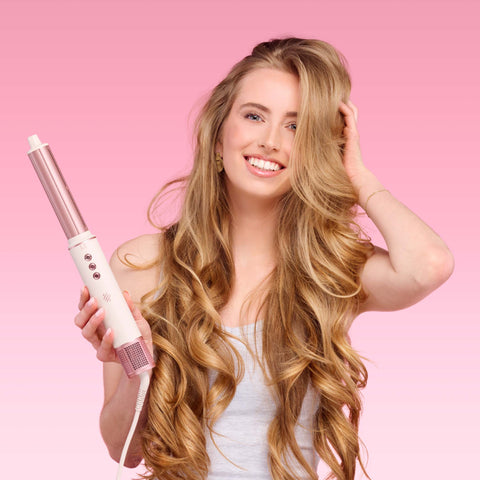
That is exactly the thinking behind the Airstyler Pro Ceramiq: the curl forms because the airflow wraps your section around the barrel, so you are not tugging hard at your hair yourself and your hair is not clamped between two hot plates. The barrels are fully ceramic coated, not a thin layer of spray, so the heat is distributed evenly instead of in hot spots. For hair that is already fragile, that solves two things at once: less pulling force and fewer heat peaks.
What do you do if your hair feels thinner because of breakage?
You cannot glue broken hair back together, but you can stop creating new breakage. You will see the result within a few months in thicker ends and less frizz.
- Turn your temperature down. Fine or slightly damaged hair rarely needs more than 150\u00b0C to 170\u00b0C. Thicker hair can handle higher, but always start low and only go up if the result does not hold.
- Never style damp hair. Make sure your hair is at least 80 percent dry, unless your tool is explicitly made for wet hair.
- Use heat protection on every section. Not just on top, but in the under layer and on your ends too.
- Take the tension out. No tight ponytail in the same spot, no metal hair ties, and detangle from the ends up to the roots.
- Get your ends trimmed. A split end keeps tearing further up. Cutting is the only real stop.
- Alternate protein and moisture. Protein masks alone make hair stiff and more brittle. Moisture alone makes it limp. The combination is what works.
When should you see a doctor about it?
Go to your GP if you see genuine shedding rather than breakage, and especially in these cases:
- your parting is visibly widening or your ponytail is noticeably thinner within a few months;
- you see round bald patches or a receding hairline at your temples;
- your scalp is sore, red, flaky, or you see smooth scar like patches;
- the shedding carries on for longer than six months;
- you have other symptoms alongside it, such as fatigue, weight changes or an irregular cycle.
A doctor can check blood values such as iron, ferritin and thyroid, and can assess whether scarring is involved. The sooner you act, the bigger the chance your hair comes back fully.
If breakage is your problem, you gain the most from a tool that shapes with airflow and even ceramic heat instead of hot plates and pulling force: the Airstyler Pro Ceramiq.
- 2 year warranty and a 30 day money back guarantee, so you can try it at home on your own hair
- Trustpilot 4.8 out of 5 ("Excellent") and 10,000+ customers
- Fully ceramic coated barrels, suitable for hair types 1A through 4C
- In Ace & Taylor's own customer research (214 users, 30 days of use, so not independent research), 87% experienced less hair damage straight away
Written by Anne Leensen, Ace & Taylor
Frequently asked questions
Can blow drying cause hair loss?
Blow drying does not cause shedding from the root. Warm air does not reach deep enough to affect the follicle. What blow drying can do is dry out the hair shaft and cause breakage, especially if you hold the dryer close to your hair or your hair is still very wet.
Does broken hair grow back?
Yes. The follicle is undamaged, so the hair simply keeps growing from the scalp, around a centimetre a month on average. You just will not see it until the new length has grown past the damaged section or until you have that section trimmed off.
Why do I lose so much hair on wash day?
Because loose hairs only really let go when you touch, wet and comb through them. If you wash every three days, three days of shedding comes out at once. So that can easily be 150 to 300 hairs without anything being wrong.
Does a white bulb on my hair mean the root is damaged?
No, quite the opposite. That bulb is the hardened end of a hair that completed its resting phase properly. The follicle stays in your scalp and can grow a new hair afterwards.
How many short hairs around my parting are normal?
Hairs a few centimetres long that get thicker towards the tip are simply new growth. Short hairs that end thin and wispy and snap at different lengths point more towards breakage. So look at the tip, not just the length.
Does styling less often help against hair loss?
Against shedding from the root, usually not, because that cause sits inside your body. Against breakage it does help, and since breakage is often the reason hair looks thinner, you often do see a difference. Lower temperatures and less pulling usually deliver more than giving up styling altogether.


