


Last updated: 3 September 2026
One slow pass at 200 degrees is usually less damaging than three or four passes at 150 degrees, because your hair heats right through again with every pass and the damage adds up. But the real answer is: do not choose between those two. Find the lowest temperature that gets you there in a single pass.
In short
- Heat damage depends on three things: the temperature, the total time your hair spends hot, and how much water is still in your hair.
- A hair is so thin that it takes on almost the full temperature of the tool within seconds. Pausing between two passes therefore prevents nothing: it is the total heat time that counts.
- Temperature weighs heavier than the number of passes, but repetition does count. Four passes on a low setting can add up to more damage than one pass on a higher setting.
- Water is the biggest risk factor. Dry keratin only starts to denature at around 230°C, but in damp hair that happens at around 150°C.
- Practical rule: the lowest temperature that gives you the result in one calm pass, on hair that is genuinely dry.
Further down you will read how to find your own lowest effective temperature in five minutes, and why the type of tool decides how many passes you need in the first place.
So what actually damages your hair: the degrees or the repetition?
Both, but not equally. Tensile tests on hair tresses show that a higher temperature and more passes both reduce the strength of the hair, and that temperature weighs the heaviest of the two.
Your hair is mostly keratin: proteins that sit neatly coiled inside fibres. Heat pushes those coiled proteins out of shape. That is called denaturing, and it cannot be undone. Once it happens, your hair becomes weaker and more porous, and it breaks sooner when you brush it.
An important detail: that damage stacks up. Researchers Ruetsch and Kamath (Journal of Cosmetic Science, 2004) found that repeated treatments with a curling iron caused steadily more surface damage as the number of rounds went up, even though the temperature stayed modest. Every pass adds something. Five gentle passes are not free.
Does it help to wait a moment between two passes?
For the damage itself: barely. For the shape of your curl: enormously. Those are two different things that often get mixed up.
McMullen and Jachowicz calculated in 1998 (Journal of Cosmetic Science) how heat travels through a hair fibre. Their conclusion: a hair is so thin that the temperature spreads through it almost evenly within a few seconds. Heating continuously and heating in short bursts therefore come down to practically the same thing. Your hair does not "recover" in those seconds in between. Adding up is adding up.
Cooling down does do something else: it sets the shape. As long as a curl is warm, it is still deformable. Let it cool completely before you touch it and it will hold far longer, so you will not have to go back in with heat later on. Over time, that saves you the most heat of all.
Why is damp hair so much more dangerous than high temperatures?
Because water lowers the temperature at which your hair gives way. In dry hair, the denaturation point of keratin sits at around 230°C. Put water into the hair and that same point shifts to roughly 150°C.
That is a huge difference. A straightener at 180°C on bone-dry hair sits below the critical line. That same straightener on hair that is still slightly damp sits well above it. On top of that, the water inside the fibre then evaporates explosively. Ruetsch and Kamath saw exactly that in wet hair: blisters and bulges in the cuticle scales where steam escaped from the fibre.
So if you have to choose what to watch: dryness first, then temperature, then the number of passes. In that order.
What has actually been researched, and what has not?
Honest answer: there is no study that literally puts "one pass at 200°C" against "three passes at 150°C" and measures the outcome. Anyone who promises you that is making it up.
What has been researched: that the damage rises measurably with the temperature, that the damage rises with the number of treatments, and that straighteners working above 200°C can seriously affect the keratin (Zhou et al., Journal of Cosmetic Science, 2011). Those three facts are what the practical rule below follows from. Not a precise calculation.
The times are realistic estimates for a shoulder-length section, meant to show the proportions. They do not come from a measurement.
How do you find your lowest effective temperature?
With a small five-minute test, once. After that you know it for good for your hair.
- Make sure your hair is completely dry. If it feels cool at the nape or at the roots, it is still damp.
- Apply heat protection and let it dry first. Wet product on your hair is still wet hair.
- Start low: 140°C for fine, coloured or bleached hair, 160°C for normal hair, 180°C for thick or coarse hair.
- Take one thin section of about 2 to 3 centimetres wide. Thinner than you think. This is the step that saves the most passes.
- Do one calm pass from root to tip. Look afterwards, not during.
- Not smooth or not in shape? Go 10 degrees up and test again on a fresh section. Do not go over the same section again.
- Keep going until one pass is enough. That setting is your setting. Write it down.
If you end up needing above 200°C to get a result in one pass, that says more about your tool than about your hair. Unevenly heated plates or barrels have cold spots, and those are exactly what force you into extra passes.
Why does the question barely come up with an airstyler?
Because an airstyler does not clamp your hair between two hot plates. It shapes with airflow and tension. Warm air transfers its heat far less efficiently than a ceramic plate pressing straight against the fibre. That lets you work at a lower peak temperature, which makes the question "once hot or three times lukewarm" much less sharp.
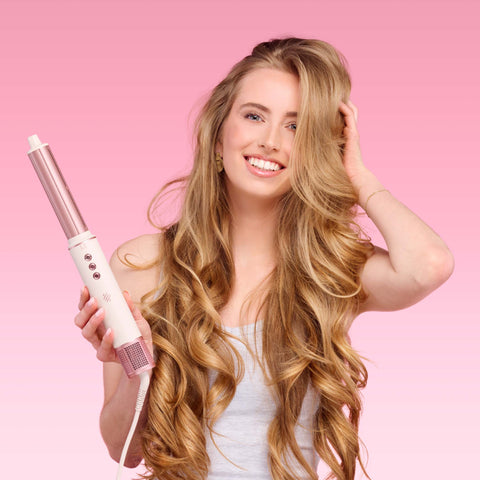
What does still hold: the more evenly the heat is spread, the less you have to redo. That is why the Airstyler Pro Ceramiq has fully ceramic-coated barrels, not a thin layer of spray coating that develops cold and hot spots after a few months. In practice, even heat means: wrap once, let it cool, done.
And the biggest gain sits in the order of your routine. An airstyler works on towel-dried hair, so you dry and shape in the same movement instead of blow-drying first and then going back through the same sections with an iron. That saves you an entire round of heat.
Frequently asked questions
How many times can I go over the same section?
Aim for one pass and accept two at most. If you structurally need three or four, your section is too thick, your hair is still damp, or your temperature is too low for your hair type.
Is 150°C always safe?
On completely dry hair, 150°C is a mild setting. On damp hair it is not: around that temperature, keratin already starts to denature in the presence of water. So dryness decides whether a setting is "low", not the number on your display.
Should I let my hair cool down between two passes?
For limiting damage it helps little, because your hair heats right back up within seconds. For holding your curl or your smooth finish, cooling helps enormously. So always let the section go cold before you release or touch it.
Which temperature is sensible for coloured or bleached hair?
Start at 140°C and go up in steps of 10 degrees until one pass is enough. Coloured and bleached hair is already more porous, so it heats up faster and has less margin. Preferably stay below 180°C.
Does an airstyler damage less than a straightener?
Usually yes, because warm air transfers less heat than plates pressing straight against your hair, so you work at a lower peak temperature. Using it wrongly is still damaging: sections that are too thick and staying too long in one spot are no good with air either.
Fewer passes starts with a tool that is equally warm everywhere: the Airstyler Pro Ceramiq dries and shapes in one movement, with fully ceramic-coated barrels and no cold spots.
- 2-year warranty and 30 days money back, so you simply test it at home
- Trustpilot 4.7/5 ("Excellent") from 400+ reviews, 10,000+ customers
- Works on all hair types, 1A through to 4C
- Free shipping in NL, BE and DE. Order before 23:59 and it arrives tomorrow
In our own customer survey among 214 users (30 days of use), 87% said they noticed less hair damage straight away. This is research among our own customers, not independent research.
View the Airstyler Pro CeramiqWritten by Anne Leensen, Ace & Taylor


