



Last updated: 7 October 2026 | Written by Anne Leensen, Ace & Taylor
Hold your hairdryer about 15 centimetres from your hair and keep it moving. In laboratory measurements, the air at 15 cm was around 47 °C, at 10 cm already 61 °C and at 5 cm a scorching 95 °C. So your distance is your real temperature dial, even more than the setting you press.
In short
- 15 centimetres of distance, dryer constantly moving: that is the safest standard distance.
- Measured air temperatures in a study in Annals of Dermatology (2011): 15 cm = 47 °C, 10 cm = 61 °C, 5 cm = 95 °C.
- In that same test, damage to the hair surface increased as the temperature rose. Only at 95 °C was the outer cuticle layer clearly broken.
- With a narrow concentrator nozzle, the air stays hot and fast for longer. In that case keep a bit more distance or turn the heat down.
- Closer is faster, though: in the test a section was dry in 15 seconds at 5 cm and in 60 seconds at 15 cm. You trade time for heat.
That 15 cm only works as long as your dryer is loose in your hand. Further down you will read what to do when your brush or curling barrel is actually resting against your hair, because then keeping your distance is impossible by definition.
Why does that 15 centimetres keep coming up everywhere?
Because the number comes from one specific study. Researchers from the dermatology department at Yonsei University (South Korea) published a test in Annals of Dermatology in 2011 in which they washed and dried hair sections 30 times, each time in a different way.
They used five groups: untreated hair, air drying at room temperature (20 °C, roughly 2 hours), blow drying at 15 cm distance (47 °C, 60 seconds), at 10 cm (61 °C, 30 seconds) and at 5 cm (95 °C, 15 seconds). The dryer was moved back and forth throughout. Afterwards they used electron microscopy to look at the hair surface, the cuticle layer, the cortex and the lipid layers between the cells.
The result: the higher the temperature, the more surface damage. In none of the groups was the cortex (the core of your hair) damaged. Strikingly, the group that air dried showed damage to the cell membrane complex, the layer of lipids that glues your hair cells together. The researchers concluded that blow drying at 15 cm with constant movement caused less damage than letting hair dry on its own.
An honest side note: this is one study, with one hairdryer, on loose hair sections in a lab. Your dryer may blow hotter or cooler at 15 cm than the researchers' did. So see 15 cm as a sensible starting point, not as a law of nature.
What exactly happens when you move closer?
The air gets hot very quickly, because hot air mixes with the cooler air in your bathroom along the way. The shorter that journey, the less mixing happens. Between 15 and 5 centimetres there was almost a 50-degree difference in the test.
Source: Lee et al., Hair Shaft Damage from Heat and Drying Time of Hair Dryer, Annals of Dermatology 23(4), 2011. View the study.
But isn't closer simply quicker?
True, and that is exactly the trap. At 5 cm a section dried four times as fast as at 15 cm. So you save time, but your hair spends that time at 95 °C instead of 47 °C.
As long as your hair is genuinely wet, the water evaporates and cools your hair fibre a little. Annoyingly, you cannot feel the moment that protection disappears. The second a section is dry and you keep blasting it for a few more seconds, the temperature of the hair itself climbs fast. That is the moment when distance matters most, not at the start.
In practice: start at a higher speed and a generous distance to blow out most of the water, and only move closer and work more slowly once you start shaping. And stop at "just dry", not at "definitely dry".
Does that 15 cm also apply with a nozzle attached?
No, with a narrow concentrator nozzle you want a bit more distance rather than less. A nozzle forces the air into a narrow, fast jet. As a result, that jet mixes with the cooler room air much later and stays hot and powerful even a few extra centimetres out.
That is also exactly why a nozzle works so beautifully for a sleek finish: you direct the air one way, from root to tip, so the cuticle scales lie flatter. But the same nozzle is less forgiving if you accidentally get too close or linger too long in one spot.
Rule of thumb per attachment:
- Narrow concentrator nozzle: 15 cm or slightly more, always moving, air following the length of the hair.
- Wide nozzle or no attachment: 15 cm is fine, the air spreads out by itself.
- Diffuser: you can go closer, see below.
How do you judge 15 centimetres without a ruler?
Use something you always have on you: most smartphones are roughly 15 cm tall when held upright, and a spread adult hand from thumb to little finger is about 18 to 20 cm. Measure it once and after that it will come naturally.
How to blow dry at the right distance, step by step
- First squeeze the water out of your hair with a towel or old T-shirt. Less water means less drying time.
- Spray heat protectant evenly through the lengths and comb it through, so every section gets some.
- Hold the dryer next to your phone once to get a feel for how far 15 cm is. Keep that distance while rough drying.
- Rough dry first on a medium heat setting and high airflow, while moving the dryer continuously. Never stay in the same spot for more than a few seconds.
- Once your hair is about 80 percent dry, that is when you start shaping with a nozzle or brush, section by section.
- Finish each section with the cool shot and let your hair cool down completely before you tie it up or brush it.
What do you do when you work with a round brush or airstyler?
Then the distance is zero, and that is not a mistake: that is how it is supposed to be. You are simply switching dials. Instead of distance, you manage heat setting, contact time, section thickness and movement.
With a dryer and round brush the hot air comes from the outside, but your hair lies tightly around a surface that heats up too. With an airstyler your hair is wrapped around the barrel by the airflow rather than pressed between surfaces. The difference then mainly comes down to how evenly that barrel distributes the heat. A spot that is much hotter than the rest (a hotspot) is the biggest risk at zero centimetres distance.
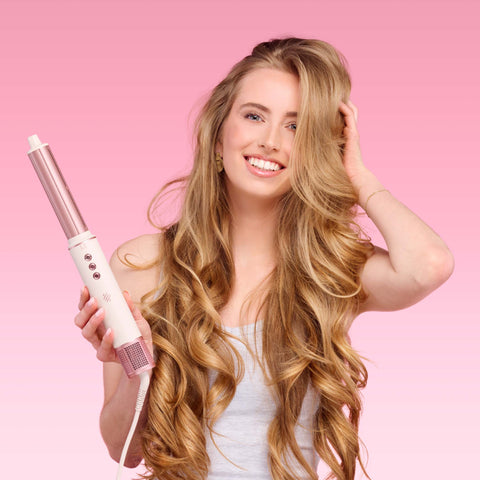
That is why material matters more here than with a standalone dryer. The barrels of the Airstyler Pro Ceramiq™ are fully ceramic coated, not just finished with a thin layer of spray. Ceramic distributes heat more evenly across the entire surface, so one section does not get much hotter in one place than another.
Three rules when you work with contact:
- Work with thin sections. A thick section forces you to stay longer, and staying longer is exactly what you want to avoid.
- Keep gliding. A brush or barrel that sits still on one point keeps heating that point up further.
- Choose a lower setting than you are used to and only go up if the result really will not hold.
Does it really matter that you keep the dryer moving?
Yes, and it was part of the research too: the dryer moved constantly there. A stationary airflow keeps stacking heat onto the same few square centimetres, and then the setting on your dryer says nothing about what that one spot is enduring.
For your scalp that counts double. Burn research shows that skin damage starts at around 44 °C in the lower layer of the epidermis, and that the time needed for it shrinks incredibly fast as the temperature rises. The air at 5 centimetres was 95 °C in the hair study. So hovering in one spot near your parting is not just a hair problem, it is also a reason for a sensitive, itchy scalp.
And what if you use a diffuser?
With a diffuser you can go closer, because the attachment actually slows the airflow down and spreads it over a large surface. That is what it was made for: the air does not push your curls apart.
Still, two things remain true. Set the heat to a medium setting rather than the highest, and do not let the diffuser rest on the same bunch of hair for minutes on end. Lift a section into the bowl, let it dry there, then move on. Finish with cool air so the curl sets before you let it go.
Is a more powerful hairdryer more dangerous, then?
Not automatically. Wattage says something about how much energy the device uses, not directly about how hot the air on your hair is. A modern high-speed dryer gets its speed mainly from airflow, not from extra degrees.
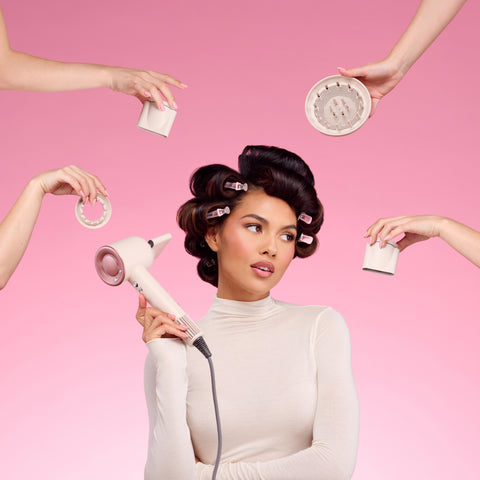
That is also the whole trick behind drying faster with less heat: more moving air carries water vapour away more quickly, which means you need less drying time. The PrecisionAir™ hairdryer works on that principle, with a 1400W high-speed BLDC motor and three heat and three speed settings that you set independently. That way you can run on a lower heat setting without blow drying endlessly.
Want to know for sure how hot your dryer blows? Hold your forearm in the airflow at 15 cm for a few seconds. If it feels unpleasantly hot, it feels that way for your scalp too.
If keeping your distance is your biggest form of protection, it helps enormously if your dryer is fast enough to let you maintain that distance: the PrecisionAir™ hairdryer combines a high-speed BLDC motor with separate heat and speed settings, so you can style lower without taking longer.
✓ 2-year warranty ✓ 30-day money-back guarantee ✓ Free shipping in NL, BE and DE ✓ Trustpilot 4.8/5 ("Excellent")
Frequently asked questions
Do I need to keep 15 cm distance on the cool setting too?
On the cool setting heat is no longer an issue, so you can move closer. Do keep in mind that a strong airflow from very close up makes your hairs rub against each other, which causes frizz. A hand's width of distance is more pleasant with cool air as well.
How far should the hairdryer be from my scalp?
At least the same 15 cm, and preferably a bit more near your parting. Your scalp cannot tell you it is getting too warm until it already hurts, and skin damage starts at around 44 °C. Keep the dryer moving continuously and aim the air along your scalp instead of straight at it.
Can I go closer while my hair is still soaking wet?
A little, because the evaporating water still cools your hair. The risk is that you will not notice when a section is dry, and then the temperature of the hair itself shoots up. It is safer to keep the distance the same and turn up the airflow instead.
Does 15 cm also apply to a round brush or airstyler?
No, with those your hair deliberately rests against the surface. With these tools you manage heat setting, thin sections, constant movement and never pausing in one spot. An evenly heated, fully ceramic coated barrel helps with that, because then you do not get localised hotspots.
So is blow drying at 15 cm better than letting my hair air dry?
According to the study in Annals of Dermatology, yes: blow drying at 15 cm with movement caused less damage than air drying, because staying wet for a long time harms the lipid layers between your hair cells. It is one study on hair sections, so see it as reassurance rather than an instruction to always blow dry.
How do I know if I am too close to my hair?
Watch for three signals: your scalp gets uncomfortably warm, you smell a faintly burnt scent, or your hair feels rough and dry on the outside of your head after drying. Those are all signs that you need more distance or a lower setting.
Written by Anne Leensen for Ace & Taylor. Questions about your own blow drying routine? Our customer service team is happy to help.


