


Last updated: 9 October 2026 | Reading time: about 8 minutes
Blow-drying is fine straight after colouring: your hairdresser does exactly that as soon as the colour is rinsed out. But do try to wait 48 to 72 hours before using hot contact heat, that is, a straightener or curling iron. That is precisely the window in which you are better off not washing your hair either. After that, the temperature matters more than the waiting time, especially after bleaching.
In short
- Warm air (a hairdryer or airstyler) is fine right away. The air that touches your hair is dozens of degrees cooler than the plates of a straightener.
- Hot contact heat above roughly 170 degrees is best postponed for 48 to 72 hours. That timeframe comes from salon practice, not from hard research.
- In laboratory research, hair turned measurably darker after 2 minutes on a hot plate at 172 degrees, while an hour of warm hairdryer air at around 60 degrees barely changed the colour (Nogueira et al., Journal of Cosmetic Science, 2004).
- Colouring and bleaching damage the lipid layer on the outside of your hair. As a result, your hair absorbs more water, dries more slowly and is more vulnerable to heat.
- Wet or damp hair tolerates far less heat than dry hair: in water, the keratin structure already starts to change at around 130 to 150 degrees.
Further on you will find, per colour treatment, how many days to wait and which maximum temperature is still sensible, plus why the type of tool you use often matters more than the number of days you manage to be patient.
Can you blow-dry your hair straight after colouring?
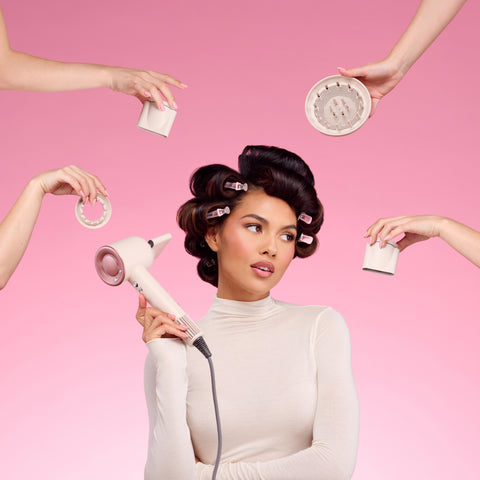
Yes. Blow-drying is fine immediately after colouring, and it happens in every salon as a matter of course. Your hair is wet at that point, and under a hairdryer wet hair stays around the evaporation temperature of water. The air is warm, but your hair fibre itself does not get as hot as it does between two scorching plates.
The difference between air heat and contact heat is bigger than most people think. In a study on heat-induced colour changes, hair was placed on a hot plate at 172 degrees for two minutes. That caused clear, measurable discolouration. Hair exposed for an hour to the much milder air of a handheld dryer (around 60 degrees) showed a colour difference that fell within the margin of error (Nogueira et al., Journal of Cosmetic Science, 2004).
In short: your hairdryer is not the problem. Your straightener, your curling iron and the highest setting on your tool are.
Why does everyone say "wait 48 to 72 hours"?
That timeframe comes from the advice not to wash your hair for two to three days after colouring. There is no study pinpointing exactly 72 hours as a magic cut-off. So be honestly sceptical when a website acts as though this is scientifically settled.
What is true about the thinking behind it:
- With permanent colour, your hair is swollen open with an alkaline agent (often ammonia) so the dye can get inside. Your cuticle scales stay temporarily more open than usual afterwards.
- The first few washes rinse away most of the loose colour particles. The later that first wash, the more pigment stays put.
- So in those first days, your hair is both at its most vulnerable and at its leakiest in terms of colour. Adding 200 degrees on top of that is simply the worst possible timing.
So think of those 48 to 72 hours not as a medical rule, but as a smart pause. You lose nothing by it, and it coincides with the period in which you are not washing anyway.
Does heat styling really make your colour fade faster?
Yes, heat speeds up colour loss and can shift the tone too. It is not just a matter of rinsing out: heat breaks down colour particles and the natural pigments in your hair.
In that same Journal of Cosmetic Science study, the researchers saw heat increase yellow tones in white and in bleached hair. That explains something a lot of blondes recognise: your toner is gone within two weeks and your hair pulls yellow, even though you are looking after it "properly". Every pass with a hot iron adds up.
Reds, coppers and pastels are the most sensitive. Those consist largely of direct pigments that are not locked deep into the hair shaft but sit more on the outside. Fewer passes and a lower temperature visibly buy you weeks of colour here.
Why is coloured hair more sensitive to heat than untreated hair?
Because colouring and bleaching damage the water-repellent lipid layer on the outside of your hair. As a result, your hair absorbs more water, dries more slowly and gets damaged faster at the same temperature.
On the outside of every hair sits a thin layer of lipids, of which 18-MEA is the most important component. That layer makes your hair smooth and water-repellent. Permanent colouring and bleaching partly break it down. The result: more friction, more tangling, and hair that attracts water instead of repelling it.
And that water is exactly the problem when heat comes in. Dry hair can take quite a lot: the keratin structure stays largely intact well above 200 degrees. But as soon as there is water in the fibre, that threshold drops enormously. In research where hair is heated in water, the turning point already occurs at around 130 to 150 degrees. Coloured hair holds on to moisture for longer, so you find yourself in that vulnerable situation more often than you realise.
A recent structural study backs this up for the combination of chemistry and heat too: bleached and chemically straightened hairs changed noticeably more under heating than untreated hair, precisely because key components at the surface had disappeared (Lima et al., Biopolymers, 2025).
Practical rule of thumb: as long as your hair still feels cool or damp, it is not dry. Only then do you bring in contact heat. A section that is still slightly damp gets a steam treatment inside the clamp instead of a styling.
How long to wait per colour treatment, and at what temperature?
The more your hair has been opened up and stripped of pigment, the longer you wait and the lower you keep your temperature. Below is a workable guideline. The temperatures are maximums for healthy-looking hair, not a target to aim for.
Did you also have a keratin or acid treatment shortly before? Then always follow your hairdresser's advice: those treatments have their own rules around washing and heat.
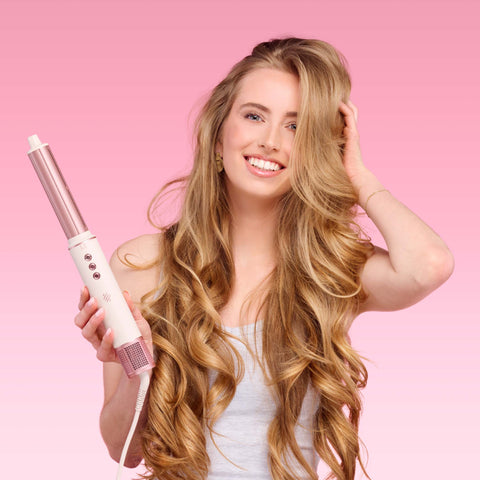
This is exactly where styling with air instead of plates pays off. With an airstyler, the airflow shapes the curl or the blow-out, while the temperature stays lower than with an iron that clamps your hair between two hot surfaces. The Airstyler Pro Ceramiq™ works with fully ceramic-coated curling attachments, not a thin sprayed-on layer, so the heat is spread evenly along the section instead of concentrating in hot spots. For freshly coloured or bleached hair, that difference really matters: it is not the peak temperature of one hot spot that determines your damage, but the average across the whole section.
Step-by-step: how to style during the first week after colouring
The goal in those first days is simple: as little heat per section as possible, and never heat on damp hair.
- Day 0, straight after colouring: go ahead and blow-dry. Keep the dryer moving and aim the airflow from root to tip, so your cuticle scales stay flat.
- Use heat protectant, with your hairdryer too. Distribute it through towel-dried hair and comb it through, so every section is covered and not just the top layer.
- Wait until day 3 to wash. This is the single measure that does the most for your colour. Do you really have to wash sooner? Use lukewarm water.
- Days 1 and 2: choose air styling. A blow-out with a brush and warm air, or an airstyler. No clamping irons.
- Day 3 and beyond: set the temperature lower than you are used to. Start at the bottom of the table above and only go higher if the result genuinely will not hold.
- Work with thin sections and a single pass. Three passes over a thick section is more heat than one pass over a thin one, even if it feels counterintuitive.
- Let your curl or wave cool down completely before you comb it out. Hair takes on its new shape as it cools, not while it heats up. That way you need less heat for the same result.
What if you cannot wait 48 hours?
Then style with air instead of plates, and bring the temperature down. A wedding or a party the evening after your salon visit is not a disaster. The combination you mainly want to avoid is high contact heat on hair that is not completely dry.
A workable compromise for an evening like that: blow-dry completely, use heat protectant, style with warm air and, if needed, briefly touch up only the few visible sections around your face with an iron on the lowest setting that works. That is a handful of sections getting heat instead of your whole head.
How do you know if you styled too soon or too hot?
You usually notice it in your colour within a week and in your ends within two weeks. Watch for these signs:
- Your colour goes dull faster or pulls yellower than normal, especially through the lengths and ends.
- Your hair feels dry and rough right after washing, while it feels limp and stretchy when wet.
- You see more frizz and little broken hairs in the top layer.
- The ends tangle faster than they did before your colour appointment.
Is this happening? Then go back to air styling only and lower temperatures for a few weeks. Heat damage eventually grows out, but a damaged hair fibre does not repair itself.
Frequently asked questions
Can I straighten my hair the day after colouring it?
Preferably not with a straightener. Your hair is still at its most swollen and your colour is still loose. Blow-drying or styling with warm air is perfectly fine, with heat protectant.
Will my colour fade faster if I blow-dry every day?
Daily blow-drying on a moderate setting costs far less colour than weekly straightening at 200 degrees. What costs your colour the most are washes with hot water and high contact heat. Blow-dry on a medium setting and finish on cool.
How long should I wait before using heat after bleaching or highlights?
Count on 72 hours for contact heat, and with fully lightened hair preferably a week. Bleaching breaks disulphide bonds in your hair and strips the lipid layer from the outside, so your hair takes more of a beating at the same temperature.
Is an airstyler safer for coloured hair than a straightener?
As a rule, yes, because you shape with airflow instead of two hot plates enclosing your hair. The temperature reaching your hair is lower and there is no pressure on the fibre. Do keep using heat protectant.
Should I use heat protectant on freshly coloured hair?
Yes, and even more consistently than usual during that first week. A heat protectant distributes the warmth and slows moisture loss. Many formulas also contain filters that limit colour loss. Apply it to towel-dried hair and comb it through thoroughly.
Can I let my hair air-dry after colouring instead of blow-drying?
You can, but it is not automatically better. Hair that stays wet for hours swells for longer and is more vulnerable to friction the whole time. A combination often works best: let it air-dry to about 70 percent and finish the rest with warm air.
Styling freshly coloured hair without wrecking your colour
If you still want some shape in your hair in those first days after your colour appointment, styling with warm air instead of hot plates is the safest route: the Airstyler Pro Ceramiq™ shapes your curl or blow-out with airflow and fully ceramic-coated curling attachments, so the heat is spread evenly along the section.
2-year warranty 30-day money-back guarantee Trustpilot 4.8/5 Works on hair types 1A to 4C
View the Airstyler Pro Ceramiq™
In our own customer survey among 214 users (30 days of use), 87 percent reported experiencing less hair damage straight away. This is research among our own customers, not independent research.
Written by Anne Leensen, Ace & Taylor
Sources: Nogueira et al., "Hair color changes caused by dyeing and thermal treatments", Journal of Cosmetic Science 55(5), 2004. Lima et al., "Thermal Induced Changes in Cuticle and Cortex to Chemically Treated Hair", Biopolymers, 2025.


