





Last updated: 15 September 2026
Heat damage doesn't heal. Your hair is dead keratin, so damaged sections can't repair themselves. The only real solution is growing it out and cutting it off. Hair grows an average of 1 to 1.25 cm per month. So every 5 cm of damaged length that has to go takes roughly 4 to 5 months of new growth.
QUICK ANSWER
- Healthy scalp hair grows about 0.35 mm per day, so around 1 to 1.25 cm per month and 12 to 15 cm per year (StatPearls, NIH).
- Want to keep your length? Then count on roughly one month per centimetre of damaged hair that needs to go.
- Just the damaged ends (2 to 3 cm): 2 to 3 months. Bottom 10 cm: 8 to 10 months. Fully damaged mid-length hair of 30 cm: 2 to 2.5 years.
- Masks, protein treatments and bond builders make hair temporarily stronger, smoother and easier to comb, but they don't rebuild denatured keratin and they don't permanently seal a split end shut.
- Split ends keep tearing further up if you leave them. Cutting is the only permanent solution, and The Trichological Society says the same.
Further down you'll read which temperature and technique prevent new damage while you grow things out, and what to look for in a styling tool if you still want to do your hair every week during that period.
Why does heat damage only grow out instead of healing?
Because the part of your hair you can see isn't living tissue. Only the hair root in your scalp is alive. The moment the hair fibre leaves your scalp, it's keratinised protein with no blood supply and no cells that can repair anything.
With heat, two things happen. The water inside the fibre evaporates and expands, and the protein structure changes at high temperatures. In laboratory measurements (DSC), the alpha helix in keratin denatures at a peak between roughly 210 and 250 degrees in dry hair. Important detail: that denaturation temperature drops when there's more water in the fibre, because water acts as a plasticiser. So taking a hot plate to damp hair is riskier than doing the same on dry hair.
On top of that, the outer layer wears away. The cuticle consists of roof-tile-like scales about 0.5 micrometres high, with around 5 to 6 layers stacked on top of each other in healthy hair. With an average hair thickness of 70 micrometres, that's about 8 percent of the cross-section. Once that layer has worn away, the core (the cortex) is exposed and the fibre starts to fray.
The Trichological Society describes split ends (trichoptilosis) as damage caused by, among other things, heat tools and chemical treatments, and states that this damage cannot be repaired. What can be done: new hair growing in is healthy, provided you adjust your routine.
And those popular bond builders? Dermatology Times puts it honestly: these products cannot fully restore the strength of virgin, untreated hair. Much of what they do comes down to a lower pH, less cuticle swelling, a smoother surface and therefore less friction and breakage when combing. That's a genuine win for how your hair feels and how quickly it breaks further. It is not a repair of the damage that's already there.
Exactly how fast does your hair grow?
An average of 0.35 mm per day, so a little over 1 cm per month and 12 to 15 cm per year. That's the number you can use to calculate your entire grow-out time.
A few facts that go with it:
- At any given moment, roughly 85 to 90 percent of your follicles are in the growth phase (anagen). For scalp hair, that phase lasts 2 to 6 years.
- Which means your ends are old. At 40 cm of length, the hair at your ends has been on your head for about 2.5 to 3 years. Every blow-dry, every straightener session, every hair tie and all that sun from those years is still in there.
- Speed differs per person and changes with age, health and season. You can't dramatically crank up your growth rate with food or shampoo. So work with 1 to 1.25 cm per month, not with a miracle plan.
This also explains why you notice so little difference with long hair. If 1.25 cm grows in per month on 50 cm of length, that's 2.5 percent of your length. Invisible. But over twelve months it's 15 cm of new, healthy hair.
How long will growing it out take in my case?
Look at how many centimetres of damaged hair need to go and divide that by your monthly growth. If you want to keep your current length, you need a centimetre of new growth for every centimetre you cut off.
Calculation based on an average growth of 0.35 mm per day. These timings apply if you want to keep your current length. Cut shorter and you'll be done sooner.
The short version of the sum: number of centimetres that need to go, divided by 1.1 = number of months. That's the honest timeline. No product shortens it, only a pair of scissors does.
Should I cut it all off at once or grow it out slowly?
That depends on how deep the damage goes. If only your ends are frayed, growing it out slowly works just fine. If your hair snaps along the whole length and keeps breaking at the same height, a big cut is faster and a lot less frustrating.
Here's how to tackle it step by step:
- Work out where the damage starts. On dry hair, take a section and slide your fingers down from your scalp. Where it feels smooth and where it turns rough or frizzy is your line. Measure that distance to your ends in centimetres.
- Choose your goal. Want to keep length? Use the table above. Want to be rid of the damage within a few months? Then cut past that line in one go.
- Cut along with your growth. Take off 1 to 2 cm every 8 to 12 weeks. You grow about 3 cm in 12 weeks, so you gain net length while removing damage at the same time.
- Pick out stray split ends in between. They tear further up the shaft. A smoothing serum hides a split temporarily, but it doesn't stop it.
- Lower your heat load starting today. Otherwise the damage line moves up with you and you'll be cutting forever.
- Take photos under the same light, every 4 weeks. Growing out takes months. You won't see it in the mirror, but you will in your photos.
How do I know it's really heat damage and not just dry hair?
Dry hair is mainly missing moisture and improves within a single wash with a good conditioner or mask. Heat damage is structural: the fibre is damaged and doesn't respond lastingly to care products.
Signs that point to real damage:
- White dots or little knots along the length of a hair. This fits trichorrhexis nodosa: weak nodules in the hair shaft where the hair snaps easily. In the medical literature this is linked to heat, excessive brushing and styling, among other things.
- Ends that fray like an old rope. Classic split ends.
- Short, broken hairs sticking out everywhere, often around the same height (shoulder or jacket-collar height).
- Sections that feel limp and stretchy when wet and then dry frizzy.
- Curly hair with limp or dead-straight sections that no longer spring back after washing and gel, while the roots still curl.
Quick test: wash one section with conditioner only and let it air dry with no products. Does it feel smooth and bouncy afterwards? Then it was mostly dryness. Does it stay rough, frizzy and shapeless? Then the damage is in the fibre and it has to grow out.
What actually helps while you're growing it out?
Everything that prevents new damage and keeps your hair from breaking as quickly in the meantime. You can't polish away the old damage, but you can prevent creating another 12 cm of newly damaged hair over the next twelve months.
What does make a difference:
- Fewer heat sessions per week. Two styling days instead of five simply halves your load.
- The lowest temperature that still works. Test the lowest setting on one section and only go higher if it genuinely won't hold.
- One pass per section instead of three. Every extra pass counts, even on a low setting.
- Never a hot plate on damp hair. Water in the fibre lowers the temperature at which keratin changes, and evaporating water causes bubbles and bumps in the shaft. Unless your tool is specifically made for wet-to-dry use.
- Heat protectant on every section, even if you're only blow-drying.
- Less friction. Comb with a wide-tooth comb working up from the ends, use a satin pillowcase and don't tie your hair up tightly with thin elastics.
- Care products with realistic expectations. Protein and bond-builder treatments make your hair stronger and smoother to work with. Think of them as a bandage, not a cure.
And the tool itself makes a difference in how the heat reaches your hair. A straightener or curling iron transfers heat through direct contact with a hot surface, right on that spot. With an airstyler, a warm airflow does the work and the heat is spread over the whole section as it wraps around the barrel. That's why airstyling works at lower temperatures than the settings many women use on their straightener.
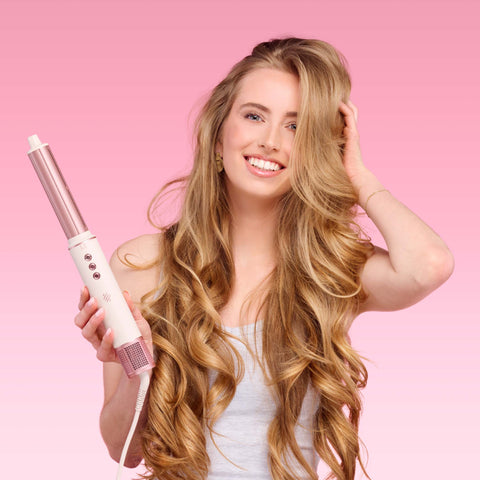
On the Ace & Taylor Airstyler Pro Ceramiq\u2122 the barrels are fully ceramic-coated, so no thin sprayed-on layer that flakes off after a few months and leaves rough patches for your hair to slide across. You choose the temperature setting yourself, and the tool is designed for all hair types from 1A to 4C. During a grow-out phase that's exactly what you need: being able to keep styling, without putting your ends through it all over again every week.
Can you prevent heat damage completely without giving up styling?
Nobody can prevent it completely, because every form of heat, friction and sun asks something of your hair. But the difference between "my ends are wrecked after a year" and "my ends are still fine after a year" mostly comes down to temperature, number of passes and how dry your hair is when the heat hits it.
In practical terms: blow-drying on a medium setting with a nozzle and then shaping once on a low setting puts far less strain on your hair than flattening wet hair straight away with a hot plate. That's not marketing talk, it follows from how keratin and water behave under heat.
Frequently asked questions
Does heat damage grow out faster if I cut more often?
No, cutting doesn't change your growth rate. That's determined at the hair root in your scalp. What regular trims do is remove the damaged centimetres faster, and stop split ends from tearing further up.
Can a hairdresser repair heat damage?
A salon treatment can temporarily make your hair much smoother, stronger and shinier by sealing the cuticle and reducing friction. That effect fades after a few washes. There's no structural repair of damaged keratin or a split end: only cutting truly removes it.
How often should I trim while growing it out?
Every 8 to 12 weeks, taking off 1 to 2 cm, works well for most women. In that time about 2.5 to 3.5 cm grows in, so you keep net length while the damage goes. If your hair breaks a lot, trim slightly more often and take off a bit less each time.
Do I have to stop styling completely until the damage is gone?
You don't. Styling less often, a lower temperature, one pass per section and always using heat protectant do most of the work. Stopping completely gets you there faster, but almost nobody can keep that up, and a routine you actually stick to is better for your hair in the end.
Will my curl pattern come back once the heat damage has grown out?
The new hair growing in has your own curl pattern, so yes: it comes back. Sections that have been permanently stretched out by heat and stay straight won't spring back. Those really do have to grow out and be cut off.
Is heat damage the same as dry hair?
No. Dry hair lacks moisture and usually perks up with one good mask or a conditioner with more nourishing oil. With heat damage, the structure of the fibre itself is compromised and the effect of care products is short-lived. Dryness you can fix, damage you can only hide until you cut it off.
Keep styling during your grow-out phase, but with warm air and a fully ceramic-coated barrel instead of a hot plate on your ends: that's exactly what the Airstyler Pro Ceramiq\u2122 was made for.
- 2-year warranty and a 30-day money-back guarantee, so you can try it out at home
- Trustpilot 4.7/5 ("Excellent") from 400+ reviews, 10,000+ customers
- Free shipping in NL, BE and DE. Order before 23:59 and it arrives tomorrow
- In our own customer survey (214 users, 30 days of use, so not independent research) 87% reported experiencing less hair damage straight away
Written by Anne Leensen, Ace & Taylor
Sources referenced in this article: StatPearls (NIH) on hair growth and the hair growth cycle, The Trichological Society on trichoptilosis, Medscape and PubMed Central on trichorrhexis nodosa, Dermatology Times on bond-builder treatments, and research into the thermal denaturation of keratin (DSC).


