




Last updated: 20 August 2026
Split ends show that the ends of your hair have been through more than the rest. They are also called dead ends, all names for the same thing: a hair that has split open at the tip. The honest answer to the question you probably have: a split end will not close back up, and cutting it off is the only way to remove it. Most of the gains, then, are in preventing the next one from forming. Below you will find what causes them, what the location of the split gives away and which adjustments make a difference.
In short
- A split end will not close back up. Cutting, just above the split, is the only way to remove it.
- Products like oil, conditioner and masks conceal and slow things down. They do not repair an existing split, no matter what the packaging says.
- The location of the split gives away the cause: only the last few centimetres is normal wear, higher up the lengths points to mechanical or chemical strain.
- With heat, things mainly go wrong on wet hair and with many passes over the same strand. A heat protectant spreads the heat and keeps the moisture inside the hair from boiling.
- Hair grows about one centimetre per month. Periodically having slightly less taken off than has grown back keeps the ends healthy while your hair gets longer.
Contents
- What are split ends?
- How to spot them, and what the location tells you
- Can split ends be repaired?
- What causes split ends?
- Heat and split ends: where exactly it goes wrong
- Trimming your ends: how often, and can you do it yourself?
- What products do and do not do
- What to do if you have split ends right now
- Frequently asked questions
What are split ends?
Split ends are hairs that have split open into two or more pieces at the tip. Every hair has a protective outer layer of scales that overlap like roof tiles. If that layer wears away at the tip, the softer inside is exposed and the hair frays. That is how a split end forms.
Dry, frizzy ends are often not a separate complaint but the early stage. A tip that feels rough and no longer reflects light smoothly has already lost part of that outer layer. Splitting is then only a matter of time.
A split end can look different from case to case: a hair that splits into two branches, a tip that frays into several branches, a small knot where the hair has twisted around itself, or a white dot at the very end. That last one is often the first signal, even before there is a visible split.
How to spot them, and what the location tells you
Take a strand about a centimetre thick, twist it loosely around your finger and hold it up to the light. The little hairs sticking out at the sides are the split and broken ends. The more of them stick out and the higher up the strand they sit, the further the damage has progressed.
The location of the split then tells you where to look. That is more useful than a general list of causes, because it lets you check your own routine against it.
- Only the last few centimetres. Normal wear, plus a trim that has been put off for too long. Your ends are the oldest piece of hair you have.
- Halfway up the lengths too. Then more is going on than age. Damage along the whole length points to mechanical strain, such as brushing wet hair, or to chemical treatments.
- Mainly on one side or at one height. Look for friction that always lands in the same spot: the strap of your bag, the collar of your coat, or the side where your parting sits.
- Clearly more after a styling session. Then it starts with your heat routine, and that is where the biggest gains are.
How quickly you run into them also depends on your hair type. Porous hair, hair that absorbs moisture quickly and loses it just as quickly, splits sooner than hair with a smooth outer layer. Bleaching, colouring and a lot of heat make hair more porous, which reinforces the problem.
Can split ends be repaired?
No. A split end does not grow back together. Cutting is the only way to remove it, above the split. The Cleveland Clinic compares it to a run in a pair of tights: it keeps travelling along the hair and you have to cut it off.
That does not mean products are useless. A good conditioner, oil or leave-in temporarily lays a coating around the hair, so the tip looks smoother, feels softer and splits further less quickly. That is concealing and slowing down, and that is useful. It just is not repair. If a bottle says "repair", that is about the appearance and about protecting what is still intact.
If you leave a split in place, the tear can continue further up the hair. The longer you wait, the more length eventually has to come off. So if you want to grow your hair out, trimming the ends is exactly what you should do.
What causes split ends?
Split ends almost never have a single cause. They are accumulated wear on the outer layer, and the ends take the biggest hit because they are the oldest piece of hair. The six factors that matter most in practice are heat when styling, friction in your daily routine, washing too often or too hot, chemical treatments, weather and water quality, and waiting too long between trims.
Heat when styling
Blow-drying, straightening and curling put the outer layer of your hair under pressure. The higher the temperature and the more often you work the same strand, the faster that layer wears down. This is where there is most to gain, so it gets its own section below.
Friction in your daily routine
Friction is the silent cause. Rubbing your hair dry with a towel, pulling a brush through wet hair, elastics with a metal clasp and sleeping with loose hair on a cotton pillowcase all add up. The American Academy of Dermatology advises detangling wet hair with a wide-tooth comb and not with a brush, because wet hair is more fragile than dry hair. Start at the bottom and then work your way up.
Washing too often or too hot
Washing too often dries out the lengths, and hot water does that faster than lukewarm water. Shampoo belongs on your scalp, not on your ends. Which formula suits your hair makes more difference here than the frequency, as we explain in our guide on which shampoo is good for your hair.
Chemical treatments
Bleaching, colouring and perming interfere with the structure of the hair and leave the outer layer more porous. That makes the hair more sensitive to everything that comes after, from heat to brushing. That is no reason to give them up, but it is a reason to make the rest of your routine gentler.
Weather, sun and water quality
Sun, wind, cold, chlorine and seawater dry out the lengths. The hardness of your tap water plays a part too: limescale and minerals stay behind on the hair and make the lengths rougher. That effect gets stronger when you then style with heat, as we explain in our article on why hard water is extra damaging for hair you style with heat.
Waiting too long between trims
At a length down to your shoulder blades, the tip is already a few years old and has been through every wash and styling session of those years. Without a trim, that wear only keeps building.
Heat and split ends: where exactly it goes wrong
"Avoid heat styling" is no help when you want your hair in shape in the morning. How you use heat matters more than whether you use heat, and that starts with water. If there is still moisture in the hair and the heat goes in hard in one spot, that water can start to boil and form small bubbles inside the hair itself. Those bubbles make the hair weak and brittle at exactly that spot. A review article on hair cosmetics in the International Journal of Trichology describes how a heat protectant with silicones spreads the heat across the surface of the hair, preventing exactly that boiling and those bubbles. A heat protectant is not a cosmetic step, then, but the layer that spreads the heat.
Four adjustments do the most in practice:
- Do not style soaking-wet hair. Blow-drying is fine on towel-dried hair, but a straightener or curling iron belongs on dry hair. The more water still in it, the bigger the chance of those bubbles.
- Pick the lowest setting that still does the job. The American Academy of Dermatology recommends a low or medium setting plus a product that protects your hair against the heat. Fine hair generally needs less than thick hair, so test downwards instead of starting on the highest setting.
- Keep your distance and keep moving. Blow-drying causes more surface damage than air drying, but in research cited by the review article above, blow-drying at about fifteen centimetres with continuous motion caused less damage than letting the hair air dry. Holding it still in one spot is what does the damage, not the dryer itself.
- One pass instead of five. Every extra pass over the same strand is an extra round of heat over the same ends. Working calmly with a tidy sectioning results in fewer passes than going back and forth quickly.
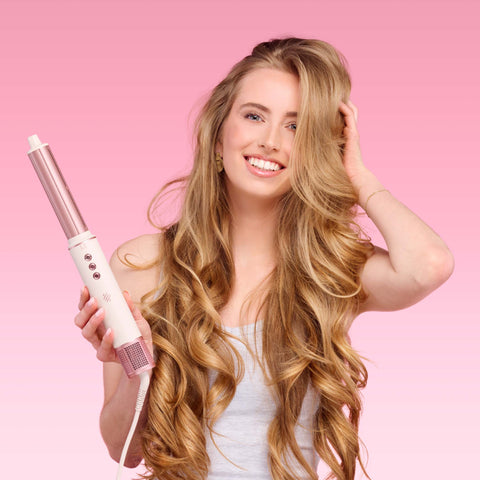
What you can look for in a tool is whether the temperature can be chosen in workable steps and whether the heat is delivered evenly. That is the thinking behind our Airstyler Pro Ceramiq: ceramic attachments and three air temperatures of 35, 70 and 110 degrees, so you do not have to start on the highest setting. The full range is in our styling tools.
Do not expect too much from that. A better tool does not remove a split end and does not make heat free; it makes it easier to work lower and more evenly, and that is the variable you control. How else to protect your hair while styling is in our article on protecting your hair against heat damage when styling.
Trimming your ends: how often, and can you do it yourself?
Cutting is the only route that actually removes a split end, and that is also exactly why a trim does not stand in the way of length. According to the Cleveland Clinic, hair grows an average of ten to fifteen centimetres per year, or about one centimetre per month.
So a workable rule of thumb is: periodically have slightly less taken off than has grown back. That keeps the ends healthy and you gain length overall. If you use a lot of heat or have your hair chemically treated, you will need to trim more often. A fixed interval in weeks says less than holding a strand up to the light and looking for yourself.
Trimming the very tips yourself is possible, within limits. Work on dry hair, in small sections, with sharp scissors you use only for hair. Kitchen scissors or nail scissors crush the hair instead of cutting through it, and with that you create exactly the new splitting point you wanted to remove. There are also small devices made especially for split ends; in practice, sharp scissors will get you there too. The honest limitation remains that you cannot see the back of your own head, so for a catch-up cut the hairdresser is faster and neater.
What products do and do not do
Products can do two things. They temporarily conceal an existing split end, and they slow down new ones forming. Repair is something they cannot do, no matter what the packaging says. With that expectation, the rest of the shelf is easier to judge.
- Shampoo. Does nothing against an existing split, but a mild formula dries out the lengths less than a harsh one. Massage it into your scalp and let the shampoo run over your lengths as you rinse.
- Conditioner and leave-in. Lower the friction, so you comb more easily and less damage is added while detangling. Which one suits your hair type is in our guide to the best conditioner for healthy styled hair.
- Hair oil. In research with hair tresses, treatment with oil reduced the formation of new split ends. Apply oil to the bottom half of your lengths, not to your scalp.
- Hair mask and protein treatment. A protein treatment temporarily tops up what the outer layer has lost, so the hair feels stronger and smoother. They do not undo an existing split: see them as maintenance, not as repair.
- Heat protectant. Of this list, this product acts most directly on the heat itself: a heat protectant with silicones spreads the heat across the surface of the hair, so the moisture inside the hair does not start to boil in one spot.
Ace & Taylor does not make shampoo, masks or oil itself. This is here because it belongs in the full answer, not because there is anything to sell.
What to do if you have split ends right now
If you have split ends right now, this order works best:
- Have the ends trimmed to above the split. This is the only step that removes existing damage.
- Tackle the cause that the location of the split pointed to. Without that step, the same pattern comes back.
- Lower the heat load. A lower setting, always a heat protectant, and fewer passes over the same strand.
- Lower the friction. Pat your hair dry, do not rub, detangle with a wide-tooth comb and choose a soft pillowcase and an elastic without a metal clasp.
The first step feels the least pleasant and delivers the most. The other three decide whether you are still dealing with this in six months.
Frequently asked questions
How can I remove split ends?
By cutting them off, just above the split. That is the only way the split truly disappears. Oils, masks and leave-ins make the tip smoother and slow down further splitting, but the split itself stays until it has been cut off.
How often should you have your ends trimmed?
Hair grows about one centimetre per month on average. Periodically having slightly less taken off than has grown back keeps your ends healthy while your hair gets longer. If you often style with heat, you will need to go more often than someone who lets their hair air dry.
What happens if you do not cut dead ends?
Then the split can continue further up the hair, so you will later have to remove more length than would be needed now. The hair also looks thinner and frizzier at the bottom, because the tips fray instead of tapering neatly.
Do you get split ends from blow-drying?
Heat contributes, but how you blow-dry determines how much. Keeping your distance, keeping the dryer moving, choosing a lower setting and using a heat protectant first limit the strain considerably. Blow-drying soaking-wet hair and holding the dryer still in one spot are the two habits that cause the most damage.
Does a hair mask help against split ends?
It helps against new ends forming, because the mask makes the hair more supple and lowers the friction. A mask does not repair an existing split end. That one you cut off, and after that the mask keeps the rest of your lengths in better shape.
Temperature you can choose in workable steps and heat that is delivered evenly: that is the thinking behind the Airstyler Pro Ceramiq, with ceramic attachments and three air temperatures of 35, 70 and 110 degrees.
2-year warranty
30-day money-back guarantee
Trustpilot 4.7/5
Free shipping NL/BE/DE
View the Airstyler Pro Ceramiq


