


Last updated: 14 September 2026
No, "heat training" isn't real training. Your hair is dead keratin and it doesn't learn to tolerate heat. What people call "trained" hair is almost always hair whose curl has dropped because the protein structure is damaged. That's permanent. What you can do is style at lower temperatures without losing your curl pattern.
TL;DR
- Your curl pattern is created in your hair follicle and held in place inside the hair fibre by sulphur bonds. Heat alone doesn't "train" any of that.
- A styled curl or sleek finish holds as long as the hydrogen bonds in your hair stay in that shape. Water, sweat or humid air undoes it again.
- In a study published in the Journal of Cosmetology & Trichology, curly hair was straightened 50 times. At 185 °C the curl pattern came back after re-wetting. At 220 °C it didn't come back for 37.5% of the hair.
- In keratin research, part of the ordered protein structure melts around 215 °C and sulphur bonds break around 230 to 250 °C. Those changes are irreversible.
- Damp hair is more vulnerable: in water, keratin loses its ordered sections as early as 140 to 150 °C.
Further down you'll find which temperature settings stay safe for curly hair in practice, and what to look for in a styling tool if you want to keep your curl.
What do people actually mean by heat training?
By heat training, people mean the idea that your curls "get used to" heat: you style your hair regularly with a straightener or curling iron, your curl loosens and smooths out, and that result sticks. It sounds logical, but it's a misreading of what you're seeing.
Your hair has no living cells left the moment it emerges from your scalp. So it can't adapt, can't get stronger and can't "learn" anything. What does happen: every time you use heat, you lose a little of the structure that keeps your curl tight. After months you see a looser pattern. That isn't training, it's accumulated damage you don't yet recognise as damage, because on the surface your hair often still looks smooth and shiny.
What you can influence is how much heat is needed for a result. By combing through properly beforehand, working in thin sections and letting everything cool completely, you get the same effect at a lower setting. That's technique, not training.
What happens inside your hair when you heat style it?
In short: heat and moisture break the weak bonds in your hair, after which they reform in a new shape as it cools. The strong bonds that determine your natural curl normally stay untouched.
There are two types of bonds in your hair fibre that matter for styling:
- Hydrogen bonds. Weak and sensitive to water. They break when your hair gets wet or warm and reform as it dries and cools, in whatever shape your hair is sitting at that moment. This is why a curl or blow-out exists at all, and also why it drops in the rain or when you sweat.
- Sulphur bonds (disulphide bonds). Much stronger. These hold your natural shape. Water does nothing to them. Changing them normally requires a chemical treatment, like a perm or a relaxer, where the bonds are first broken open and then closed again in a new position.
As long as you stay in hydrogen bond territory, styling is temporary. Your curl comes back after a wash. Push the temperature higher and you start affecting the protein structure itself. Then there's no way back, because that kind of damage doesn't get repaired by a mask.
Can you permanently lose your curl pattern from heat alone?
Yes, you can, but it depends heavily on the temperature. Research in which curly hair was straightened 50 times illustrates this nicely: at 185 °C (365 °F) the curl pattern didn't change permanently, while at 220 °C (428 °F) part of the hair never regained its own pattern after being wetted and dried. In that study, published in the Journal of Cosmetology & Trichology, it was 37.5%.
That lines up with what lab research on keratin fibres measures. At around 215 °C part of the ordered protein structure starts to melt, around 235 °C the bulk of it follows, and sulphur bonds only break down around 230 to 250 °C. Below that there's a zone where you mainly lose moisture and damage the cuticle (the scale layer). That feels and looks like dry, frizzy hair, but your curl still comes back out of it.
The number of times you style counts just as much as the setting. In a 2011 study in the Journal of Cosmetic Science on heat damage from flat irons, the number of pores in the hair fibre rose quickly between 190 and 220 °C, and also with the number of passes over the same strand. One pass over a strand at 200 °C is a very different thing from ten passes over the same strand.
At what temperature does it really go wrong?
There isn't one fixed tipping point, but the risk zones are clear enough. Below is what research says happens inside the hair fibre per temperature range.
The figures come from research into hair keratin (including DSC measurements described in the International Journal of Cosmetic Science), from a 2011 study in the Journal of Cosmetic Science on flat irons, and from the study mentioned above in the Journal of Cosmetology & Trichology. They apply to hair fibres in a lab, so treat them as a guideline, not an exact limit for your hair.
Why is damp hair riskier than dry hair?
Because water makes your hair softer and more vulnerable to heat. In keratin research, the point at which the ordered protein structure gives up shifts from around 230 °C in dry hair to roughly 140 to 150 °C in water. That's an enormous difference.
And there's more. When you clamp hot plates onto a damp strand, the water inside the fibre evaporates and the steam looks for a way out. That creates bubbles in the hair, known as "bubble hair". According to the Trichological Society, research as far back as 1994 showed that an iron at 125 °C, held one minute on the same spot, can be enough to create those bubbles. Hair with bubbles feels straw-like and snaps easily.
The practical lesson: plates straight onto wet hair is the worst plan. If you want to work from damp hair, do it with airflow and a lower temperature, so the water is gone before the shape goes in. An airstyler works on that principle: it dries and shapes with warm air instead of a hot surface pressing on your hair.
Heat trained or heat damaged? Check it in 4 steps
There's a simple test: wet a strand and let it dry without any product. If the curl doesn't come back, it's damage, not training.
- Take a strand from the area you style most often, for example your hairline around your face or the top layer.
- Wet that strand thoroughly with water, no conditioner, gel or cream.
- Let it air dry without pulling or combing it.
- Compare it with a strand from your nape or bottom layer, where you usually use less heat. If you see a clear curl there but not on top, the top section is damaged.
Other signs pointing to heat damage: limp, straight ends with wave at the root, hair that feels very elastic when wet and then snaps, lots of white dots along the length, and curls that look completely different from strand to strand.
How do you heat style without losing your curl pattern?
Keep the temperature below the risk zone, work in thin sections and do no more than one or two passes over the same strand. That keeps you in temporary hydrogen bond territory.
- Start low. For fine and blonde hair around 130 to 150 °C, for normal hair 150 to 170 °C, for thick and coarse hair 170 to 180 °C. If it isn't working, improve your technique first, not the setting.
- Style on dry hair. With damp hair the risk thresholds are far lower. Blow-dry to 90 to 100% dry before you shape.
- Use heat protectant on towel-dried hair. In the flat iron research, polymer layers on the hair measurably reduced damage. They don't bring it to zero, but they do make a difference.
- Take thin sections. A strand that's too thick doesn't heat through, so you end up going over it again. Two passes over a thin strand is gentler than four over a thick one.
- Let it cool completely. The shape only sets as it cools. So don't pull the curl out straight away and don't comb through it immediately.
- Go easy on your face-framing hair. That's the hair you restyle most often. Skip it now and then during touch-ups.
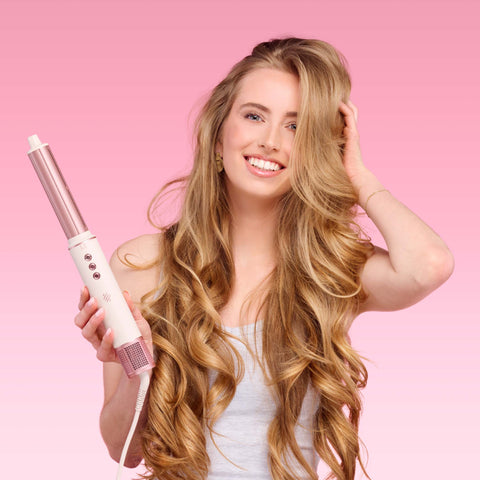
The type of tool makes a difference here. An iron with hot plates transfers heat through direct contact, while an airstyler works with warm air and a curling attachment that holds your hair in shape while it dries. That's why you often get results at a lower setting with an airstyler. The Airstyler Pro Ceramiq™ from Ace & Taylor has adjustable temperature settings and fully ceramic-coated curling attachments (not a thin sprayed-on layer), so the heat is distributed evenly and there are no hot spots sitting in one place in your hair. For curly and coily hair, which is prone to permanent pattern loss, that's exactly the difference that counts.
Can heat damage still be repaired?
No. Once the protein structure in your hair has changed, you can't put it back. What you can do: grow the damage out neatly and prevent further loss.
Masks, bond builders and protein products can make your hair feel temporarily stronger and break less, because they fill and reinforce the fibre from the outside. That's genuinely useful, but it won't bring your curl back. Your new growth will have your own pattern again. So: turn the temperature down, use heat less often, and have the straight sections cut off in stages. For most people hair grows about one centimetre a month, so count on months rather than weeks.
Styling with air instead of hot plates
If you want shape without giving up your curl pattern, it helps to use a tool that works with warm air and a ceramic-coated curling attachment instead of a hot surface pressed against your hair: the Airstyler Pro Ceramiq™, with adjustable settings and suitable for all hair types from 1A to 4C.
2-year warranty 30-day money-back guarantee Free shipping NL/BE/DE Trustpilot 4.8/5, 632 reviews
In our own customer survey (214 users, 30 days of use, so not independent research), 87% reported noticing less hair damage straight away.
Frequently asked questions
What temperature is safe for curly hair?
On dry hair, stay below about 180 °C, and preferably around 150 °C if your hair is fine, blonde or colour-treated. In research, 50 straightening passes at 185 °C caused no permanent loss of curl pattern, while 220 °C did for part of the hair. On damp hair the limits are far lower.
Will an airstyler or curling iron change my curl pattern if I only style occasionally?
If you work at a moderate setting and don't keep going over the same strand, the result stays temporary and your curl comes back after washing. Permanent loss mainly shows up with high temperatures, repeated passes over the same section of hair, and styling on damp hair.
Will my curl come back after heat damage?
Not in the damaged hair. Those fibres have lost their structure and that can't be repaired. Your new growth will have your own curl pattern again, so it's a matter of growing it out and trimming in stages.
Is heat training the same as a keratin treatment or a relaxer?
No. In those treatments the hair structure is chemically altered and then set with heat, under controlled conditions and with a fixed protocol. Heat training isn't a treatment, it's a name people give to damage that has built up slowly.
Does heat protectant prevent all damage?
No, but it does help. In research on flat irons, polymer layers on the hair reduced measurable heat damage. So see heat protectant as an addition to a lower temperature, not a replacement for it.
Why do my curls drop in the rain?
Because water releases the hydrogen bonds holding your styled shape in place. Your hair then slides back into its own shape. A strong hold and proper cooling help, but moisture always wins in the end.
Written by Anne Leensen, Ace & Taylor


