




Last updated: 20 September 2026
White dots in the middle of a hair are almost always trichorrhexis nodosa: tiny spots where the hair fibre has frayed and the inside is pushing out. Light bounces off those frayed ends, which is why they look white. They are mainly caused by friction and pulling. Heat styling doesn't create them by itself, but it does make them more likely.
In short
- A white dot or little knot along the length of a hair is a breakage point: the fibre frays open there. Under a microscope it looks like two brushes pushed together.
- A white bulb at the end of a shed hair is something completely different: that's a resting hair (club hair) and it's perfectly normal.
- White tubes you can slide along the hair are hair casts (pseudonits), not lice. Nits don't slide.
- In the lab, these white dots are created purely mechanically: by pressing hairs together and rubbing them. Heat and bleach make your hair rougher, so it happens faster.
- A white dot won't heal over. You cut it off and prevent new ones with less friction, less pulling and lower temperatures.
Further down you'll read which styling method limits that friction most, and why the type of tool matters more than the number on the display.
What exactly is a white dot in my hair?
It's a spot where the hair fibre has partly broken. The medical term is trichorrhexis nodosa: nodes or thickenings in the hair shaft where the hair snaps easily. It's the most common form of hair breakage.
Inside, your hair is made up of long keratin fibres twisted into bundles, wrapped in a layer of overlapping scales (the cuticle). When that protective layer breaks in one spot, the bundle underneath can fray apart. Under a microscope you then see the classic image of two paintbrushes pushed against each other: all the loose fibres sticking out. Every one of those fibre ends reflects light, and that's exactly why you see a white speck with the naked eye.
Important: that spot isn't dirt and it isn't a vitamin deficiency in that one place. It's real, irreversible damage to a dead piece of fibre. Sooner or later the hair snaps there, usually when you comb it, tie it into a ponytail or style it.
White dot, dandruff, nit or something else: how do you tell the difference?
The quickest test is sliding and sticking: damage inside the hair itself doesn't move, loose bits sitting on the hair do. Use this table to work out what you're looking at.
The difference between hair casts and nits matters clinically: hair casts are tube shaped, slide along the hair without any effort and don't itch, while nits are oval and stay firmly attached. The two get mixed up regularly.
Are these white dots caused by heat styling?
Indirectly, yes. The dots themselves form mechanically, through friction and pressure. But heat makes the surface of your hair rougher, and rougher hair rubs harder against itself. That's how heat styling raises the odds of breakage points forming.
In a 2026 lab study (Journal of the Mechanical Behavior of Biomedical Materials), researchers managed to recreate these white dots on healthy hairs purely by placing bundles of hair between rubber sheets and rubbing them back and forth under pressure. Their conclusion: the dots form because of high, localised stress when two hairs are pressed together and bend over each other. Hair from someone who already had the problem formed white dots after fewer repetitions than hair from healthy participants. It's a small, exploratory study, so read it as a strong indication rather than the final word.
The medical literature points the same way. It lists causes including brushing too hard, backcombing, tight hairstyles, the use of heat and prolonged sun exposure (UV). So it's the sum of lots of small injuries, not one bad moment.
Where heat comes in exactly: a healthy hair has an ultra thin lipid layer (18-MEA) that keeps the surface smooth. Thermal, chemical and mechanical treatments speed up the loss of that layer, which sends friction way up. With damaged, lifted scales, hairs no longer glide past each other, they catch on each other. And that catching is precisely the kind of stress researchers use in the lab to trigger the white dots.
Also watch out for the combination of wet hair plus heat. Keratin changes shape irreversibly when it gets too hot, but water lowers that threshold dramatically: dry keratin holds up to around 240 \u00b0C, wet keratin gives way from about 120 to 150 \u00b0C. Pressing soaking wet hair flat with a hot plate is therefore a completely different story from styling nearly dry hair, even if the number on your tool is the same.
Are white dots the same as split ends?
No, but they belong together. A split end is a hair that tears open lengthwise, usually starting at the tip. A white dot is a spot in the middle of the hair where the fibre frays crosswise.
In that same lab study, hair from someone with split ends formed white dots very easily, and those dots went hand in hand with lengthwise splits. So see them as two expressions of the same wear and tear. If you have a lot of white dots, split ends are usually the next step.
Can you repair a white dot?
No. The fibre is broken there and your hair is dead material: it doesn't repair itself. A mask, oil or bond builder can make your hair feel smoother, softer and stronger, but a frayed node won't become whole again.
What care products do achieve is delaying the next bit of damage. A conditioner or leave-in lays a slip layer over the hair, lowers friction and makes combing easier. That reduces the force landing on those vulnerable spots. That's a genuine win, just not in the sense of repair.
The only way to get rid of a white dot is to cut it off, just below the spot. If you don't, the hair will snap there on its own and you'll be left with a shorter, frayed hair that splits all over again.
What can you do about it? 8 steps that make the difference
- Trim off the damaged sections. They're usually in the bottom few centimetres. You don't have to sacrifice your length, only the affected part.
- Detangle from ends to roots. Start at the bottom and work upwards in sections with a wide tooth comb or a flexible brush. Dragging through from the top pulls knots tight, and that's exactly the press-and-rub stress that creates the dots.
- Don't brush roughly when your hair is wet. Wet hair stretches further and is more fragile. Apply a leave-in first, so the comb glides more easily too.
- Only style once your hair is nearly dry. Around 80 percent dry is the tipping point: most of the moisture is gone, so your keratin's temperature threshold is much higher again.
- Go for a lower setting with one calm pass rather than a high setting where you go over the same section three times and keep snagging.
- Work with thin sections. Thick sections force you to pull harder and heat for longer, and within a thick bundle the hairs grind against each other.
- Reduce friction outside your styling routine too. Switch up your parting and the position of your hair tie, use a smooth scrunchie instead of a tight elastic, and choose a smooth pillowcase if you tangle a lot overnight.
- Check your tools. Run your finger along the plates, the bristles and the curling attachments. Every scratch, burr or chipped patch is a snag point that rips the cuticle open.
Which styling method creates the least friction?
The less you tug on a section and the more evenly the heat is spread across the hair, the smaller the chance of breakage points. That's why the type of tool matters more here than the temperature alone.
With a straightener or a classic curling iron, everything happens at once: pressure, heat and a sliding motion along the section. With airflow styling, your hair is wrapped around a curling attachment and held in place by the air, without you dragging anything along it. That removes precisely the kind of stress researchers use to create this damage in the lab.
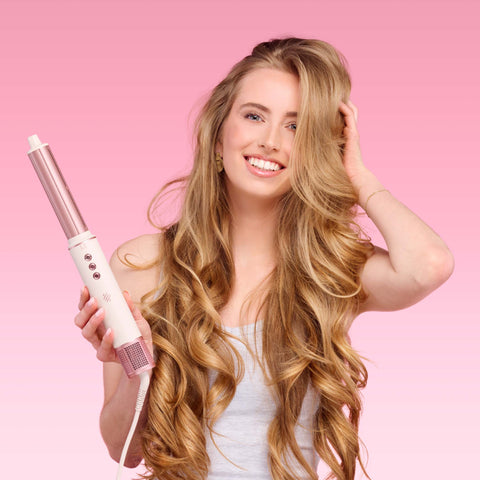
On the Airstyler Pro Ceramiq\u2122, the curling attachment is fully ceramic coated, not just given a quick spray of a thin layer. A smooth, completely sealed ceramic surface gives your hair less to catch on and spreads the heat evenly, so there's no hot spot concentrated in one place. It's no miracle cure for breakage, but it does remove two of the three factors behind these white dots: rough surfaces and pulling.
When is it not styling damage, but something else?
See your GP or a dermatologist if the breakage doesn't match how you treat your hair. Think white dots sitting close to the scalp and all over your head, hair that snaps at the slightest tug, or breakage that shows up in your eyebrows or lashes too.
This type of breakage can also be congenital: it's the most common inherited hair shaft abnormality, and in that case hair snaps under very little stress. A thyroid problem or a deficiency (iron, for example) can also make hair more fragile. If you're seeing it mostly in a child, or alongside bald patches, itching or flaking, always get it checked.
White dots are friction damage, so the real gain is in styling without pulling: the Airstyler Pro Ceramiq\u2122 wraps your hair around a fully ceramic coated curling attachment using air, instead of dragging it between hot plates.
- 2 year warranty and a 30 day money back guarantee, so you can try it at home on your own hair
- Trustpilot 4.7/5 ("Excellent") and more than 10,000 customers
- Works on all hair types, from 1A to 4C
- Free shipping in NL, BE and DE: order before 23:59 and it arrives tomorrow
In our own customer survey (214 users, 30 days of use), 87 percent reported noticing less hair damage straight away. That's research among our own customers, not independent research.
Frequently asked questions
Will a white dot heal over on its own?
No. Your hair is dead material and has no way to repair itself. The hair will eventually snap at that point. Only the new hair growing out of your scalp is undamaged.
Do protein treatments or bond builders help against white dots?
Those products can make your hair feel stronger and smoother, which reduces new breakage. But they don't rebuild a frayed spot. See them as prevention for the rest of your length, not as repair.
Do I need to cut off all my length?
Usually not. The damage is almost always in the bottom few centimetres, the oldest part of your hair. Have that section taken off and then tackle the cause, otherwise the dots will be back within a few months.
Can I still use heat if I'm seeing white dots?
Yes, but adjust your routine. Style on nearly dry hair, pick a lower setting, use thin sections and go over the same section as few times as possible. Above all, avoid pulling hard with a brush or iron through a warm section.
Are white dots the same as lice?
No. A white dot sits inside the hair itself and doesn't move. A nit is an oval egg glued to the hair near the scalp and usually comes with itching. If you can slide the white thing easily along the hair, it's a hair cast and therefore not lice either.
What does a white bulb on a shed hair mean?
That's a resting hair that had finished its growth phase, and it's completely normal. Losing around 50 to 100 hairs a day is part of the deal. Only if you suddenly lose a lot more hair or your scalp becomes visible is it worth getting checked.
Written by Anne Leensen, Ace & Taylor. Designed in the Netherlands.


