


Last updated: 1 September 2026
Almost always, it's not your hair. It's your technique. With your non-dominant hand you rotate the barrel less far, hold on for a shorter time and grab bigger sections. On top of that come your natural hair growth direction, your parting and the side you sleep on. Both sides can give you the same result, as long as you mirror the movement properly.
TL;DR
- Cause 1 is nearly always your dominant hand: on your "difficult" side you rotate less far, keep less tension and style for a shorter time.
- Cause 2 is your hair growth direction. In right-handed people, the crown swirls clockwise in over 90 percent of cases (research by Klar, 2003), which means the hair on one side lies against the grain.
- Cause 3 is measurable and easy to fix: uneven section thickness and unevenly distributed product between left and right.
- A curl sets while it cools down, not while it heats up. Heat breaks the hydrogen bonds in the hair; they reform once the hair cools and is dry.
- Bone-dry hair only becomes genuinely mouldable around 144 degrees, but add water and that threshold drops towards room temperature (Wortmann and Stapels, 2006). So styling damp hair works perfectly well on a lower setting.
Further down you'll also read why it matters whether a styling tool comes with one barrel or two, and how to check that before you buy anything.
Why does one side of my hair turn out better than the other?
Because you have two hands that can't do the same things, and because your head isn't symmetrical. In practice there are four causes, in order of how often they occur.
1. Your dominant hand. On the side that goes "well", your hand moves in a natural rotation. On the other side you have to lift your arm, push your elbow outwards and twist your wrist further than is comfortable. The result: you grab a thicker section (because it's quicker), you pull the section less straight and you let go as soon as your arm gets tired. Those are three things that all weaken the curl.
2. Your hair growth direction. Your hair doesn't grow straight out of your scalp but at an angle, and that angle differs per zone. Around your crown the hair grows in a spiral, and that spiral has a direction. On the side where the growth direction moves along with the way you're styling, the hair falls easily. On the other side you're working against the growth, and then the top layer keeps wanting to fall back or stick up.
3. Uneven sections and uneven product. You never see your left side and your right side equally well in the mirror. On your weak side you style more by feel, and then the sections get wider and the time per section gets shorter. You also usually distribute heat protectant and mousse with your dominant hand, so that side often gets just a little bit more.
4. Habits outside of styling. If you always sleep on the same side, that side gets flattened and rubbed against your pillow every night. If you've worn your parting in the same place for years, the hair on that side gets used to falling in that direction. A shoulder bag or a phone wedged between shoulder and ear plays a part too.
Is one side of my hair really different from the other?
A bit, yes, but less than you think. There's no research showing that the hairs on one side of your head "hold a curl worse" than on the other side. What is documented has to do with direction and with zones.
On direction: the classic study by Amar Klar (2003) found that 8.4 percent of right-handed people have a crown that swirls anticlockwise, while for non-right-handed people it's roughly half. In other words: in most right-handed people the crown runs clockwise, so your hair on one side sits just that bit differently from the other. A 2025 study in the Journal of Craniofacial Surgery into hair growth direction in male hair transplant patients also found a clear preference towards the right, in line with that crown rotation. That study was about men and about hairline design, so don't draw any conclusions from it about your curls. The point is simply this: asymmetry in growth direction is normal, not unusual.
On zones: hair thickness and curl also differ within one head. Research comparing hairs from different scalp zones under the microscope shows differences between, for example, the crown, the sides and the nape. And a twin study into hair thickness and curl reports variation within one person alongside heritability. In short: your hair isn't exactly the same anywhere, so don't expect an exactly identical curl either.
An important distinction: growth direction determines how your hair falls. Technique determines how well the curl sits. You can't change the first, and you can change the second almost entirely.
How do I know which cause applies to me?
With four quick tests you'll know within a single styling session whether it's your technique, your growth direction or your distribution.
- The hand test. Style your difficult side once with your other hand, or have someone else do that side. Does it immediately go better? Then it's technique, not your hair.
- The crown test. Find your crown in the mirror (or with your phone camera) and see which way the spiral turns. The side where the hair runs backwards along with that swirl is almost always your "easy" side.
- The section test. Consciously measure how wide your sections are, just once. Use the width of your barrel as your measure and keep both sides the same. Notice you're taking four sections on the right and three on the left? Then you've found your cause.
- The wet hair test. Comb your hair through wet without product and let it air dry. If it already falls asymmetrically, part of it comes down to your growth direction and your cut. Does it fall evenly when wet, but not after styling? Then it's purely execution.
How do I style my difficult side just as well as the other one?
By doing your weak side first and making everything measurable: equal sections, equal time, equal cooling. Here's how, step by step.
- Start on your difficult side. Your arm is still fresh and your attention is at its sharpest. The last sections of a session are always the sloppiest, and you don't want those on your weak side.
- Work on towel-dried hair (around 80 percent dry). Dripping wet hair takes too much time per section, bone-dry hair takes the shape less well.
- Divide your hair into four sections and clip them up. That way you can take the same amount of hair per section on both sides.
- Keep sections narrow: about as wide as your barrel, so roughly 3 to 4 centimetres. Two narrow sections always give a firmer result than one thick one.
- Always curl away from your face, on both sides. That means the direction of rotation is opposite on the left and the right (see the next section).
- Adjust your body position instead of your wrist. Lift your elbow slightly, turn your head a little with it, or hold the tool with the handle pointing up. Your wrist then has to twist far less.
- Count out loud. For example 15 counts per section, the same on both sides. Going by feel, you'll always do your weak side for less time than you think.
- Finish every section with the cool setting, 5 to 10 seconds.
- Leave the curl coiled up or pin it with a clip, and let it cool completely for at least a minute. Only then release it and shake it open with your fingers, don't comb it through.
Why does the barrel's direction of rotation matter?
Because a barrel only winds your hair one way. If you use the same barrel on both sides of your head, you curl one side away from your face and the other side automatically towards your face, unless you twist your wrist into an unnatural position. That's exactly why one side falls beautifully "all by itself" while the other side looks stiff.
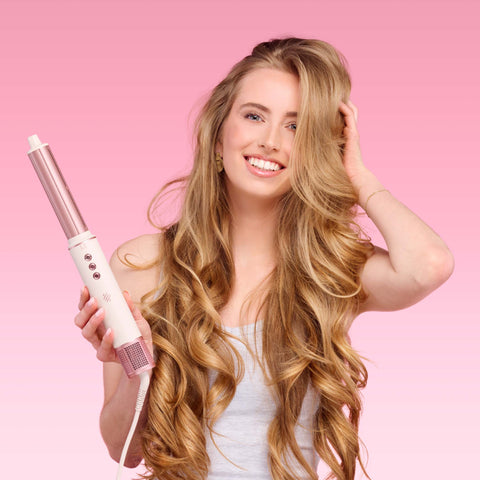
The solution is simple: two barrels that rotate in opposite directions, one for the left and one for the right. So keep an eye out for that when you're comparing an airstyler or curling set. That's why the Airstyler Pro Ceramiq from Ace & Taylor comes with two fully ceramic-coated barrels, one per direction of rotation, plus a cool shot setting to cool the curl without swapping tools. That ceramic layer isn't a thin sprayed-on coating: it holds the heat evenly, so you don't end up compensating on your weak side with a higher setting.
Prefer a loose, natural look? Then alternate deliberately: don't curl every section the same way, but switch direction from section to section. That instantly makes small differences between left and right less noticeable.
Why is cooling more important than a higher temperature?
Because the shape sets while it cools. Heat makes hair temporarily mouldable because the hydrogen bonds between the keratin chains let go. Those bonds reform, in the new shape, once the hair cools down and the water has gone. Touch the curl while it's still warm and you pull it out of shape at exactly the moment it would have set.
Water plays the leading role here. Research using DSC measurements found a glass transition temperature of around 144 degrees for bone-dry hair, and that threshold drops towards room temperature when the hair is fully saturated with water (Wortmann and Stapels, 2006). In plain language: the damper your hair, the less heat you need to shape it. Which is why styling towel-dried hair on a medium setting often works better than fully dried hair on the highest setting.
That same chemistry also explains why a curl drops in humid weather: the new hydrogen bonds are sensitive to moisture and disappear in high humidity or when you wash your hair. On your weak side the curl usually sits just a bit looser, so that's the one that gives way first.
Which cause matches which symptom?
Use this table to see at a glance what you're seeing on your difficult side, and what to do about it.
And if it's still not even after all that?
Then that's normal. No head is symmetrical: your ears aren't at exactly the same height, your parting never runs perfectly straight and your cut follows all of that. So don't aim for two identical sides, aim for a look where the difference doesn't show.
Three things that help:
- Bring your strongest side forward. Lay the side with the nicest fall over your shoulder and push the weaker side back.
- Go for a deeper side parting. It gives more volume on one side and turns asymmetry into part of the style.
- Photograph your result. In the mirror you see a mirror image, in a photo you see what other people see. Often the "bad" side turns out to look far better in the photo than you thought.
Still working with one barrel for both sides? Then a set with two counter-rotating, fully ceramic-coated barrels like the one in the Airstyler Pro Ceramiq is the fastest way to even out your difficult side.
- 2-year warranty and 30-day money-back guarantee: try it at home on your own hair
- Works on all hair types, 1A through to 4C
- Trustpilot 4.7 out of 5 ("Excellent") and 10,000+ customers
- Designed in the Netherlands, free shipping in NL, BE and DE
In our own customer survey (214 users, 30 days of use), 96 percent reported curls that lasted at least 24 hours. This is research by Ace & Taylor among its own customers, not independent research.
Frequently asked questions
Why does my hair curl inwards on the right and outwards on the left?
Usually because you're using the same barrel in the same direction on both sides. The curl then turns away from your face on one side and towards it on the other. Use the barrel with the matching direction of rotation for each side, or consciously turn your hand around.
Should I curl all my curls in the same direction?
For a classic, sleek look, yes: every section away from your face. For loose waves, alternating works better, because the curls then blend into each other less and the difference between left and right is less noticeable.
Can I change my hair growth direction?
No. The angle at which your follicles sit in your scalp is fixed and grows back the same way every time. You can steer the fall temporarily by blow-drying the roots against the growth direction with warm air and letting the shape cool before you touch your hair.
Is it worth learning to style with my other hand?
For some people, yes, but it's the hardest route. It's simpler to adjust your body instead of your hand: elbow higher, head tilted slightly with it, tool held with the handle pointing up. And always do your difficult side first.
Why does my hair look fine in the mirror but asymmetrical in photos?
In the mirror you see a reversed image that your brain is used to, in a photo you see the side other people see. That's why asymmetry jumps out much faster in a photo. So use photos as a check and the mirror to style.
How long should a curl cool before I'm allowed to touch it?
Count on at least a minute, and longer for thick or long hair. The shape sets while the hair cools and dries, so anything you touch or comb through during that minute costs you staying power. The cool setting speeds this up.
Written by Anne Leensen
Anne writes for Ace & Taylor about heat, hair structure and styling technique, and tests every routine on different hair types herself first.
Sources
- Wortmann, F.-J. and Stapels, M. (2006). The effect of water on the glass transition of human hair. PubMed 16358248
- Klar, A. (2003). Human handedness and scalp hair-whorl direction. Columbia University (pdf)
- Natural Asymmetry in Hair Growth Direction (2025), Journal of Craniofacial Surgery. PubMed 40100127
- Kinetics of the changes imparted to the main structural components of human hair by thermal treatment (on cohesive set and hydrogen bonds). ScienceDirect
- Variation and Heritability in Hair Diameter and Curvature in an Australian Twin Sample. PubMed 27291867


