


Yes, you can use heat when there's dry shampoo in your hair, but not straight after spraying and not over white residue. Wait 1 to 2 minutes so the propellant and alcohol evaporate, massage and comb the powder through and out of your hair, and style after that. Dry shampoo is not a heat protectant.
Last updated: 11 September 2026
TL;DR
- Aerosol dry shampoo contains propellants (butane, isobutane, propane) and alcohol. The label carries the EU warnings H222 ("Extremely flammable aerosol") and H229 ("Pressurised container: may burst if heated"). So let it evaporate for a few minutes before any heat comes near.
- The real fire risk comes from open flames and sparks, not from a ceramic plate at 180 degrees. Ethanol only self-ignites at around 369 degrees (a measured value from the Journal of Chemical & Engineering Data), and propellants also sit a few hundred degrees above your styling temperature.
- The powder doesn't "burn" at styling temperatures: according to thermal analyses, starch only starts breaking down around 300 degrees. The real problem is mechanical: residue makes your hair grippy, your tool drags and you end up going over the same section again and again.
- Dry shampoo does not protect against heat. Use a proper heat protectant on your lengths and keep dry shampoo at the roots.
- Best order: dry shampoo at the roots, let it sink in, comb it out thoroughly, then style. Or: style first, then dry shampoo for texture and volume.
Further down you'll also find out which type of tool is most forgiving for day-2 hair with some product in it, and what to watch out for with an airstyler.
Can you use a straightener or curling iron when there's still dry shampoo in your hair?
Yes, as long as the product is dry and combed out properly. The rule of thumb: if you can still see white powder or your fingers feel sticky or dusty, your hair isn't ready for heat yet.
A spray has two parts: the powder that absorbs the oil (rice, corn or tapioca starch, aluminium starch octenylsuccinate, silica or clay) and the liquid side that carries the powder (alcohol denat. and propellant). That second part needs to be gone before you pick up a hot tool. In practice that means waiting 1 to 2 minutes, then massaging thoroughly with your fingertips and combing or brushing it out.
What you really shouldn't do: spray while your hot straightener or airstyler is in your other hand, or spray and immediately clamp a section. Then you're working with a still-wet, solvent-rich layer, and you'll often smell that typical sharp odour right away.
Can dry shampoo catch fire from the heat of your styling tool?
A normal straightener, curling iron or airstyler won't just ignite dry shampoo. The temperatures needed for self-ignition are far higher than anything you style at. The risk lies with open flames, sparks and with the can itself.
Let's put the numbers side by side. You usually style between 150 and 200 degrees. Ethanol, the alcohol in many sprays, only self-ignites around 369 degrees in measured laboratory tests. Propellants like butane and propane also sit hundreds of degrees above your styling setting. So a hot plate is not an ignition source the way a gas flame or a spark is.
Where it does go wrong
Alcohol and gas vapour ignite very easily with a spark or small flame: think a gas hob, a candle in the bathroom or a cigarette. And the can itself is pressurised. That's why P210 is on the label: keep away from heat, hot surfaces, sparks and open flames. So don't leave the can next to your hot tool, on a radiator or in a hot car.
Does the powder in your hair "burn" at 180 degrees?
No, not literally. Starch, the main ingredient in most dry shampoos, only starts breaking down around 300 degrees according to thermal analyses. No consumer tool reaches that. And yet you do notice a difference, and that's down to something else.
What actually happens when you style over residue:
- Your tool drags. Powder plus film formers (like VP/VA copolymer, which is also in hairspray) make the hair surface rough and tacky. A straightener glides less smoothly and keeps snagging.
- You go over the same section more often. Because the result is mediocre, you add another pass. Those extra passes are the real damage, not the powder.
- Your curl holds less well. A layer of powder sits between your hair and the barrel. Heat transfer becomes uneven, so one half of your section is set and the other isn't.
- Build-up forms on your tool. Product bakes onto plates and barrels. That layer then tugs at your hair, so the problem quietly grows.
- You smell a "burnt" odour. That usually comes from baked-on product on the tool or from moisture evaporating, not from your hair being on fire.
In short: the combination isn't dangerous, but it's needlessly bad for your result. And a poor result almost always leads to more heat.
Is dry shampoo a kind of heat protectant?
No. Dry shampoo is made to absorb oil and moisture, not to distribute heat. It actually makes your hair drier at the surface, so the opposite of what you want for styling.
A heat protectant works differently: it lays a thin film (often with silicones or polymers) around the hair shaft, so heat is spread more evenly and your hair loses less moisture all at once. Powder doesn't do that. It sits loosely on your hair, falls off and gives you a false sense of security on top of that.
In practice this means: dry shampoo belongs at your roots, heat protectant belongs on your lengths and ends. Those are two different zones and two different goals. And don't apply heat protectant over a thick layer of powder, because then it lands on the powder instead of your hair.
In what order do you use dry shampoo, heat protectant and your tool?
There are two good routines: dry shampoo before styling (for fresh, less oily roots) or after styling (for texture and volume). Both work, as long as you don't let heat and wet product overlap.
Routine A: freshen up day-2 hair, then style
- Spray dry shampoo from about 20 to 30 cm away, only into the partings at your roots. Not all over your head.
- Wait 1 to 2 minutes. This is the step almost everyone skips and it's exactly what makes the difference.
- Massage through your roots with your fingertips, as if you were washing your scalp.
- Brush or comb everything through properly until you can't see any white.
- Apply heat protectant to your lengths and ends (not to the roots).
- Style on the lowest setting that works for your hair type, in neat sections, with as few passes as possible.
- Let your curl cool down completely before you touch it or comb it out.
Routine B: style first, then dry shampoo as a styling product
- Style your hair the way you normally do, with heat protectant on the lengths.
- Let everything cool until your hair is genuinely at room temperature.
- Then spray dry shampoo at the roots for grip and lift, or through the lengths for texture.
- Lift your hair at the roots with your fingers and shake it out. No more heat over it.
Careful with damp hair. Dry shampoo is meant for dry hair. Spray it on damp hair and then go over it with heat and you'll get clumps and sticky roots that only washing will fix.
Which tool handles day-2 hair with some product in it best?
The less pressure and direct contact, the more forgiving the tool. Warm air spreads the heat across a section, while a plate literally presses the residue against your hair.
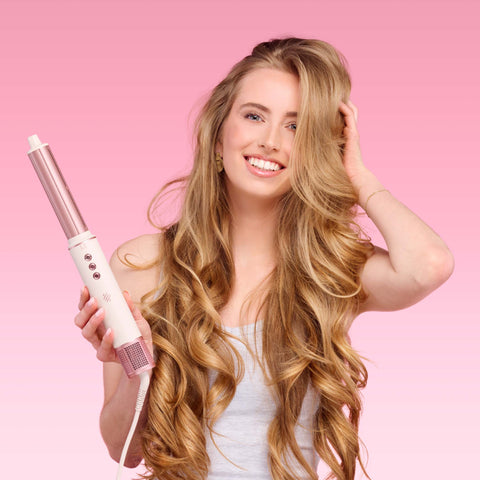
That's exactly why an airstyler is so popular for quick refresh days. With the Airstyler Pro Ceramiq™ your section is wrapped around a fully ceramic-coated barrel by the airflow, so there's no plate pressing residue into your hair. That fully ceramic barrel (not a thin sprayed-on layer) has another practical advantage: it's smooth and easy to wipe clean, so build-up from dry shampoo and hairspray doesn't stick around.
One warning that applies specifically to air tools: powder heads towards the air intake. A blocked intake or filter means less airflow, which can make a tool run hotter or cut out via its overheat protection. So wipe your filter clean every few weeks if you use dry shampoo often.
How often can you combine dry shampoo and heat without scalp problems?
Now and then is fine, days on end without washing is not. This is less about your hair and more about your scalp.
Dermatologist Nada Elbuluk explained in an article on TODAY.com that dry shampoo doesn't cause major issues for most people with normal use, but that excessive use can lead to scalp irritation or folliculitis, an inflammation around the hair follicles. Powder, sebum, sweat and styling residue build up, and warm air and heat from your tool make the roots that bit tackier.
A workable approach: use dry shampoo to postpone one, at most two wash days, and then really wash properly with attention to your scalp. Notice itching, small bumps or sore spots along your parting? Skip a few days and during that time use only air, no contact styling at the roots.
Myth check: "hair with dry shampoo holds a curl better"
A little texture does help against slipping, for instance with very smooth, fine hair. But you get that effect from a light layer, not a thick coat of powder. If there's a lot in there, the curl actually sets unevenly and drops faster, because the powder blocks heat transfer.
What if your hair is already full of residue and you need to style now?
Then the fastest fix isn't more heat, it's mechanical work. You can get a long way in three minutes without washing your hair.
- Comb through your roots with a wide-tooth comb or brush, then work down section by section.
- Blast along the roots with your hairdryer on the cool or lowest setting to get loose powder out.
- Wipe your styling tool clean (cold and unplugged) with a slightly damp cloth, so you're not reheating old build-up.
- Then style only the lengths and leave the greasiest roots alone, or pin them up instead of using heat.
Fewer passes needed on day-2 hair
Because the Airstyler Pro Ceramiq™ works with airflow and a fully ceramic-coated barrel instead of a clamping plate, you don't have to keep going over the same section when your hair has a bit of dry shampoo in it.
- 2-year warranty and 30-day money-back guarantee: just try it at home
- Works on all hair types, from 1A to 4C
- Trustpilot 4.7/5 ("Excellent") from 400+ reviews, 10,000+ customers
- Free shipping in NL, BE and DE. Order before 23:59 and it arrives tomorrow
Written by Anne Leensen, Ace & Taylor
Frequently asked questions
How long should I wait after dry shampoo before using heat?
Count on 1 to 2 minutes, so the alcohol and propellant have evaporated. Then massage through your roots and comb the powder out. Still see white? Wait a little longer and keep combing.
Do I need to wash my hair first if there's dry shampoo in it?
Not necessarily. Combing it out well and massaging it through is usually enough for a fresh style. If there's residue from several days, your roots feel sticky or your scalp is irritated, washing is the better choice.
Can dry shampoo damage my straightener or barrel?
It doesn't damage the coating directly, but it does leave build-up that bakes on. That layer tugs at your hair and makes heat distribution uneven. Wipe your tool clean regularly with a slightly damp cloth, cold and unplugged.
Is powder dry shampoo without an aerosol can safer with heat?
For the flammability part, yes, because there's no propellant or alcohol in it. But the powder itself still makes your hair grippy and still leaves residue on your tool, so you still comb it out thoroughly before styling.
Can I use dry shampoo on my roots and then an airstyler for volume?
Yes, that's one of the nicest combinations, as long as you let the powder sink in and comb it out first. Do keep an eye on your tool's air intake: loose powder gets sucked inside and a blocked filter means less airflow.


