


Last updated: August 16, 2026 · 8 min read
Yes: wet hair is demonstrably weaker and stretches further than dry hair, because water temporarily breaks the hydrogen bonds between keratin proteins. That repeated wetting and drying adds up on its own to lasting "material fatigue" (the term hygral fatigue) is less firmly proven than many brands suggest: the term originally comes from textile research on wool.
In short
- That wet hair is temporarily weaker and stretches more than dry hair isn't up for debate: water temporarily breaks the hydrogen bonds between the keratin proteins in your hair.
- The term "hygral fatigue" originally comes from textile research into wool fibers, not research into human hair. Several well-known hair brands (including Davines) still present it as an established fact, while a widely shared Medium post calls it a myth.
- There's no solid evidence that the swelling and shrinking itself, separate from what you do to your hair, adds up to lasting damage under normal washing habits. The process is largely reversible.
- The real risk lies in what happens while your hair is wet: rough combing, wringing it out, or heat styling on soaking wet (not towel-dried) hair. That last one can demonstrably cause lasting damage, known as "bubble hair."
- How often you wash or "refresh" matters less than how gently you treat your hair in the few minutes it's wet or damp.
Further on, you'll find out what this means in practice for how often you can use an airstyler on damp hair, and whether a refresh day without washing puts extra strain on your hair.
What exactly is hygral fatigue?
Hygral fatigue is the name for the idea that hair weakens because it repeatedly swells when wet and shrinks again as it dries, as though the material gets "tired" from the repetition. The term didn't originate in hair research, but in textile science, where wool fibers were tested for material fatigue under repeated, often extreme, moisture cycles.
The hair care industry, particularly within the curly-hair community, adopted the term to explain why hair sometimes feels flatter or loses its curl pattern after periods of heavy conditioner use and too little protein. The analogy you'll come across most often is that of a rubber band that eventually stays stretched out after being pulled too many times. That comparison falls short on one important point: the bonds that temporarily break in wet hair (hydrogen bonds) reform on their own once the hair dries, whereas an overstretched rubber band never returns to its original shape.
Is hygral fatigue a myth or a scientific fact?
The honest answer sits somewhere in between: the swelling and shrinking of hair caused by moisture is a real, measurable process, but the idea that this alone, separate from heat or mechanical stress, adds up to lasting damage hasn't been solidly demonstrated in human hair under normal conditions.
That's exactly why you'll find such conflicting claims online. A widely shared Medium post titled "Hygral Fatigue is a Myth" points out that the studies often cited as evidence either concern wool fibers under extreme test conditions, or mention the term only once in passing without directly testing the effect on human hair. At the same time, brands like Davines treat it as an established fact in their own content blogs, using the same explanation and the same rubber-band comparison that gets repeated from site to site. That's exactly the pattern that should make you cautious: a claim that sounds identical everywhere isn't automatically independently confirmed, it could just as easily be copy-pasted.
The table below breaks down which parts of the story are well supported and which parts are mostly repeated without solid evidence.
| Claim | How solid is the evidence? |
|---|---|
| Wet hair is temporarily weaker and stretches further than dry hair | Well supported. Water temporarily breaks hydrogen bonds between keratin chains, this is widely accepted hair science. |
| Hair swells when wet and absorbs water up to a portion of its own weight | Cited in several hair science sources (order of magnitude: around 20% swelling in diameter, up to roughly 30% of its own weight in water). Underlying mechanism well supported, exact percentages vary by source. |
| Repeated swelling and shrinking, on its own and separate from heat or mechanical stress, cumulatively damages the hair structure ("hygral fatigue" as material fatigue) | Weakly supported for human hair and normal washing habits. The term was borrowed from wool research, and widely cited sources turn out, on closer inspection, not to directly address this effect in human hair. |
| Heat styling on soaking wet hair can cause lasting damage | Well supported, but a separate mechanism: water that gets heated to steam inside the hair shaft can deform the hair from the inside out ("bubble hair"). |

What actually happens inside your hair, scientifically speaking, when it gets wet?
Water penetrates through the outer scale layer (cuticle) into the cortex, the core of the hair fiber, and temporarily breaks the hydrogen bonds between the keratin protein chains there. Those bonds normally hold the protein structure firmly in place. Without them, the hair can stretch further before breaking, which is why wet hair feels limper and more elastic.
As the cortex absorbs water, the hair fiber swells and lifts the scale layer slightly, which makes the hair surface feel rougher until it dries again. Once the hair dries, the water evaporates, the hydrogen bonds re-form, and the fiber largely returns to its original shape. That recovery is exactly why hair scientists consider the rubber-band comparison inaccurate: in a rubber band, permanent bonds break and never come back, while in hair it's temporary bonds that close again every time.
It's worth mentioning here: hair with higher porosity (a rougher, more open scale layer, often from previous heat or color damage) absorbs water faster and in larger amounts than healthy, low-porosity hair. That explains why people with already damaged hair more readily recognize the symptoms attributed to hygral fatigue: their hair goes through the same swell-and-shrink process, just in a more pronounced form.
So does hair actually get weaker from repeated wetting and drying, or not?
There's no solid evidence that the swelling and shrinking of hair, on its own and separate from what you do to it, leads to cumulative, lasting damage under normal washing habits. But getting your hair wet more often does mean more moments where it's temporarily more vulnerable, and what happens during that window does add up.
In other words: it's not the wetting itself that's the problem, but rough combing or brushing of soaking wet hair, wringing hair roughly in a towel, or heat styling on soaking wet rather than towel-dried hair. Each of these is a well-documented way to damage hair, and they happen to occur, more often than not, at exactly the moment your hair has just gotten wet. That's likely also why the curly-hair community picked up on the pattern: the complaints (frizz, less springy curl, duller hair after periods of heavy conditioner use) are real, but they're more plausibly explained by a combination of overly rough mechanical handling and over-conditioning than by "fatigue" from the swelling process itself.
What does this mean for using an airstyler on wet hair?
An airstyler is designed for towel-dried, damp hair to begin with, not for soaking wet hair: the device dries and styles at the same time using warm air, which only works well once most of the moisture is already gone. That ties in directly with the point where the science gets most concrete: heat styling on soaking wet hair can cause water inside the hair shaft to boil into steam, deforming the fiber from the inside out. This is known as "bubble hair" and is generally linked to temperatures above roughly 125°C applied to soaking wet hair. Unlike the contested hygral fatigue claim, this mechanism is well documented, and the damage is permanent: it only grows out with new hair growth.
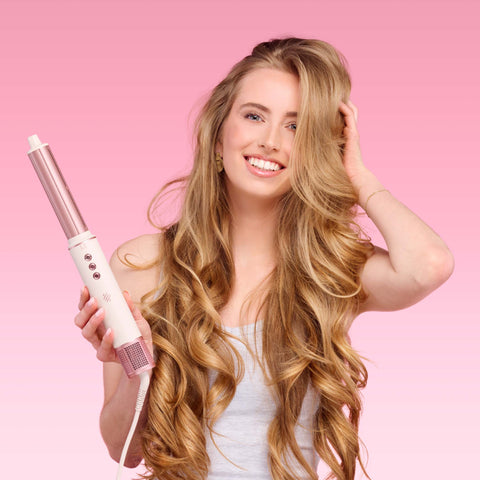
This is precisely why temperature choice and even heat distribution matter in practice, not as minor extras but as a direct way to reduce the risk during that vulnerable, damp window. The Ace & Taylor Airstyler Pro Ceramiq has three heat settings (35°C, 70°C and 110°C, well below the threshold where bubble hair occurs), so you can pick a level that matches your hair's thickness instead of defaulting to the highest setting. Its fully ceramic-coated curling attachment also distributes heat more evenly than a thin sprayed-on coating, with fewer sudden hotspots in one place. That matters precisely because your hair is still damp, and therefore mechanically more vulnerable, while you're styling: an evenly heated surface prevents one section of hair from repeatedly hitting a hotter spot on the curling attachment while the rest of the section gets less heat.
To stay honest: this doesn't prevent damage if you ignore the lowest setting and style soaking wet hair anyway. Towel-dried still means towel-dried, no matter which device you use.
How often can you wash and style, and is a refresh day without washing a problem?
There's no universal number that applies to everyone, it mainly depends on hair type and porosity. As a rough guideline: straight to wavy hair often lasts 2 to 3 days between washes, curly hair can usually go longer (around once a week), and thick, coily or tightly curled hair is often fine with once every 1 to 2 weeks. Washing too often dries out the scalp and lengths by stripping away natural sebum, which in turn indirectly increases mechanical vulnerability.
A refresh day, briefly wetting your hair with water or a spray without fully washing it and restyling, does add one extra swell-and-shrink moment, but based on what's explained above, that's not a reason to panic on its own: it's a smaller, milder version of the same reversible process. What matters is how you treat your hair during that damp moment. Comb gently with a wide-tooth comb instead of brushing hard, don't use a higher temperature than necessary, and let the hair get at least towel-dry before using the airstyler on it. Handled that way, a refresh day isn't an extra risk, just an extra styling session.
Frequently asked questions
Is hygral fatigue a recognized scientific term for human hair?
Not really. The term originally comes from textile research into wool fibers and was later adopted by the hair care world. The underlying swell-and-shrink process is real and measurable, but the specific claim that this alone causes cumulative damage in human hair isn't solidly supported.
Does hair really get weaker from frequent wetting and drying?
Wet hair is temporarily weaker in that moment, that's well supported. That this automatically adds up to lasting damage hasn't been demonstrated. The risk lies mainly in how you treat your hair while it's wet, not in getting it wet in the first place.
Can you safely use an airstyler on wet hair?
On towel-dried, damp hair, yes, that's exactly what an airstyler is designed for. On soaking wet hair, it's not a good idea with any device, because heat styling on soaking wet hair can cause water inside the hair shaft to boil into steam, resulting in permanent damage.
How often should you wash your hair to prevent damage?
That depends on your hair type: straight to wavy hair usually every 2 to 3 days, curly hair around once a week, thick or tightly curled hair often fine with once every 1 to 2 weeks. There's no fixed number that applies to everyone.
Is a refresh day without washing bad for your hair?
There's no solid evidence that briefly wetting hair without fully washing it is harmful on its own. It's a milder version of the same reversible swell-and-shrink process. Just treat your hair gently while it's damp: comb softly and don't style on the highest heat setting.
What's the difference between heat damage and hygral fatigue?
Heat damage happens when protein structures in the hair are damaged by high temperatures, regardless of whether the hair was wet or dry. The hygral fatigue claim, by contrast, is about damage from repeated swelling and shrinking caused by moisture, separate from heat. So these are two distinct mechanisms discussed separately, not the same problem under a different name.
A calm, consistent styling routine at the right temperature does more than anxiously avoiding every wet moment. The Ace & Taylor Airstyler Pro Ceramiq has three heat settings you can match to your hair type, and a fully ceramic-coated curling attachment that distributes heat evenly instead of through hotspots. In Ace & Taylor's own customer survey (214 users, 30 days of use, so not an independent scientific study), 87% reported noticeably less hair damage.
2-year warranty
30-day home trial
Works on all hair types, 1A to 4C
Trustpilot 4.7/5
Shop the Airstyler Pro Ceramiq


