


Last updated: August 9, 2026 · 7 min read
Curls and blowouts fall apart in humidity because hair is hygroscopic: it absorbs moisture molecules from the air. Those extra water molecules disrupt the temporary hydrogen bonds that hold a style in place, causing the hair to revert to its natural structure and the hair shaft to swell, which leads to frizz and loss of curl.
In short
- Hair is hygroscopic: the higher the humidity, the faster a curl or blowout falls flat.
- A blast of cold air (cool shot) at the end of styling locks the hydrogen bonds into the new shape.
- Let your hair cool down completely before you touch it or brush it out.
- Choose products with film-forming polymers or silicones: they create a moisture barrier around the hair shaft.
- Dry your hair until it's truly 100% dry. Residual moisture is the fastest way to lose a style.
- Don't wash your hair too often: natural oils act as an extra barrier against moisture.
Further down, you'll also find out what role your styling tool itself plays in how long a curl lasts, and what to look for when choosing anti-humidity products.
Why does a curl fall out in humidity?
A curl falls out because the hydrogen bonds holding the temporary shape are disrupted by water molecules from the air. Hair is largely made up of keratin proteins, connected by weak but numerous hydrogen bonds. Those bonds give hair its temporary shape (straight, wavy, curly), unlike the permanent sulfur bonds that determine the base structure of the hair fiber.
At high humidity, the air contains far more water molecules than dry air does. Hair actively attracts those molecules (that's what "hygroscopic" means). Once water penetrates the hair shaft, the existing hydrogen bonds break and re-form randomly, rather than in the direction you styled them.
The result: the hair shaft swells, the outer cuticle layer opens up slightly, and the hair frizzes or loses its curl. This is a purely physical process, not a matter of "bad hair" or a wrong product as such.
The more porous your hair (for example, from color treatments or previous heat damage), the faster moisture gets in and the sooner a style falls flat. That also explains why two people can end up with very different hair on the same rainy day.
Which techniques help a blowout or curl last longer in humid weather?
The most important technique is to cool your hair with cold air (the cool shot function) after styling, before you touch it: that locks the hydrogen bonds into the new shape. On top of that, a few simple habits help that shape last longer.
- Use the cold-air setting at the end of every section: warm air opens the cuticle layer so the hair is pliable, cold air closes it again and fixes the shape.
- Let your hair cool down completely before brushing it out or working through it with your fingers. Warm hair hasn't set yet.
- Dry your hair until it's truly 100% dry. Residual moisture in the hair shaft is the fastest way to lose a style within a few hours.
- Work in smaller sections, so each strand gets enough warm air and then enough cold air.
- Don't go too heavy with an intensive conditioner on your lengths right before styling: too many smoothing ingredients make it harder for styling products to get a grip.
Which products help protect hair against moisture?
The products that work best against moisture create a thin, water-repellent film around the hair shaft: think of silicones (like dimethicone) or film-forming polymers in an anti-humidity spray or heat serum. That layer doesn't block styling itself, but it does block the water molecules that would otherwise flatten the curl again.
Note: not every "moisture-resistant" product holds up equally well. Products that rely mainly on oils reduce the frizzy feeling, but build less of a real barrier than formulas with specifically film-forming polymers.
What role does your styling tool play in how long a curl lasts?
Besides products and technique, the styling tool itself makes a difference. A tool that uses warm air to shape the curl and then allows for a cool-down phase locks the hydrogen bonds more firmly than a tool you release right away without a cooling moment.
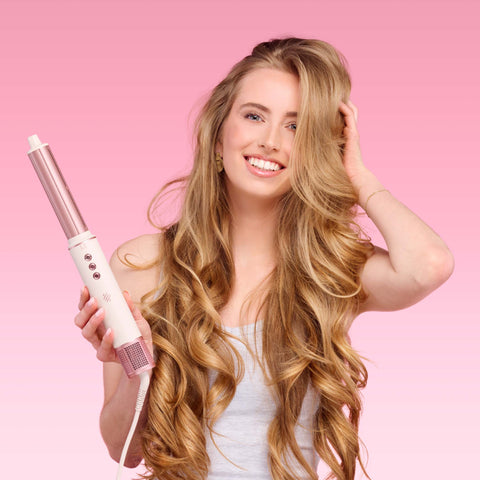
The Airstyler Pro Ceramiq combines this principle with a fully ceramic-coated barrel: the even heat release delivers a consistent shape per strand, instead of hotspots that actually dry the hair out more and make it more prone to frizz. On the product page, the tool is marketed with a curl hold of up to 24 hours. That's a claim from Ace & Taylor itself, based on use under normal conditions, not an independent test specifically under high humidity.
In extremely humid weather (think of a tropical downpour), every style, regardless of the device, eventually loses some of its shape. What an even coating and a good cool-down technique do is slow that process down. That also ties into the reason for the 2-year warranty on this coating: a layer baked into the barrel wears down more slowly than a thin spray layer, and so keeps that even heat release for longer.
Frequently asked questions
Why does my hair always frizz in rain or high humidity?
Because hair is hygroscopic and absorbs moisture molecules from the air. Those extra water molecules disrupt the hydrogen bonds holding your style, causing the hair shaft to swell and the cuticle layer to open up more. The more porous your hair, the faster this happens.
How long does a curl normally last in humid weather?
That varies a lot by hair type, humidity level, and technique used. At low to moderate humidity, a well-set curl often holds for 24 hours. At high humidity, that can drop to within a few hours if no anti-humidity product or cool-down step was used.
Does hairspray actually help against humidity?
Yes, a strong-hold hairspray with film-forming polymers creates a barrier around the hair shaft that slows down moisture absorption. It works best as a final step, after the hair has fully cooled down, and especially on the spots where a curl falls flat first, like the crown and fringe.
Should I fully blow-dry my hair before heading out in humid weather, or can it air dry instead?
Fully blow-drying to 100% dry is better in humid weather. Wet hair that air dries picks up extra moisture from the surrounding air while it dries, which actually makes frizz worse. Blow-drying with a cold cool-down step at the end gives a firmer, longer-lasting result.
Looking for a tool that helps curls last longer, even in humid weather?
The Airstyler Pro Ceramiq uses a fully ceramic-coated barrel and is marketed on the product page with a curl hold of up to 24 hours. Works on every hair type, from 1A to 4C. In a customer survey of 214 users after 30 days of use, 96% said their curl lasted at least 24 hours, 87% experienced less hair damage right away, and 97% would recommend Ace & Taylor.
2-year warranty
30-day home trial
Free shipping
Trustpilot 4.7/5
Shop the Airstyler Pro Ceramiq
Figures based on Ace & Taylor's own customer survey of 214 users, not an independent clinical study.
A&T
Written by the Ace & Taylor Team, based on the science behind hair and moisture (hydrogen bonds, hygroscopy) and everyday customer questions about styling in changing weather conditions.


