


Last updated: August 16, 2026 · 8 min read
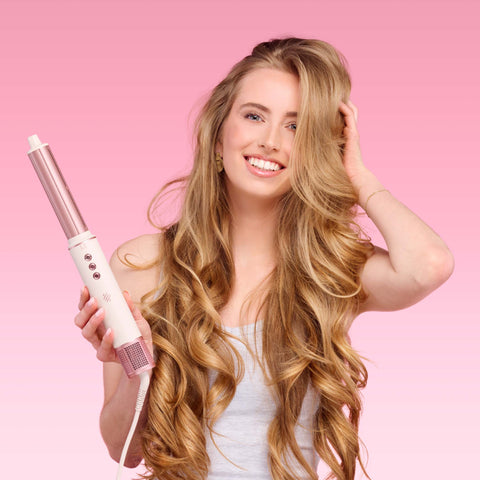
The safest way to style the regrowth halo, the short new hairs around your hairline, is on the lowest heat setting of your airstyler or hairdryer, using a round brush that directs the airflow from root to tip. Work in small sections a few centimeters wide and turn the hairs gently inward, toward your face, instead of letting them stick out.
In short
- Postpartum shedding usually starts 3 to 4 months after giving birth, and the first short "regrowth halo" hairs around your hairline typically become visible around month 6 to 9.
- These new hairs are more fragile than the rest of your hair: they're still short and new, and haven't yet built up the thickness of older hair.
- A low heat setting (around 35°C) is enough to blend them in, you don't need higher settings at this stage.
- Using a round brush or a narrow attachment, work the hairs in small sections toward your face so they lie flat instead of standing straight up.
- Volume at the crown and a calm, smooth hairline are two separate techniques within the same styling session.
Below you'll find the exact step-by-step technique, including which heat setting and which attachment work best for this fragile, new hair.
When exactly does the regrowth halo appear?
For most women, the first short hairs around the hairline become visible about 6 to 9 months after giving birth, once the shedding that starts around month 3 to 4 has gradually eased off. For some it happens a little earlier, for others a little later: every hair follicle follows its own timing, and that's exactly why regrowth first feels uneven rather than like one smooth new hairline.
This is a common, temporary phase linked to the hormonal shifts around childbirth, not something that says anything about you personally. That doesn't make it any less annoying if you're looking at it in the mirror every day, and that's completely okay too.
Why are these new hairs so fragile?
These hairs are more fragile because they've only been growing for a few months: they're thinner and haven't yet built up the full thickness and strength of older hair. Hair gradually becomes stronger the longer it stays in the growth phase, and regrowth hair simply hasn't had that time yet.
Part of the "halo" you see also comes down purely to length: hairs just a few centimeters long are too short to fall with the weight of your longer hair around them, which is why they stay standing up regardless of how healthy they are. Styling therefore solves two things at once: it protects hair that's still fragile, and it helps physically guide the hairs in the right direction.

Which heat setting is safe for this hair?
For this phase, the lowest heat setting on your device is more than enough. On the Ace & Taylor Airstyler Pro Ceramiq that's 35°C, compared to 70°C and 110°C on the higher settings you'd normally use for thicker or coarser hair.
Fine, short hair simply needs less heat to temporarily hold its shape than thicker or longer hair does. A higher setting doesn't add any extra styling result for this purpose, only unnecessary heat exposure on hair that's already fragile. So deliberately choose the lowest setting as your starting point, and only go up if you notice the result on the lowest setting genuinely falls short.
How do you blend the regrowth halo step by step?
The goal isn't to force the hairs flat, but to gently guide them toward your face using warm air and a round brush, so they move along with the rest of your hair instead of standing against it.
- Style on towel-dry to dry hair, never soaking wet: this avoids unnecessary heat exposure and gives you more control.
- Set your airstyler or hairdryer to the lowest setting, around 35°C.
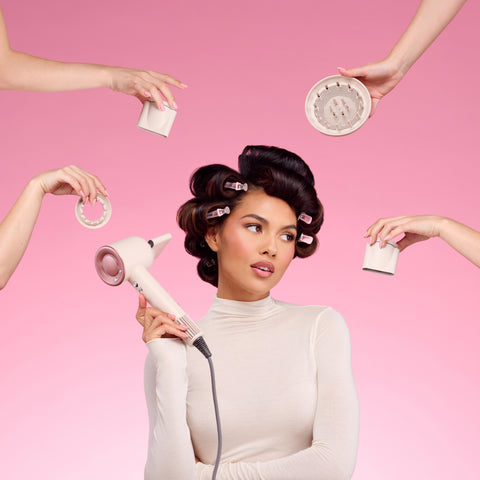
- Attach a round brush or a narrow attachment to your device, this gives more precision than a large curling attachment.
- Work in very small sections a few centimeters wide, not your whole hairline at once.
- Direct the airflow from root to tip and turn the brush gently inward, toward your face, instead of outward or upward.
- Hold each section for a few seconds and let it cool before releasing: warm hair is pliable, and the shape only "sets" once it cools down.
- Repeat section by section along the whole hairline, and let the rest of your hair simply follow its usual styling.
If your regrowth is very fine or thin, don't force it if the brush catches for a moment. Release it, slide the brush back a little more loosely and try again, instead of pulling it through.
How do you create volume at the crown while keeping the hairline calm?
Treat the crown and the hairline as two separate zones within the same routine: at the crown you lift the hair at the root for volume, while at the hairline you use a calm, downward motion instead. For many women, the hair at the crown has kept more of its original length and weight than the new regrowth around the forehead, which is why these two zones call for a different approach.
Start at the crown: lift a section at the root against the direction of growth, hold for a few seconds and let it cool before releasing, just like a regular root-volume routine. Only move on to the hairline afterward, where the goal isn't lifting but blending, using the smaller sections and lower heat setting described above.
| Zone | Goal | Technique |
|---|---|---|
| Crown | Volume | Lift at the root, section by section, from bottom to top |
| Hairline (regrowth halo) | Blend, smooth down | Small sections, toward the face, no pulling, lowest heat setting |
| Rest of the hair | Normal styling | Your usual routine, adjusted to your hair type |
This technique essentially works regardless of your natural hair type, from straight to very curly. Regrowth hair often behaves a little differently from your regular hair: with straighter hair it tends to stand up more, while with curly or coily hair it springs back more strongly. The approach (low heat, small sections, toward the face) stays the same in both cases, only the amount of attention each section needs will differ.
This technique doesn't have to become a daily obligation. Five minutes with a round brush along your hairline is often enough. Not because you need to look "perfect again," but because it can simply feel good to have a small moment for yourself amid all the care you're giving your baby.
Frequently asked questions
Is it normal for the hairs around my forehead to keep standing up after giving birth?
Yes, that's completely normal. It's mainly because these new hairs are still too short to fall in line with the rest of your hair, not because there's anything wrong with their quality. As they grow longer, this naturally becomes less noticeable.
Can I damage these new hairs by styling them?
With a low heat setting and without pulling or forcing, the risk is small. Avoid high heat and hard pulling with the brush, and stop if you feel resistance instead of pulling through.
How long does it take before the regrowth halo stops standing out?
This varies from person to person, but for most women the length difference with the rest of the hair gradually shrinks toward the one-year mark after giving birth. Until then, the styling technique above helps make it less noticeable.
Does a bit of product help keep the hairs flat between styling sessions?
A very small amount of serum, wax, or hair oil on your fingertips, lightly swept over the hairline after styling, can help hold flyaway hairs in place. Use it sparingly, too much product makes fine regrowth hair sticky and weighed down.
When does postpartum hair loss stop being ordinary shedding?
Persistent, patchy bald spots, hair loss that still hasn't eased up after about 12 to 18 months, or noticeable itching and irritation of the scalp are signs to check in with a doctor. This article is general styling information, not medical advice about the cause of hair loss.
For fragile regrowth hair, a genuinely low heat setting isn't a side note, it's the starting point. The Airstyler Pro Ceramiq has three clear settings (35°C, 70°C and 110°C), so you never have to guess whether "low" is actually low enough for new, thin hairs. In Ace & Taylor's own research among 214 users (30 days of use), 87% reported noticeably less hair damage right away. This is our own customer research, not an independent study.
Works on all hair types 1A-4C
30-day home trial
2-year warranty
Trustpilot 4.7/5
Shop the Airstyler Pro Ceramiq


