

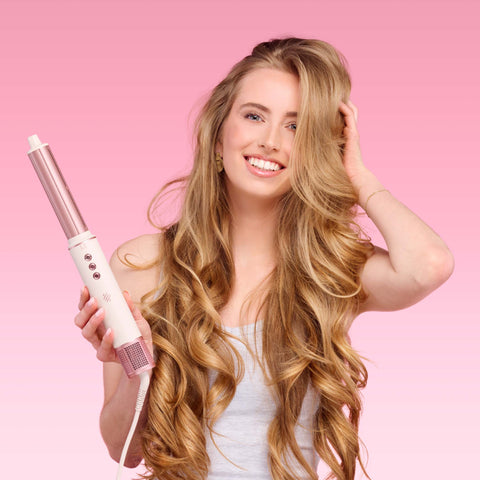


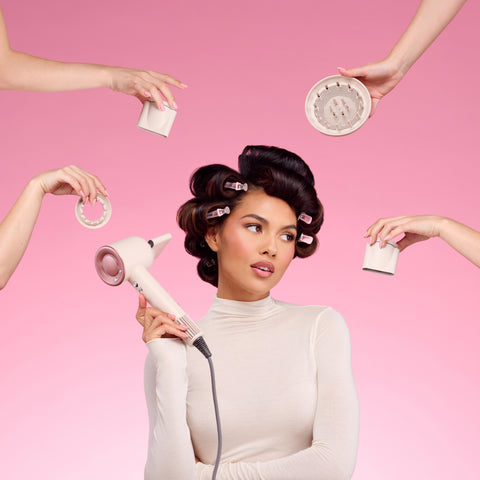

Why heat damage is your hair's biggest enemy, and how Ace & Taylor is tackling it differently
You see them everywhere: style tools that promise to transform your hair without damage. But what actually happens to your hair when you pull a hot air blowtorch over your locks every morning? And why does it matter which device you use?
We dove into the science behind heat damage, commissioned independent research, and the results were clearer than we expected.
What heat does to your hair
Hair is fragile. The outer layer, the cuticle, consists of overlapping scales that protect your hair shaft. Once those cuticles are exposed to high temperatures, they begin to open up, break down, and your hair loses its shine, resilience and strength.
Most professional styling tools operate at temperatures between 150 and 230 degrees Fahrenheit. At those temperatures, hair loses moisture, the keratin structure breaks down and the bonds that give your hair its elasticity are permanently damaged. That's not theory, that's chemistry.
What many people don't know: it's not just the maximum temperature that does damage. It's also about how long the hair is exposed to that heat, how evenly the heat is distributed, and whether the device can regulate the temperature without spikes.
The market: lots of promises, little evidence
The market for airstylers has exploded in recent years. Dyson set the tone with the Airwrap, a device that uses airflow to style hair without direct contact with a hot plate. Shark followed with the FlexStyle, which offers a similar approach but sits at a different price point. In addition, smaller Dutch brands were tested, each claiming to offer the most hair-friendly solution.
The problem? Most claims are based on marketing materials, not verified research. "Up to 50% less damage" sounds impressive, but compared to what? Measured how? By whom?
We thought that question deserved an honest answer.
The research: what we had tested
Together with an independent testing agency, we commissioned an extensive comparative study. More than 75 participants took part, spanning different hair types: fine, normal, thick, chemically treated and damaged hair. The Dyson Airwrap, the Shark FlexStyle and several other popular airstylers were tested alongside the Ace & Taylor Airstyler Pro Ceramiq.
The researchers looked at several factors:
- Loss of moisture in the hair
- Structural changes in the cuticle measured by electron microscopy
- Breaking strength after repeated use
- Subjective perception of participants in terms of gloss, smoothness and feel
The Ace & Taylor Airstyler Pro Ceramiq operates at a maximum temperature of 110 degrees Celsius, considerably lower than most competitors. This is not an accidental choice. It is a conscious design decision based on the question: what is the lowest temperature at which you can achieve professional styling results?
The outcome
The results were unequivocal. Across all hair types and all measured parameters, the Ace & Taylor Airstyler Pro Ceramiq showed the least heat damage:
- Hair's moisture content was retained better than all competitors tested
- The cuticle showed less damage after repeated use
- Participants consistently reported that their hair felt softer, shinier and stronger after use
The lower maximum temperature did not prove to be a concession to results. It was the key to better results.
What this means for you
If you style your hair every day, that damage adds up. Not after just one time, but after weeks, months, years of daily use. Choosing a tool with a lower working temperature and better temperature control is not a luxury. It is one of the simplest things you can do for the long-term health of your hair.
The full research results are available on our website. We believe in transparency, because claims without proof are exactly the problem we wanted to solve.
Always use a heat protector for optimal protection no matter what tool you use.


