



Last updated: 3 October 2026
Partly. A bond builder targets the sulphur bonds in the core of your hair, and heat does indeed damage those bonds. But heat also does something no product can undo: it dries your hair out, lifts the cuticle and deforms the protein. Your hair feels stronger and smoother, but it doesn't become undamaged hair again.
IN SHORT
- Heat damage isn't one single thing. It's a mix of moisture loss, lifted and cracked cuticle scales, deformed protein and partly broken sulphur bonds.
- Bond builders like Olaplex (bis-aminopropyl diglycol dimaleate) and K18 (sh-oligopeptide-78) only address that last part: the connections inside the hair.
- Cracked cuticles, split ends and deformed protein don't come back. You can soften and smooth them, not repair them.
- In damp hair the protein starts deforming at around 140 to 150 degrees, in dry hair not until around 230 degrees. Wet hair plus high heat is the worst possible combination.
- Prevention pays off far more than repair: lower temperature, drier hair, fewer passes over the same section.
Below you'll read which part of heat damage you actually do have control over, and why the type of heat your tool uses matters more than the jar on your shelf.
What exactly does heat do to your hair?
Heat first pulls the water out of your hair, and only then pulls the protein out of shape. It happens in layers, and every layer has a different repair story.
1. Water disappears. Your hair always holds some moisture. As soon as you go above the boiling point of water, which virtually every straightener or curling iron does, that moisture evaporates at lightning speed. That's why hair feels smooth right after styling, but rough and dull a few days later.
2. The cuticle lifts. Research into heat damage shows that hot air creeps underneath the cuticle scales, causing them to lift and expand. That doesn't only start at 200 degrees: even blow-drying with warm air produces measurable changes at the surface. Lifted cuticles mean more frizz, less shine and more tangles.
3. The protein deforms. Keratin has a springy spiral shape. With enough heat, that spiral loses its structure. In bone-dry hair that only happens at high temperatures (lab measurements show the big shift around 230 to 250 degrees), but in damp hair that point sits much lower, somewhere around 140 to 150 degrees. So water makes your hair more vulnerable to heat, not safer.
4. Bubbles form. If you clamp genuinely wet hair between hot plates, the water inside can evaporate and create cavities in the hair shaft. This is called bubble hair and it has been described in dermatological literature since 1986. Hair with cavities like that simply snaps off.
5. Sulphur bonds break. This is the part bond builders talk about. Sulphur bonds are the strongest connections in your hair. They mostly break down through bleaching and perming, but 2025 research in the International Journal of Cosmetic Science showed that heat and UV light also chemically alter those sulphur bonds.
What does a bond builder actually do?
A bond builder lays a chemical bridge between two loose ends inside your hair. It doesn't nourish, it connects.
For Olaplex, that's the ingredient bis-aminopropyl diglycol dimaleate. The molecule has two ends that can each bind to a sulphur atom, creating a kind of artificial bridge where a sulphur bond has been broken. K18 works with a peptide (sh-oligopeptide-78) that is said to reconnect broken protein chains, after which the sulphur bonds reportedly repair themselves more easily.
Worth knowing: most of the evidence for these claims comes from tests the brands commission themselves. In an ingredient analysis, trade journal Cosmetics & Toiletries noted that there is no peer-reviewed clinical evidence that bis-aminopropyl diglycol dimaleate reduces hair damage. That doesn't mean it does nothing. It means you're entitled to read the promise of "repairs your hair" with healthy scepticism.
What users do consistently notice: less breakage while combing, hair that feels more supple and snaps less easily. That's a real win. It's just something other than new hair.
So does a bond builder repair heat damage or not?
It can partly address one of the five types of damage, and at best mask the rest. Below you'll see what's realistically possible per type of damage.
| Type of heat damage | Does a bond builder help? | What does help |
|---|---|---|
| Moisture loss (dry, rough hair) | Barely | Conditioner, mask, leave-in, oil on the ends |
| Lifted cuticles (frizz, dullness) | Indirectly, formulas often contain care ingredients too | Smoothing leave-in, cool finish, gentler brushing |
| Broken sulphur bonds | Yes, this is the target | Bond builder, plus less heat so fewer break in the first place |
| Deformed protein (limp, stretchy hair) | No, this is permanent | Temporarily filling with protein treatments, eventually growing it out |
| Split ends and breakage | No, temporary glueing at most | Cutting, and preventing it afterwards |
To put it bluntly: the further the damage sits from the core towards the surface, the less a bond builder can do about it. And the visible misery (frizz, parched ends, snapped hairs) tends to sit right at the surface.
Does a bond builder work as a heat protectant too?
Only if heat protection is explicitly stated on the label, and even then that protection comes from the rest of the formula, not from the bond chemistry itself.
Olaplex No.9, for example, states heat protection up to 232 degrees. That's a claim about the whole product (the film it leaves on your hair), not about the bond builder molecule. So a mask or treatment you rinse out, like Olaplex No.3, won't protect you while blow-drying. If you use a rinse-out bond builder, you still need a proper heat protectant alongside it.
So what does actually work against heat damage?
Prevention. Almost everything you read about "repair" is cosmetic in reality: it feels and looks better, but the fibre itself stays damaged. These steps reduce the damage that gets added in the first place.
- Don't style soaking wet hair. In damp hair the protein deforms at much lower temperatures, and wet sections between hot plates can create cavities in your hair. Blow-dry to around 80 percent dry first, or use a tool that's specifically made for that.
- Keep your distance and keep moving. In a study in Annals of Dermatology (2011), blow-drying from 15 cm away with continuous movement caused less surface damage than letting hair air-dry. Holding still in one spot is the problem, not the hairdryer itself.
- Use the lowest setting that works. The American Academy of Dermatology advises simply: lowest heat setting, shortest possible contact, and as infrequently as possible. Start low and only go up if you genuinely aren't getting results.
- Limit how many times you pass over the same section. Three quick passes over a section are often more damaging than one slow, well-done pass. Take thinner sections, then you need fewer repeats.
- Choose warm air over hot plates where you can. A curl shaped with air is exposed to lower peak temperatures than a curl wrapped around a metal barrel at 190 degrees.
- Let everything cool down before you touch it. The shape only sets once your hair has cooled. Combing it out too early means you have to redo the work, which means another round of heat.
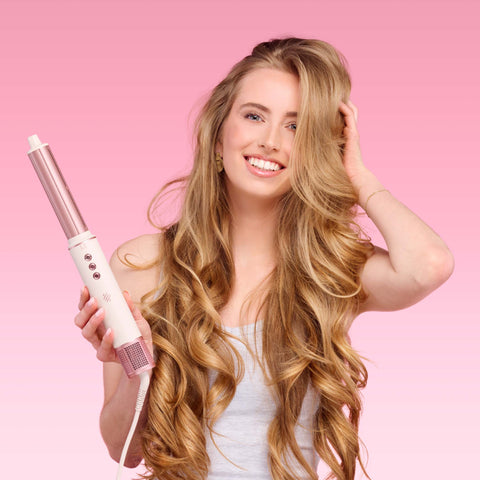
That fifth point is exactly why our Airstyler Pro Ceramiq™ works with a warm airflow and a fully ceramic-coated curling attachment instead of a thin sprayed layer on metal. Ceramic distributes heat more evenly, so fewer hot spots form where your hair touches the attachment. It won't fix existing heat damage, it simply adds less of it.
How do you know whether a bond builder makes sense for you?
It makes the most sense if your hair is chemically treated, because that's where most of the broken sulphur bonds are. With pure heat damage, the effect is smaller.
A simple way to check: gently pull on a wet strand from a section you always style. If it stretches a long way and doesn't spring back, the internal structure is compromised and a bond builder can help. If it snaps straight away and your hair feels bone-dry and coarse, you need moisture and conditioning more than extra protein or bonds.
And if your ends are fraying: they're done. A product can temporarily stick them back together, but the only real solution is a trim.
Frequently asked questions
How often can you use a bond builder?
Follow the packaging, which usually means once a week to once per wash. More often is rarely necessary and can make hair feel coarse if you're using a lot of protein products alongside it. If you notice your hair getting harder and more brittle, alternate with a moisturising mask.
Can heat damage be fully repaired?
No. Hair is dead material with no repair system of its own. You can smooth the outside and strengthen the fibre, but the damaged part eventually grows out and gets cut off. Anything promising "complete repair" means cosmetic repair.
Is a protein treatment the same as a bond builder?
No. A protein treatment temporarily fills gaps in the hair shaft with protein fragments and washes out again after a few washes. A bond builder tries to rebuild existing, broken connections. They can complement each other, but they don't do the same thing.
Do I need a bond builder if I only blow-dry and never colour?
Probably not as a first step. For untreated hair that you only blow-dry, a good conditioner, a heat protectant and a lower temperature usually deliver more than a bond builder. If you do colour or bleach, that changes the picture.
Does a bond builder work on split ends?
Only visually and temporarily. A split end is a split fibre, and it won't grow back together. Products can hold the two halves together for a while, until the next wash. Cutting is the only lasting solution.
Should I use my bond builder before or after conditioner?
Usually after shampooing and before conditioner, on towel-squeezed hair. Conditioners and masks leave behind a layer that can block the bond builder from penetrating. If the packaging says otherwise, follow that.
Less damage to repair starts with your tool
Because you can't undo heat damage, the temperature you style at matters more than whichever jar goes on afterwards: the Airstyler Pro Ceramiq™ shapes your curls with warm air around a fully ceramic-coated curling attachment, instead of with scorching hot plates.
- 2-year warranty
- 30-day money-back guarantee, so you can simply try it out at home
- Free shipping to NL, BE and DE. Order before 23:59 and it arrives tomorrow
- Trustpilot 4.8/5 ("Excellent") and more than 10,000 customers
Written by Anne Leensen, Ace & Taylor


