






Last updated: August 9, 2026 · 6 min read
Ceramic styling tools spread heat more evenly and are gentler on fine or damaged hair. Titanium tools heat up faster, reach higher temperatures, and glide more smoothly through thick or coarse hair. For most hair types, ceramic is the safer default choice; titanium is worth it mainly if your hair is thick, coarse, or hard to style.
In short
- Ceramic holds heat more evenly than bare metal, with less chance of hotspots.
- Titanium heats up faster and holds a more stable, higher temperature.
- Fine, color-treated, or damaged hair: choose ceramic.
- Thick, coarse, or hard-to-style hair: titanium often works faster.
- Many tools combine both: a titanium core with a ceramic coating.
Further down, you'll also find what to look for when judging a ceramic coating, so you can tell yourself whether a tool is actually good enough.
What's the difference between ceramic and titanium styling tools?
The difference is in how the material holds and releases heat. Ceramic plates and barrels are made from (or coated with) a ceramic material with good insulating properties, which means heat is held and released more evenly than with bare metal. That prevents hotspots (points that get much hotter than the rest), which lowers the risk of localized heat damage.
Many brands call this "infrared" in their marketing. Physically, that's technically true, warm ceramic does emit infrared heat, but that applies to almost any heated surface, so it isn't a unique feature of one specific product. The real difference lies in the insulating properties of the material itself, not in the word "infrared" on the box.
Titanium is a lightweight metal that heats up faster and handles higher temperatures (often up to 230°C and beyond). Its surface is naturally smoother, so the tool glides more easily through thick or coarse hair without snagging. The downside: titanium holds heat less evenly than ceramic, so the chance of an overheated spot is slightly higher if you linger too long on one section.
In practice you'll also see plenty of hybrid tools: a titanium or aluminum core with a ceramic coating over it. These combine titanium's fast heat-up time with ceramic's more even heat release.
Does ceramic work better for fine or damaged hair?
Yes, generally speaking. Fine, color-treated, or damaged hair has a weaker hair shaft that's more sensitive to sudden temperature spikes. Because ceramic releases heat more slowly and evenly, the risk of overheating one spot is smaller.
Rule of thumb: the finer or more brittle your hair, the lower the temperature you need, and the more even heat distribution matters. For fine hair, 160–180°C is often enough; ceramic makes it easier to style consistently within that range without hot-cold swings.
When should you choose titanium instead?
Titanium is the stronger choice if your hair is thick, coarse, tightly curled, or hard to style. Hair like this often needs higher temperatures to hold the desired result (straight, curl, blowout), and titanium reaches and holds those higher temperatures faster. Its smoother surface also reduces pulling and snagging while styling, which is more comfortable on thick hair.
Stylists who style multiple clients back-to-back all day also often choose titanium, because of its faster heat-up and recovery time between sessions.
Comparison: ceramic vs titanium
How do you recognize a good ceramic coating?
Not every "ceramic" tool is the same. A thin spray coating wears off faster than a coating baked into the plate or barrel. Look for:
- An even, matte finish with no visible scratches or uneven color.
- A stable temperature reading during use (no strong fluctuations).
- Brands that specify whether it's a fully ceramic barrel or a coating over another metal, which tells you something about long-term durability.
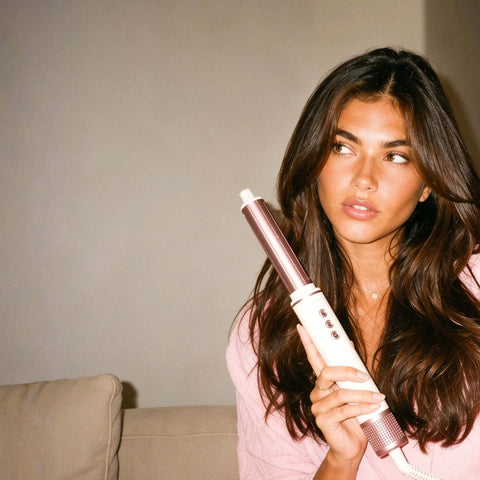
The Airstyler Pro Ceramiq, for example, uses a fully ceramic-coated barrel instead of a thin spray layer, specifically to combine that even heat distribution with the speed of hot-air styling. It also carries a 2-year warranty, precisely because a coating baked into the material lasts so much longer than a spray layer.
Frequently asked questions
Is ceramic always better than titanium?
No. Ceramic is generally gentler on hair, but titanium is faster and more effective on thick or coarse hair. The best choice depends on your hair type, not on which material is "better" in absolute terms.
Does titanium damage hair faster than ceramic?
Titanium itself doesn't damage hair faster. The risk lies in the higher temperatures titanium tools often reach and the less even heat distribution. Used incorrectly (too high a temperature, too long on one spot), the risk of heat damage is greater than with ceramic.
Can I use ceramic tools on thick hair?
Yes, but expect it to take a bit longer. Ceramic heats up more gradually and typically holds a slightly lower maximum temperature than titanium, so thick or coarse hair sometimes needs more passes to get the same result.
What's a safe styling temperature for most hair types?
As a guideline: 160–180°C for fine or color-treated hair, 180–200°C for normal hair, and 200–230°C for thick or tightly curled hair. Always start at the lower end of the range and only increase if needed.
Looking for a ceramic tool that actually delivers on this?
The Airstyler Pro Ceramiq uses a fully ceramic-coated barrel and works on every hair type, from 1A to 4C. In a customer survey of 214 users after 30 days of use, 96% said their curl lasted at least 24 hours, 87% experienced less hair damage right away, and 97% would recommend Ace & Taylor.
2-year warranty
30-day home trial
Free shipping
Trustpilot 4.8/5
Shop the Airstyler Pro Ceramiq
Figures based on Ace & Taylor's own customer survey of 214 users, not an independent clinical study.
A&T
Written by the Ace & Taylor Team, based on the material science behind hair styling tools and everyday customer questions about our own tools.


