


Last updated: August 10, 2026 · 5 min read
If you have a sensitive scalp, you can usually still use an airstyler, as long as you pick a low heat setting and keep some distance from the scalp. If you have a skin condition, a sunburned scalp, or you've just had a medical treatment, talk to a doctor or dermatologist first before using heat styling. This article offers general, practical tips and is not medical advice.
Quick summary
- With a sensitive scalp, choose the lowest heat setting and only go higher if it turns out to be necessary.
- Keep some distance from the scalp while styling, especially when curling close to the hair root.
- If you have a skin condition, open patches, or you've just had a medical treatment, talk to a doctor or dermatologist first.
- An airstyler mainly heats the air around the hair, rather than pressing the barrel continuously and directly against the skin like some other tools do.
- Stop right away if you notice redness, itching, or discomfort, and wait until the irritation has cleared before styling again.
Below you'll find which heat setting is most suitable and which practical adjustments help prevent irritation.
Can you use an airstyler with a sensitive scalp?
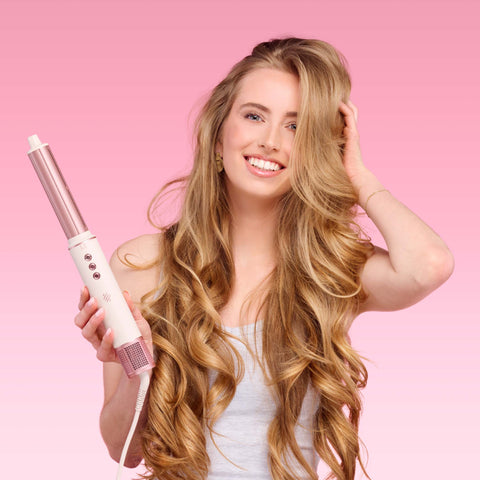
In most cases, yes, as long as you pay attention to the heat setting and the distance from the skin. An airstyler wraps hair around a heated barrel and blows air over it, which means the barrel presses against the scalp less often and less directly than, say, putting hair up with a straightener close to the root.
That doesn't mean heat can never be an issue for a sensitive scalp. Any form of heat styling brings warmth close to the skin, and a sensitive scalp reacts to that faster with irritation than a less sensitive one. So care still matters.
Which heat setting is safest?
With a sensitive scalp, choose the lowest heat setting as your starting point. On the Airstyler Pro Ceramiq, that's 35°C, compared to 70°C and 110°C on the higher settings. Only move to a higher setting if the result on the lowest setting is genuinely not enough, and pay extra attention to how your skin reacts.
A lower temperature generally means less heat stress overall, which is more comfortable for sensitive skin, even though the barrel itself isn't in constant direct contact with the scalp the way it is with some other styling tools.
When is it better to see a doctor or dermatologist?
If you have an existing skin condition like eczema, psoriasis, or seborrheic dermatitis on the scalp, open patches, wounds, a sunburned scalp, or you've recently been treated for a skin issue, talk to a doctor or dermatologist first before using heat styling. They can assess whether and how heat poses a risk in your specific situation.
This also applies if you're unsure whether a reaction on your scalp is related to styling or something else: a doctor or dermatologist is better placed to judge that than a general guideline in a blog article.
What can you do in practice to prevent irritation?
Consciously keep some distance from the scalp while styling, especially when curling strands close to the hair root. Work in small sections, so you have more control over exactly where the barrel ends up, instead of quickly and carelessly wrapping large strands around it.
Stop right away if you notice redness, itching, a burning feeling, or any other discomfort, and only style again once the irritation has fully cleared. If you're unsure, test a small section of hair first and pay close attention to how your skin responds before styling your whole head.
Frequently asked questions
Is an airstyler bad for a sensitive scalp?
Not necessarily. Choose the lowest heat setting, keep some distance from the scalp, and pay attention to how your skin reacts. If you have an existing skin condition, it's best to talk to a doctor or dermatologist first.
Can I use an airstyler if I have eczema or psoriasis on my scalp?
We can't assess that in general terms. Talk to a doctor or dermatologist before using heat styling, they can assess whether this is advisable in your situation.
Which heat setting should I choose for a sensitive scalp?
Start with the lowest setting (35°C on the Airstyler Pro Ceramiq) and only move to a higher one if it turns out to be genuinely necessary, while paying attention to how your skin reacts.
What should I do if my scalp turns red or irritated after styling?
Stop styling and wait until the irritation has fully cleared before using heat again. If the irritation persists or keeps coming back, see a doctor or dermatologist.
Three settings, so you can choose what feels comfortable.
The Airstyler Pro Ceramiq has settings of 35°C, 70°C, and 110°C, so with a sensitive scalp you can start on the lowest temperature. If you have an existing skin condition, always talk to a doctor or dermatologist first.
Works on all hair types 1A-4C
30-day home trial
2-year warranty
Trustpilot 4.7/5
Shop the Airstyler Pro Ceramiq
AL
Written by Lena A. for Ace & Taylor. This article is general, practical information, not medical advice. If in doubt, or if you have a skin condition, always talk to a doctor or dermatologist.


